See it in action
Three screens from the portal itself. No mock-ups.
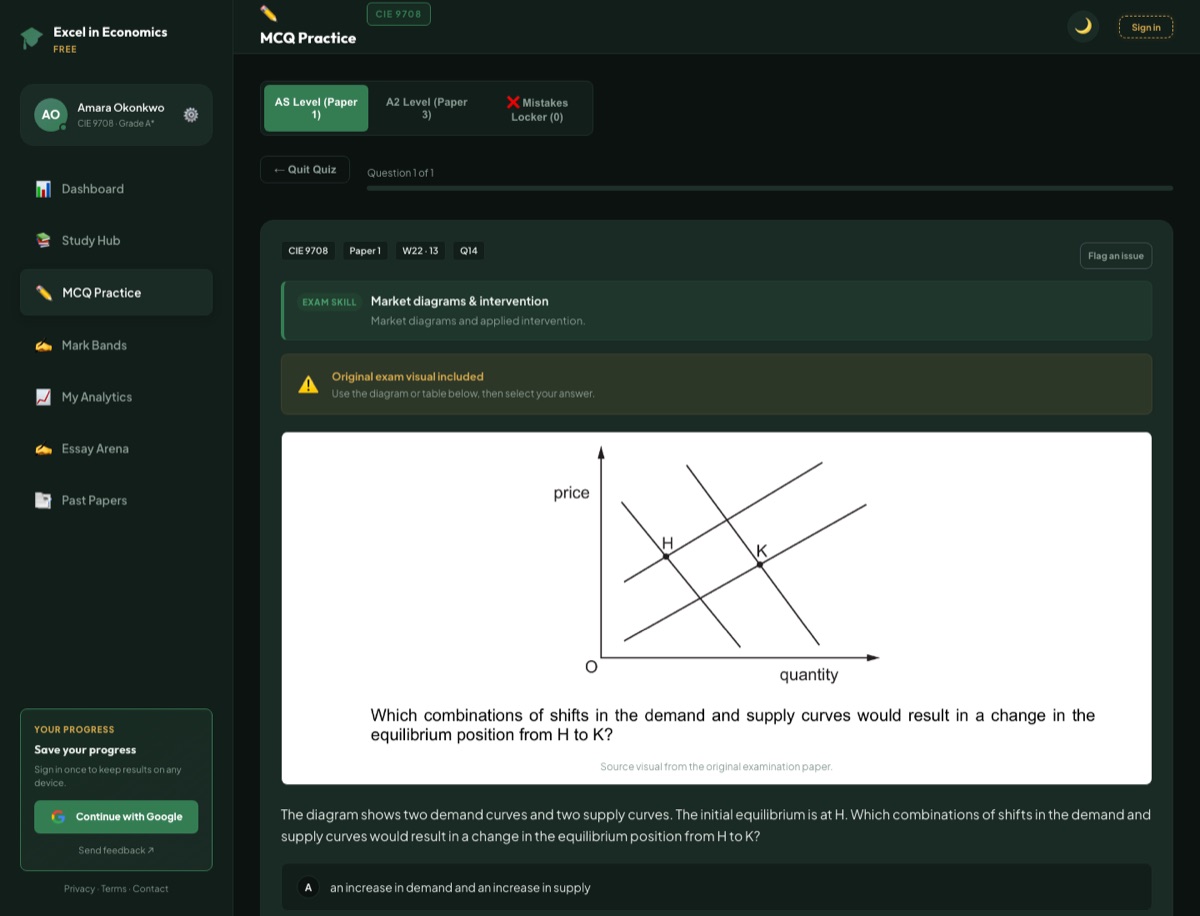
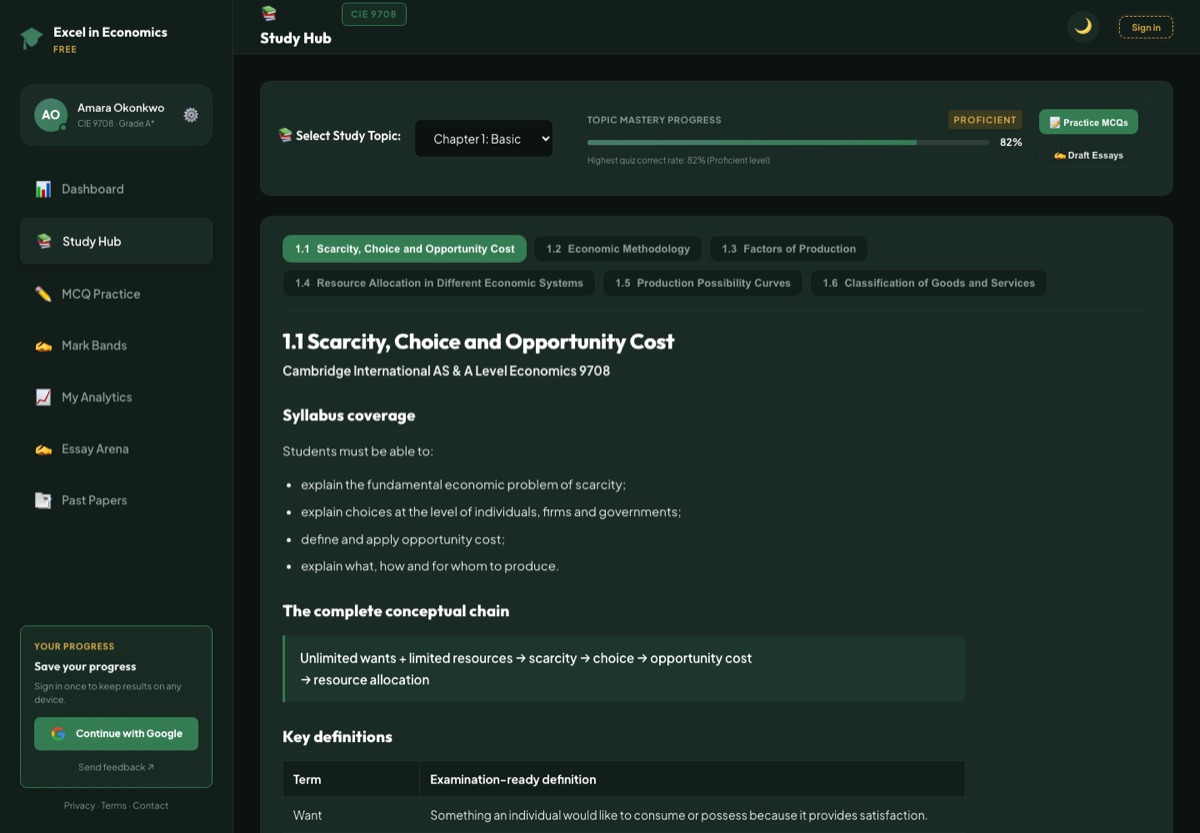
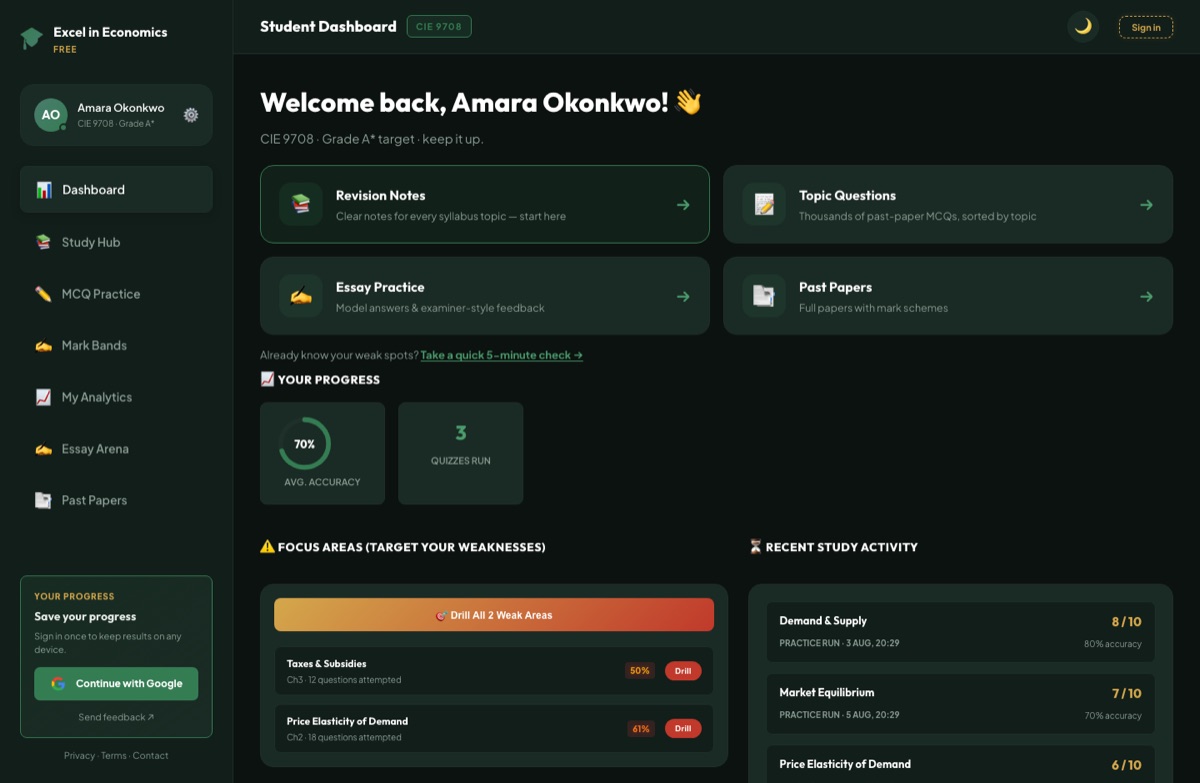
Syllabus-aligned practice with worked solutions and feedback
Syllabus-mapped revision notes and practice questions for ten subjects across twenty-three exam boards: real past-paper questions in nine subjects, and Mathematics practice written to the syllabus by Excel in Economics, not taken from Cambridge papers. Worked solutions and feedback show how an answer is reached, not only whether yours was right. Free, and no card.
Start revising, freeTen subjects across twenty-three exam boards. Pick yours, then your syllabus, and everything after that is filtered to it.
Three screens from the portal itself. No mock-ups.
If yours is not here, the contact page will reach a person.
Free. There is no card, no trial that expires and no locked chapter. You create an account so your progress and your mistakes are saved for next time, and that is the only thing an account is for.
Twenty-three, across ten subjects, all listed under Start with your subject above. Economics has eight: Cambridge A-Level (9708), Cambridge IGCSE (0455), Cambridge O Level (2281), AQA A-Level (7136), Edexcel A-Level (9EC0), Edexcel IGCSE (4EC1), IB Economics, and AP Microeconomics and Macroeconomics. The other nine subjects follow Cambridge syllabuses. You pick your board once and everything after that is filtered to your syllabus.
In every subject except Mathematics, past papers published by the exam boards, with their own mark schemes. They are not questions we invented that look like exam questions. Where the original paper had a diagram or a table, we show it alongside the question. Mathematics practice is written to the Cambridge syllabus by Excel in Economics, not taken from Cambridge papers.
In multiple-choice practice you get the written explanation for that question, which sets out why the correct option is right and often why the tempting ones are wrong, because knowing why a tempting answer is wrong is what stops you picking it again. The question also goes to a mistakes locker so you can come back to exactly those. Mathematics has no options to choose from: you type your answer, check it, and the worked solution shows each step.
No. You can read every revision note and start practising without an account. Signing in saves your results across devices, which is the point at which most students do it.
Sign-in is handled by Google, so we never see a password. We store the answers given and the topics practised, which is what makes the progress tracking work. We do not sell data and there is no advertising on the portal. The privacy page sets out exactly what is kept and how to have it deleted.
No, and it is not meant to be. It is the practice and feedback part, which is the part that usually gets squeezed. It works best alongside teaching, not instead of it.
On a multiple-choice question, use the flag button. It comes straight to us and it is genuinely useful. Past-paper answers are checked against the board's published mark scheme, but the banks are large and we would rather hear about it. Mathematics questions are written by Excel in Economics, so there is no board mark scheme behind them; if one looks wrong, the contact page will reach us.