14 past-paper questions on this unit. Five of them are below. Answer on the page: each one is marked the moment you pick, the correct option is shown whether or not you found it, and the full explanation opens either way.
CIE 0452 AccountingPaper 1 MCQsFree account
The purpose of accounting: five questions to try now
Real past-paper questions, the answer key from the mark scheme, and the explanation that goes with it. No account needed to answer them.
Question 1
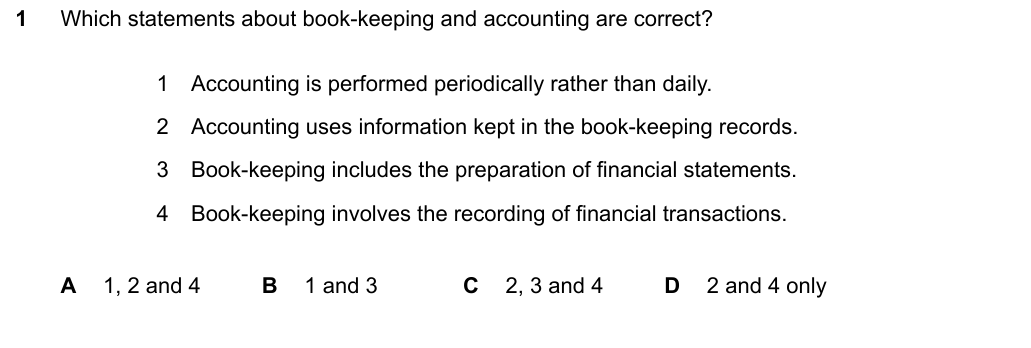
Which statements about book-keeping and accounting are correct? Use the complete source image for the question and answer choices. Source reference: M24 Paper 12, Q1.
Answer: A.
1, 2 and 4. Accounting is periodic work done on top of the daily records, and it uses what book-keeping has captured, which is why accurate book-keeping comes first. Book-keeping itself is the recording of transactions. Statement 3 puts the boundary in the wrong place: preparing financial statements is an ACCOUNTING task, not a book-keeping one, and it is the single distinction this question is built on.
Question 2
A book-keeper made two errors which cancelled each other out. Which type of error did he make?
Answer: A.
A compensating error. Two errors that cancel each other out leave the trial balance totals agreeing, which is exactly what compensating means. A complete reversal has both entries on the wrong sides, an error of original entry carries the same wrong figure to both accounts, and an error of principle puts the amount in the wrong CLASS of account. All four escape the trial balance, but only compensating does so by one error offsetting another.
Question 3
Which interested party uses the financial statements of a business to assess current performance and plan for future activities?
Answer: D.
Managers. Assessing how the business is performing now and planning what it does next is an INTERNAL use, and managers are the only internal party listed. Banks look at whether a loan is safe, employees at job security and pay, and government at tax and statistics. All three read the same statements, but each is asking a narrower question from outside the business.
Question 4
Why would a supplier be interested in the financial statements of a credit customer?
Answer: A.
To know whether the customer can pay what he owes. A supplier selling on credit is taking a risk on being paid, so it looks at liquidity and at whether the business can meet its debts as they fall due. The profit for the year and the value of inventory are of some interest but neither answers the question directly, and the amount owed by the customer's OWN receivables is a detail of their business rather than a measure of their ability to pay.
Question 5
Why would a bank manager be interested in the financial statements of a business?
Answer: D.
Ensuring the business can cover its loan interest. A bank lends money and wants to know it will be repaid, so it looks for enough profit and enough cash to service the debt. Trade payables turnover is an internal efficiency measure rather than the bank's concern, tax is a matter for the tax authority, and hourly rates are a matter for the employees and their union. Each interested party reads the same statements looking for something different.
These questions are drawn from past CIE 0452 Accounting papers and filtered to the purpose of accounting. You answer, you find out immediately whether you were right, and you get the reasoning for the correct option and for each distractor. Wrong answers go to a mistakes locker so you can come back to exactly those.
Practice is free. You need an account only so your progress and your mistakes are still there next time.
These are the errors that cost marks on the purpose of accounting, taken from our own topic notes. Read them before you practise and you will recognise the traps in the questions.
Saying book-keeping and accounting are the same thing.
Saying the purpose of accounting is only to work out the tax.
Listing users without saying what each one needs.
Saying the statement of financial position shows profit. It shows the position at a date.
Saying the accounts show what the business is worth. They show recorded amounts, not market value.