16 past-paper questions on this unit. Five of them are below. Answer on the page: each one is marked the moment you pick, the correct option is shown whether or not you found it, and the full explanation opens either way.
CIE 0452 AccountingPaper 1 MCQsFree account
The accounting equation: five questions to try now
Real past-paper questions, the answer key from the mark scheme, and the explanation that goes with it. No account needed to answer them.
Question 1
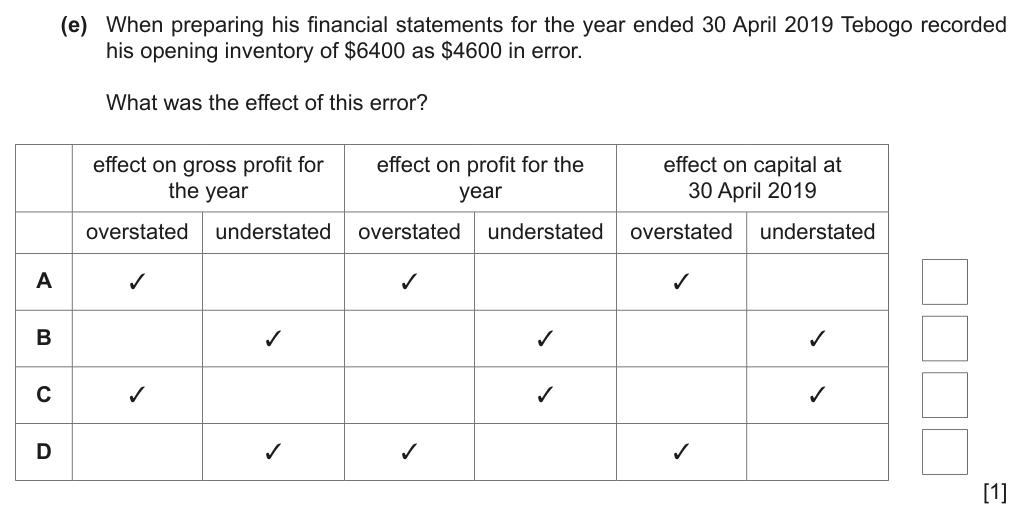
Use the complete source image for the question and answer choices. Source reference: S19 Paper 11, Q1(e).
Answer: A.
All three overstated. Opening inventory is ADDED in calculating cost of sales, so recording $4600 instead of $6400 understates cost of sales by $1800 and overstates gross profit by the same amount. That flows straight down: profit for the year is overstated, and since profit is added to capital, capital at the year end is overstated too. All three move the same way, which is what makes a single row of overstated the answer rather than any mixture.
Question 2
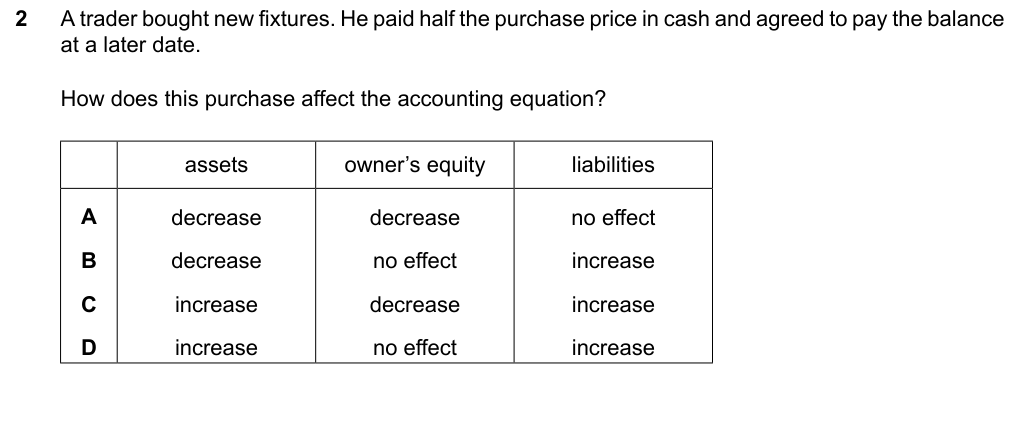
A trader bought new fixtures. He paid half the purchase price in cash and agreed to pay the balance at a later date. How does this purchase affect the accounting equation? Use the complete source image for the question and answer choices. Source reference: W24 Paper 12, Q2.
Answer: D.
Assets increase, owner's equity is unaffected, liabilities increase. Three things happen at once: the fixtures come in at their full price, cash goes out by half of it, and a payable is created for the other half. Assets therefore rise by the full price less the half paid, which is a net increase of half, and liabilities rise by the same half. Nothing has been earned or lost and the owner has put nothing in, so equity does not move. Options A and B miss that the asset coming in is worth more than the cash going out.
Question 3
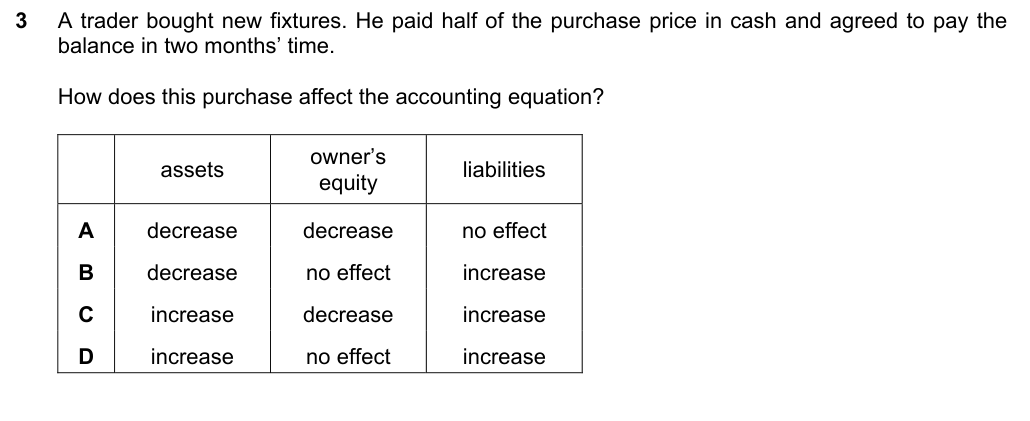
A trader bought new fixtures. He paid half of the purchase price in cash and agreed to pay the balance in two months’ time. How does this purchase affect the accounting equation? Use the complete source image for the question and answer choices. Source reference: S20 Paper 12, Q3.
Answer: D.
Assets increase, owner's equity is unaffected, liabilities increase. Three things happen at once: the fixtures come in at their full price, cash goes out by half of it, and a payable is created for the other half. Assets therefore rise by the full price less the half paid, which is a net increase of half, and liabilities rise by the same half. Nothing has been earned or lost and the owner has put nothing in, so equity does not move. Options A and B miss that the asset coming in is worth more than the cash going out.
Question 4
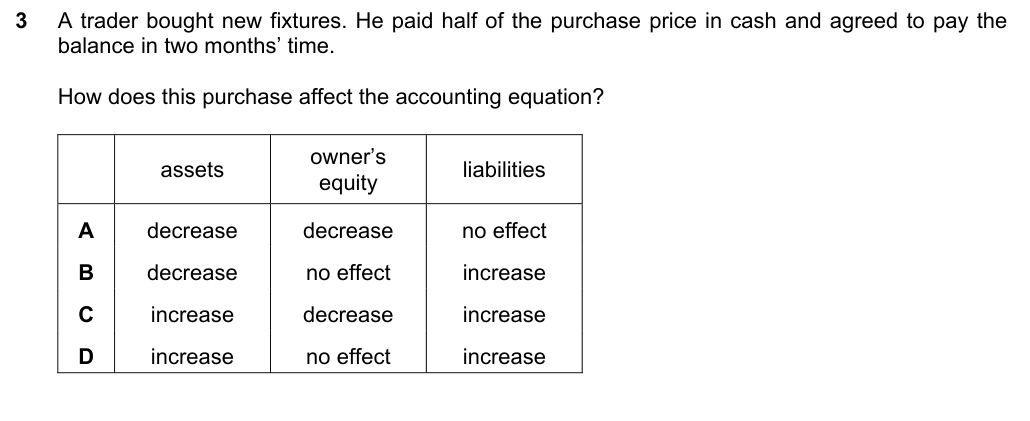
A trader bought new fixtures. He paid half of the purchase price in cash and agreed to pay the balance in two months’ time. How does this purchase affect the accounting equation? Use the complete source image for the question and answer choices. Source reference: S20 Paper 13, Q3.
Answer: D.
Assets increase, owner's equity is unaffected, liabilities increase. Three things happen at once: the fixtures come in at their full price, cash goes out by half of it, and a payable is created for the other half. Assets therefore rise by the full price less the half paid, which is a net increase of half, and liabilities rise by the same half. Nothing has been earned or lost and the owner has put nothing in, so equity does not move. Options A and B miss that the asset coming in is worth more than the cash going out.
Question 5
Beth provided the following information. 1 January 31 December net assets $28 000 $24 000 Her drawings during the year amounted to $3000. What was Beth’s profit or loss for the year?
Answer: A.
Profit is the change in net assets with drawings added back. Net assets FELL from $28 000 to $24 000, a decrease of $4000, and $3000 was withdrawn, so the business lost 4000 less 3000, which is a $1000 LOSS. The drawings are added back because they reduced net assets without being a cost of trading. Ignoring them gives a $4000 loss, and the answer is a loss because the fall exceeds what was taken out.
These questions are drawn from past CIE 0452 Accounting papers and filtered to the accounting equation. You answer, you find out immediately whether you were right, and you get the reasoning for the correct option and for each distractor. Wrong answers go to a mistakes locker so you can come back to exactly those.
Practice is free. You need an account only so your progress and your mistakes are still there next time.
These are the errors that cost marks on the accounting equation, taken from our own topic notes. Read them before you practise and you will recognise the traps in the questions.
Writing the equation as assets = liabilities − capital.
Classifying a loan repayable in six months as non-current.
Putting inventory among non-current assets because it is "goods".
Treating drawings as an expense in the income statement.
Forgetting that buying an asset for cash leaves total assets unchanged.
Saying capital is the cash in the business. Capital is the owner's claim, and it is rarely held as cash.