Nitrogen and sulfur: five questions to try now
Real past-paper questions, the answer key from the mark scheme, and the explanation that goes with it. No account needed to answer them.
Question 1
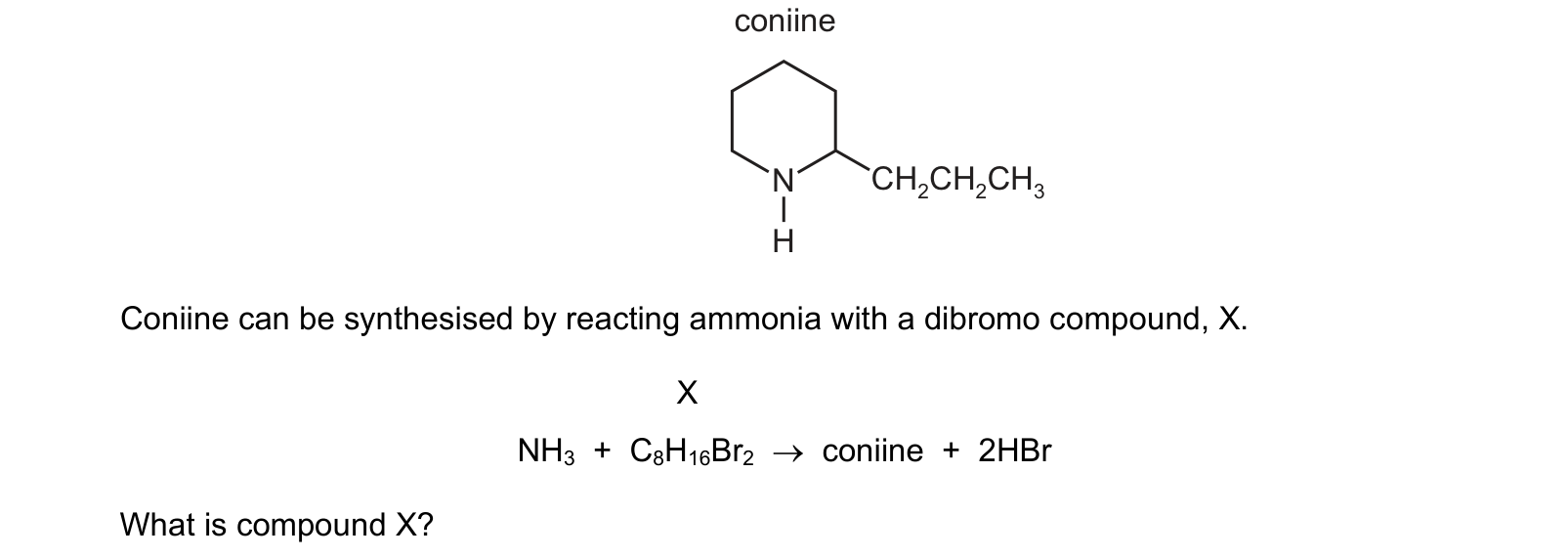
The structure of coniine is shown.
coniine Coniine can be synthesised by reacting ammonia with a dibromo compound, X.
X
NH3 + C8H16Br2 → coniine + 2HBr
What is compound X?
Answer: D.
Ammonia forms the ring by substituting at both carbons carrying bromine, so the nitrogen ends up bonded to the two carbons that held them. For a six-membered ring the nitrogen plus five carbons must close the loop, which means the two bromines are on carbons five apart along the chain.
D, Br(CH₂)₄CHBr(CH₂)₂CH₃, is exactly that. The bromines are on carbon 1 and carbon 5, so nitrogen joins those two and closes a ring of six atoms. The remaining (CH₂)₂CH₃ hangs off carbon 5 as the propyl group, which is next to the nitrogen. That is D.
C, Br(CH₂)₃CHBr(CH₂)₃CH₃, has its bromines only four carbons apart, so it would close a five-membered ring, and the side chain would be a butyl rather than a propyl. It has the right molecular formula, C₈H₁₆Br₂, which is what makes it the sharp distractor.
A and B are cyclic already, so the ring is in the wrong place and no nitrogen could be built into it.
The method is to count how far apart the bromines are, since that fixes the ring size, and then check that what is left over is the right side chain.
Question 2
The Haber process for the manufacture of ammonia is represented by the equation shown. Which statement is correct about this reaction when the temperature is increased?

Answer: A.
B and C each say only one direction speeds up, which cannot be right. The molecules in the vessel do not know which reaction they are supposed to be taking part in; the temperature rise affects them all.
D says there is no effect, which contradicts the whole of reaction kinetics.
The point worth separating is rate from position. Both rates go up, so equilibrium is reached sooner, but the two do not go up by the same factor. The direction with the larger activation energy is speeded up more, and for an exothermic forward reaction like the Haber process that is the backward one. So the position of equilibrium shifts backwards and the yield of ammonia falls, even though ammonia is being made faster than before.
That is exactly the compromise the Haber process settles: about 450 °C, high enough for a workable rate and low enough for an acceptable yield, with an iron catalyst to help the rate further.
Question 3
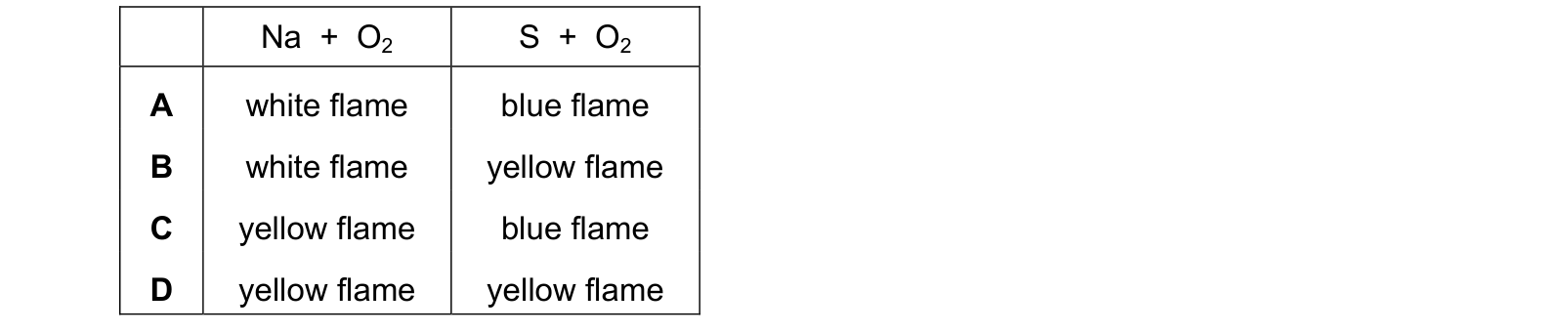
Sodium and sulfur are burned separately in oxygen. Each reaction has a distinctive coloured flame. Which row is correct? Each answer gives, in order: Na + O2; S + O2.
Answer: C.
Sodium burns with a yellow flame. The intense yellow is the sodium D line, the same colour as a street lamp and the same colour a sodium compound gives in a flame test. The product is a mixture of Na₂O and the peroxide Na₂O₂.
Sulfur burns with a blue flame, giving sulfur dioxide. The pale blue is quite unlike anything else in the period and is worth remembering as a distinct observation.
So yellow then blue, which is C.
D gives both as yellow, which confuses the sulfur with the sodium.
A and B give sodium a white flame, which is magnesium. Burning magnesium ribbon gives the brilliant white light that makes it a standard demonstration, and it is the colour most people picture when they think of a metal burning.
The three to keep apart across Period 3 are therefore sodium yellow, magnesium white and sulfur blue. Each is caused by a different mechanism: sodium's colour comes from electronic transitions in the atom, magnesium's white light from the incandescent solid oxide, and sulfur's blue from excited SO₂ molecules.
Question 4
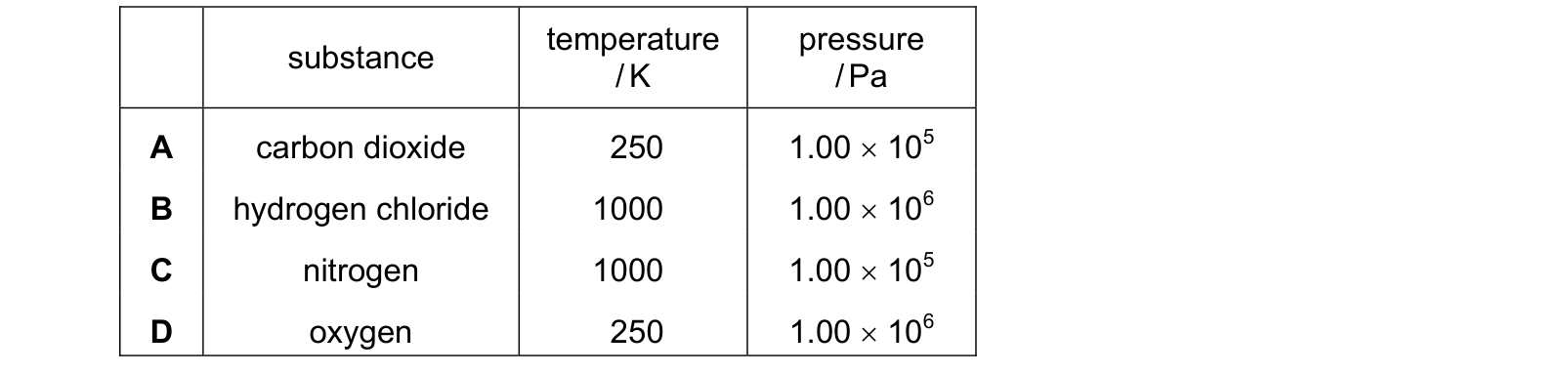
Each of the substances shown is gaseous. Which substance is most likely to show ideal behaviour in the conditions shown? Each answer gives, in order: substance; temperature / K; pressure / Pa.
Answer: C.
C, nitrogen at 1000 K and 1.00 × 10⁵ Pa, has all three. The temperature is the highest offered, the pressure the lowest, and nitrogen is non-polar with only weak instantaneous dipole forces between its small molecules. So C.
B, hydrogen chloride at 1000 K and 1.00 × 10⁶ Pa, is the near miss. The temperature is just as high, but the pressure is ten times greater, and HCl is a polar molecule with permanent dipole attractions, which is a further departure from ideality.
A and D are both at 250 K, the lowest temperature, where the molecules are slowest and intermolecular attractions matter most. D compounds that with the higher pressure.
Three variables are being traded off, and the answer is the option that wins on all of them at once, which is what makes it findable without weighing them against each other. The most important single factor is usually the pressure, since it controls how close the molecules are and therefore how much their own volume and attractions matter.
Question 5
Solid sodium iodide reacts with concentrated sulfuric acid to form more than one product that contains sulfur.
What is the lowest oxidation number of sulfur in these products?
Answer: A.
SO₂, where sulfur is +4
S, the element, where sulfur is 0
H₂S, where sulfur is −2
The lowest is −2, which is A.
Sulfur starts at +6 in H₂SO₄, so the sequence is a progressive reduction: +6 to +4 to 0 to −2. The further down it goes, the more electrons the iodide has supplied.
D, +6, is the starting oxidation number in the sulfuric acid, and the question asks for the lowest reached.
The contrast with the other halides is what makes this worth remembering. Chloride cannot reduce sulfuric acid at all, so sodium chloride gives only HCl and NaHSO₄ with sulfur still at +6. Bromide gets it as far as SO₂. Only iodide, the strongest reducing agent of the three, reaches H₂S, and the smell of rotten eggs is the giveaway.
What this practice covers
These questions are drawn from past CIE 9701 Chemistry papers. You answer, you find out immediately whether you were right, and you get the reasoning for the correct option and for each distractor. Wrong answers go to a mistakes locker so you can come back to exactly those.
Practice is free. You need an account only so your progress and your mistakes are still there next time.
What examiners see students get wrong here
These are the errors that cost marks on nitrogen and sulfur, taken from our own topic notes. Read them before you practise and you will recognise the traps in the questions.
- Explaining nitrogen's unreactivity by saying it is a gas. The reason is the strong triple bond and the non-polar molecule.
- Giving the ammonia bond angle as 109.5°. The lone pair reduces it to 107°.
- Saying the Haber catalyst increases the yield. It increases the rate only.
- Saying a high temperature is used in the Haber process for a better yield. It lowers the yield and is used for rate.
- Adding SO₃ directly to water in the Contact process. It is absorbed in concentrated sulfuric acid first.
- Confusing the pressures: high in the Haber process, low in the Contact process, and knowing why the answer differs.
Revise it first
If any of the above is unfamiliar, work through the notes before practising: Nitrogen and sulfur revision notes.