Hydrocarbons: five questions to try now
Real past-paper questions, the answer key from the mark scheme, and the explanation that goes with it. No account needed to answer them.
Question 1
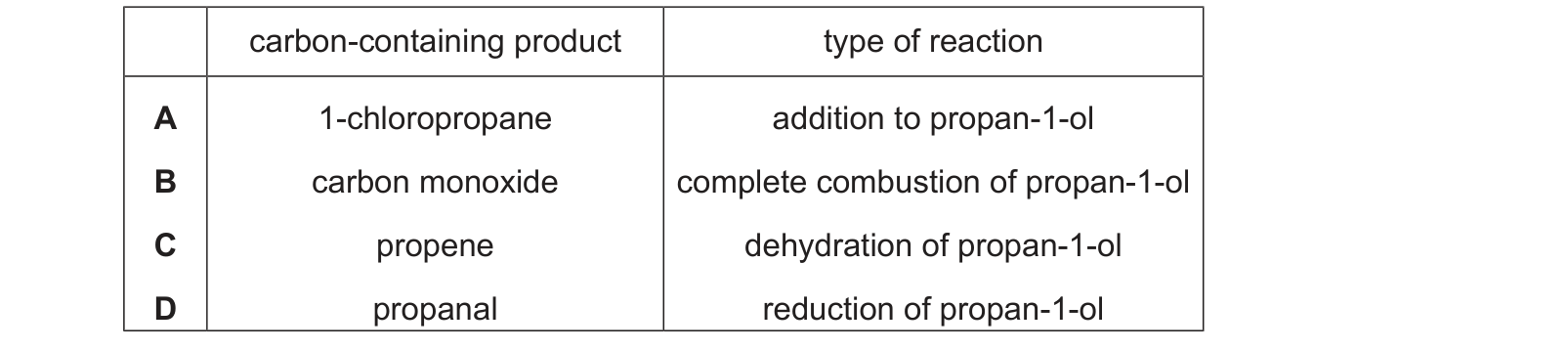
Which row describes the type of reaction that occurs when propan-1-ol reacts to form the named carbon-containing product? Each answer gives, in order: carbon-containing product; type of reaction.
Answer: C.
CH₃CH₂CH₂OH → CH₃CH=CH₂ + H₂O
Losing a water molecule from within one molecule is dehydration, a kind of elimination.
A names the wrong reaction type. 1-chloropropane is made by substitution, replacing the OH with Cl. Addition would need a double bond in the starting material, and propan-1-ol is saturated.
B names the wrong kind of combustion. Carbon monoxide is a product of incomplete combustion. Complete combustion gives carbon dioxide and water.
D has the direction backwards. Propanal comes from oxidation of propan-1-ol, using acidified dichromate and distilling the aldehyde off as it forms. Reduction would go the other way, and there is nothing below a primary alcohol to reduce it to except an alkane.
Each wrong option pairs a real product of propan-1-ol with the wrong label, so the question is testing the vocabulary rather than the chemistry: addition, substitution, elimination, oxidation and reduction each mean something specific.
Question 2
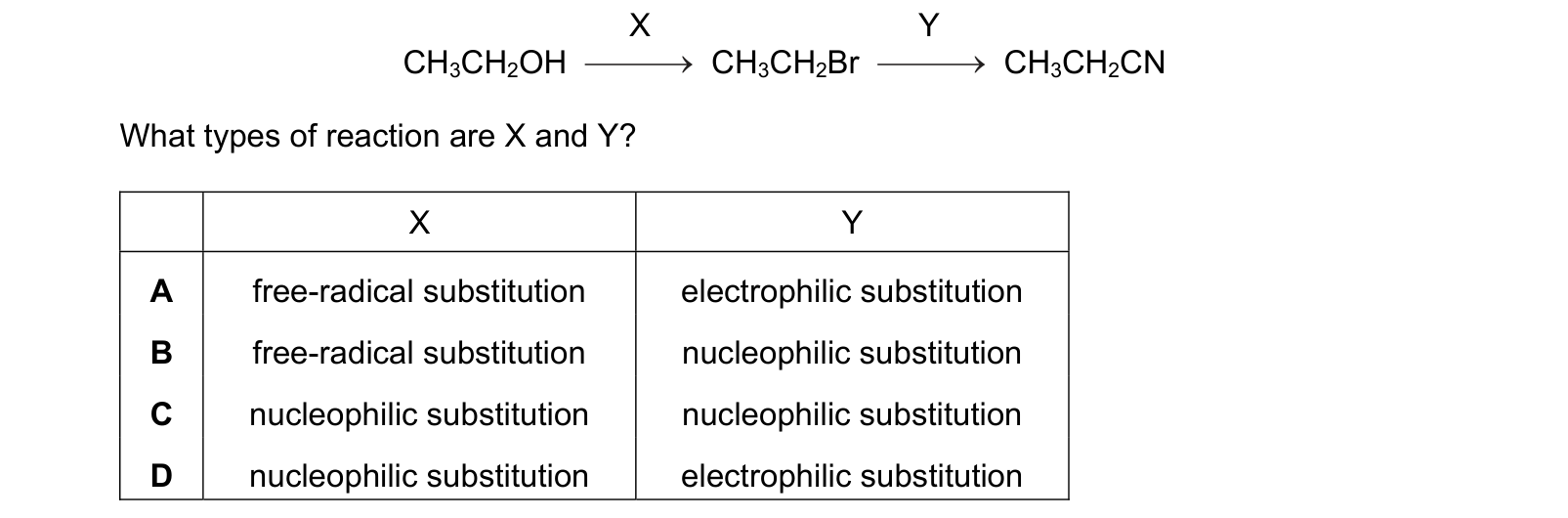
Ethanol can be used to make propanenitrile in two steps. X Y What types of reaction are X and Y? Each answer gives, in order: X; Y.
Answer: C.
Step X: ethanol to a halogenoalkane. The OH is replaced by a halogen, using HBr or phosphorus pentachloride. A halide ion attacking the δ+ carbon is a nucleophilic substitution.
Step Y: halogenoalkane to nitrile. Potassium cyanide in ethanol replaces the halogen with CN, adding the third carbon. The cyanide ion attacks the δ+ carbon, so this is also a nucleophilic substitution.
Both nucleophilic substitutions, so C.
A and B call the first step free-radical substitution, which is what happens to an alkane in ultraviolet light. Ethanol is not an alkane and the reaction needs no light.
A and D call one step electrophilic substitution, which belongs to arenes and is not on this route at all.
The common thread is that both steps have a δ+ carbon being attacked by a species with a lone pair, which is the definition of nucleophilic substitution. The carbon count is also a useful check: two carbons after step X and three after step Y.
Question 3
The alkene shown reacts with an excess of HBr via an electrophilic addition reaction.
What is the major product formed?

Answer: B.
Number the longest chain as hexane with the methyl at C2. The first C=C is between C2 and C3. Adding H+ to C3 leaves the positive charge on C2, which is tertiary and therefore the more stable carbocation, so Br ends up on C2.
The second C=C is between C5 and the terminal C6. Adding H+ to C6 leaves a secondary cation at C5, which beats the primary cation that the other orientation would give. Br ends up on C5.
Each wrong option is one or both additions run backwards: A puts Br at C3, C puts it at the terminal C6, and D does both. Markovnikov is not a rule about which carbon has more hydrogens so much as a rule about which carbocation is more stable, and the two ways of saying it agree every time.
Question 4
Bromine reacts with alkenes by an electrophilic addition mechanism in which a cation is formed as an intermediate.
Which mixture will produce the most stable intermediate cation?
Answer: C.
C, methylpropene, (CH₃)₂C=CH₂, has two methyl groups on one carbon of the double bond. Adding Br⁺ to the CH₂ end puts the positive charge on that doubly substituted carbon, giving a tertiary cation. Most stable, so C.
D, propene, has one methyl on the double bond, so its cation is secondary.
A, 3,3-dimethylpent-1-ene, looks the most substituted of the four and is the trap. Its branching is at carbon 3, which is not part of the double bond at all. The double bond is between carbons 1 and 2, so the cation formed is only secondary, same as propene's.
B, ethene, has no alkyl groups on the double bond, so its cation is primary and the least stable.
What matters is only what is attached directly to the carbons of the double bond. Alkyl groups further along the chain are too far away to feed electron density into the positive centre, however many of them there are.
Question 5
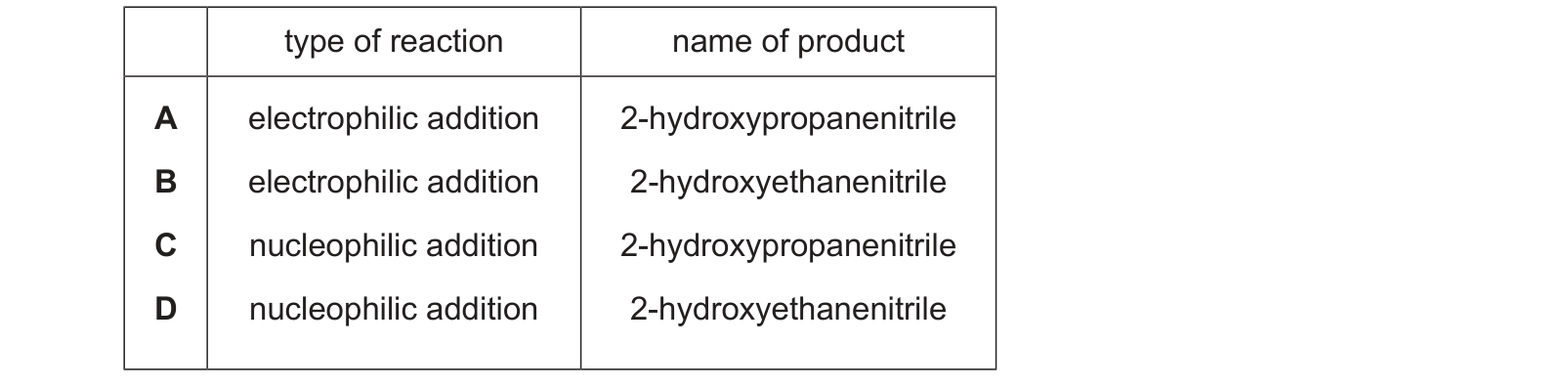
Ethanal, CH3CHO, undergoes an addition reaction with HCN in the presence of CN– ions. Which row identifies the type of reaction and the name of the product formed? Each answer gives, in order: type of reaction; name of product.
Answer: C.
The mechanism. The carbonyl carbon is δ+, because oxygen is far more electronegative than carbon, so it attracts an electron-rich species. The cyanide ion attacks it with its lone pair, which makes this nucleophilic rather than electrophilic. That removes A and B. Electrophilic addition belongs to C=C bonds, which are electron-rich.
The product. The cyanide adds to the carbonyl carbon and a hydrogen ends up on the oxygen:
CH₃CHO + HCN → CH₃CH(OH)CN
Counting carbons for the name, the nitrile carbon counts as carbon 1, so the chain is CN, then the CH(OH), then the CH₃: three carbons, giving propanenitrile as the stem, with the OH on carbon 2. So 2-hydroxypropanenitrile, and the answer is C.
D calls it ethanenitrile, which would be only two carbons and forgets that the HCN has brought one in.
That the reaction lengthens the chain by one is what makes it useful in synthesis, and it is the only reaction on the syllabus that does so apart from cyanide substitution on a halogenoalkane. The nitrile can then be hydrolysed to a carboxylic acid, giving a two-step route from an aldehyde to an acid with an extra carbon.
What this practice covers
These questions are drawn from past CIE 9701 Chemistry papers. You answer, you find out immediately whether you were right, and you get the reasoning for the correct option and for each distractor. Wrong answers go to a mistakes locker so you can come back to exactly those.
Practice is free. You need an account only so your progress and your mistakes are still there next time.
What examiners see students get wrong here
These are the errors that cost marks on hydrocarbons, taken from our own topic notes. Read them before you practise and you will recognise the traps in the questions.
- Leaving out the initiation or termination step, or forgetting to say UV light is needed.
- Writing free-radical substitution as a good way to make a pure halogenoalkane. It gives a mixture.
- Forgetting the induced dipole when bromine adds to an alkene.
- Drawing the curly arrow from the carbon rather than from the C=C bond.
- Predicting the anti-Markovnikov product for an unsymmetrical alkene.
- Saying bromine water is decolourised by alkanes. Only alkenes do it, which is why it is a test.
Revise it first
If any of the above is unfamiliar, work through the notes before practising: Hydrocarbons revision notes.