Analytical techniques: four questions to try now
Real past-paper questions, the answer key from the mark scheme, and the explanation that goes with it. No account needed to answer them.
Question 1
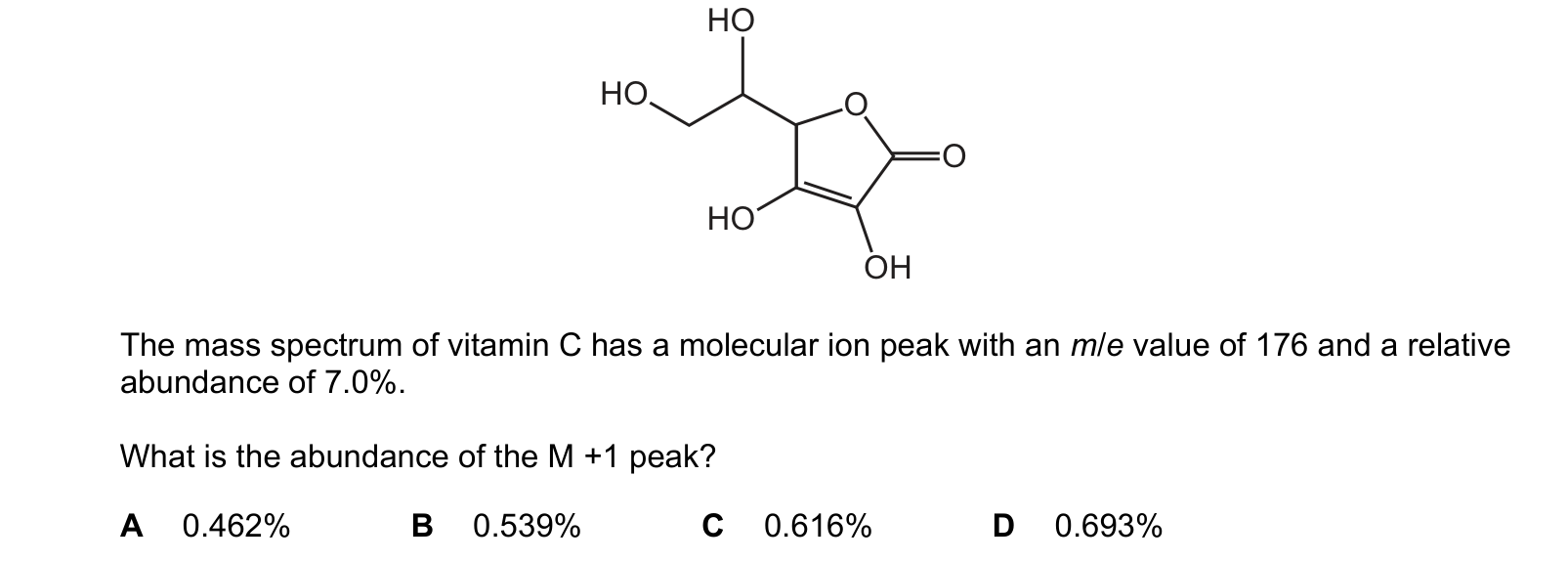
Vitamin C has the structure shown. The mass spectrum of vitamin C has a molecular ion peak with an m/e value of 176 and a relative abundance of 7.0%.
What is the abundance of the M +1 peak?
Answer: A.
About 1.1% of all carbon atoms are ¹³C, so for a molecule with n carbons the chance of containing one of them is roughly n × 1.1%, taken relative to the height of the M peak.
Vitamin C is C6H8O6, so n = 6:
M+1 = 7.0 × (6 × 1.1 / 100) = 7.0 × 0.066 = 0.462%
The abundance is quoted relative to the same scale as the molecular ion peak, which is why the 7.0% has to be carried through rather than dropped.
The wrong options are the same calculation with the wrong carbon count: 0.539 uses 7 carbons, 0.616 uses 8 and 0.693 uses 9. So the entire question turns on reading six carbons off the structure, and a miscount of one changes the answer.
Only carbon is doing this. Hydrogen and oxygen have heavy isotopes too, but ²H is about 0.015% and ¹⁷O about 0.04%, both far too rare to matter at this level. This is also why an M+1 peak is useful: divide its relative height by 1.1 and you have the number of carbon atoms.
Question 2
Three organic compounds are listed. 1 ethanal 2 propan-1-ol 3 propan-2-ol Which compounds will have a mass spectrum that contains a fragment peak at m / e = 43?
Answer: D.
1, ethanal, CH₃CHO, has Mr 44. Losing the hydrogen from the carbonyl gives CH₃CO⁺ at 43 ✓ This is the characteristic fragmentation of any methyl carbonyl compound.
2, propan-1-ol, CH₃CH₂CH₂OH, has Mr 60. Losing the OH gives C₃H₇⁺ at 43 ✓
3, propan-2-ol, has the same formula and loses its OH the same way, giving the propyl ion at 43 ✓
All three, which is D.
The two ions happen to coincide in mass because CH₃CO is 12 + 3 + 12 + 16 = 43 and C₃H₇ is 36 + 7 = 43. That coincidence is why a peak at 43 on its own does not identify a compound, and why the molecular ion peak matters so much: 44 for the aldehyde and 60 for the two alcohols.
Propan-1-ol and propan-2-ol are distinguished by their other fragments rather than by this one: the secondary alcohol gives a strong peak at 45 from losing a methyl, which the primary one does not.
Question 3
In the mass spectrum of a compound, Z, the relative abundances of the M and M+1 peaks are in the ratio 13 : 1.
What is compound Z?
Answer: D.
number of carbons ≈ (height of M+1 / height of M) × 100 / 1.1
Here M : M+1 is 13 : 1, so
(1 / 13) × 100 / 1.1 = 7.69 / 1.1 = 7 carbons
Now count the carbons in each option:
A, butyl butanoate, C₈H₁₆O₂: 8
B, hexan-3-one, C₆H₁₂O: 6
C, 2,2,3-trimethylhexane, C₉H₂₀: 9
D, 3,3-dimethylpentan-1-ol, C₇H₁₆O: 7 ✓
So D.
Counting carbons from a name is the only real work here. Pentan gives five in the chain and the two methyl groups add one each, making seven. For C, hexane gives six and three methyls add three, making nine. For A, both halves of the ester have to be counted: butanoate is four and butyl another four.
Note that the oxygen atoms contribute nothing to the M+1 peak. Oxygen-17 is so rare, about 0.04%, that it is ignored at this level.
Question 4
The mass spectrum of compound X has M, M+1 and M+2 peaks. Other peaks are also present.
Peak M is the molecular ion peak, M+. Peak M has a relative abundance fifteen times that of peak M+1.
Peaks M and M+2 are of equal height.
What could be compound X?
Answer: D.
M and M+2 are equal in height. That is the signature of bromine, whose two isotopes bromine-79 and bromine-81 occur in almost exactly equal amounts. Chlorine would give an M+2 peak one third the height of M, from its 3 : 1 ratio of chlorine-35 to chlorine-37. So the compound contains bromine, which removes A and B.
M is fifteen times M+1. The M+1 peak comes from carbon-13, at about 1.1% per carbon, so
number of carbons ≈ (1/15) × 100 / 1.1 = 6
Now count the carbons in the two bromine compounds:
C, 2-bromo-2-methylhexane, is C₇H₁₅Br, seven carbons ✗
D, 3-bromo-2,2-dimethylbutane, is C₆H₁₃Br, six ✓
So D.
The two isotope patterns are the most useful thing in this topic, and they are easy to keep apart by picturing the peak heights: bromine gives two peaks of the same height, and chlorine gives a tall one and a short one in a 3 : 1 ratio. Neither depends on the rest of the molecule.
What this practice covers
These questions are drawn from past CIE 9701 Chemistry papers. You answer, you find out immediately whether you were right, and you get the reasoning for the correct option and for each distractor. Wrong answers go to a mistakes locker so you can come back to exactly those.
Practice is free. You need an account only so your progress and your mistakes are still there next time.
What examiners see students get wrong here
These are the errors that cost marks on analytical techniques, taken from our own topic notes. Read them before you practise and you will recognise the traps in the questions.
- Treating this topic as A Level material because of its position in the syllabus. Every objective in it is tiered AS.
- Reading an infrared spectrum as though absorption gave an upward peak. Transmittance falls, so absorption is a trough.
- Confusing the broad O-H of an alcohol with the much broader O-H of a carboxylic acid, or missing that a carboxylic acid shows both O-H and C=O.
- Trying to assign individual bonds in the fingerprint region.
- Taking the tallest peak in a mass spectrum as the molecular ion. The tallest peak is the base peak; the molecular ion is the one at the highest m/e apart from isotope peaks.
- Assuming m/e 43 must be C₃H₇⁺, or that m/e 29 must be C₂H₅⁺. Each has two common identities.
- Inverting the M+1 formula, so that the M abundance ends up on top.
- Forgetting the factor of 1.1 altogether, which gives a carbon count about a hundred times too large.
Revise it first
If any of the above is unfamiliar, work through the notes before practising: Analytical techniques revision notes.