States of matter: five questions to try now
Real past-paper questions, the answer key from the mark scheme, and the explanation that goes with it. No account needed to answer them.
Question 1
The table shows the melting points of SiO2 and P4O6.
oxide SiO2 P4O6
melting point / K 1883 297
Which statement explains the difference between the melting points of SiO2 and P4O6?

Answer: D.
SiO₂ is giant covalent, a three-dimensional network in which every silicon is bonded to four oxygens and every oxygen to two silicons. Melting it means breaking covalent bonds throughout the crystal, which is why it takes 1883 K.
P₄O₆ is simple molecular. It exists as discrete P₄O₆ molecules held to one another only by weak instantaneous dipole-induced dipole forces. Melting it means separating those molecules, leaving the covalent bonds inside each one untouched, so 297 K is enough.
So the structure changes from giant molecular to simple molecular, which is D.
A is false. Both oxides are covalent. The change from ionic to covalent happens further left in the period, between the metal oxides and the non-metal ones.
B is true of the period as a whole but does not explain this pair, since neither silicon nor phosphorus is a metal.
C is true and irrelevant. The oxidation number does rise from +4 to +3 per phosphorus in these two, and oxidation number has no bearing on melting point.
The general point is that melting point is decided by structure and bonding, not by composition, which is why the sharpest drop in Period 3 comes between silicon and phosphorus.
Question 2
Consider the following four compounds. 1 (CH3)3CH 2 CH3CH2CH2OH 3 CH3CH2CH2SH 4 CH3CH2CH2CH3 What is the order of increasing boiling point of the compounds (lowest first)?
Answer: B.
2, propan-1-ol, has an O–H group, so it hydrogen bonds. Highest boiling point, 97 °C.
3, propane-1-thiol, has S–H. Sulfur is not electronegative enough to hydrogen bond, so this is dipole-dipole only, 67 °C. Second.
1 and 4 are hydrocarbons with instantaneous dipole-induced dipole forces alone, so both are far below. Between them, 1 is (CH₃)₃CH, methylpropane, which is branched. A branched molecule is more nearly spherical, so its molecules touch over a smaller area and the forces are weaker: −12 °C against butane's −0.5 °C.
So 1 → 4 → 3 → 2, which is B.
D gets the alcohol and thiol the right way round but puts butane below methylpropane. They have exactly the same formula, C₄H₁₀, so nothing separates them except shape, and the straight chain always boils higher than the branched one.
Question 3
Under which conditions will nitrogen behave most like an ideal gas? Each answer gives, in order: temperature; pressure.
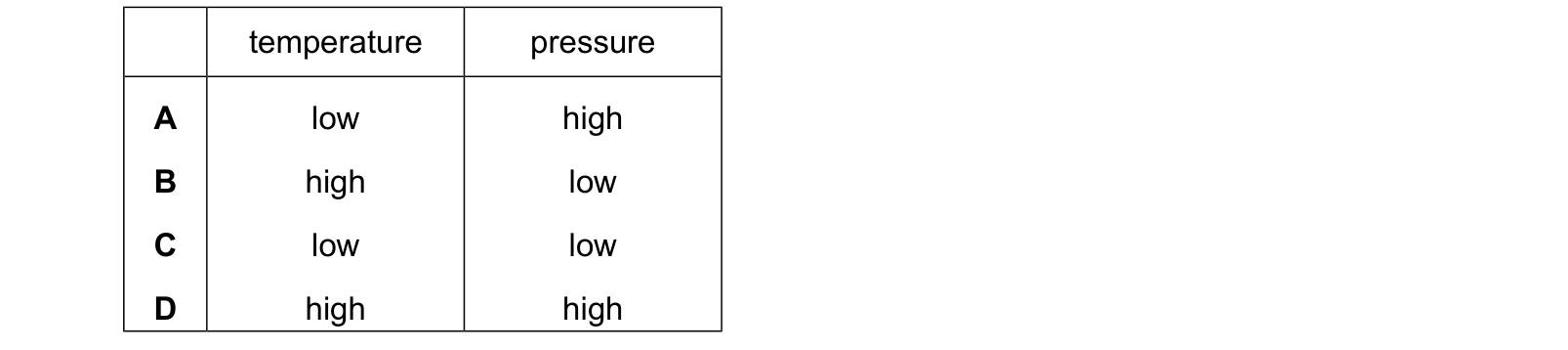
Answer: B.
High temperature gives the molecules more kinetic energy, so the intermolecular attractions matter less relative to their motion.
Low pressure keeps the molecules far apart, so their own volume is a negligible fraction of the total and they rarely come close enough to attract each other.
So high temperature and low pressure, which is B.
A, low temperature and high pressure, is the exact opposite and the condition under which a gas is most likely to deviate, and indeed to liquefy, which is the extreme case of non-ideal behaviour.
C and D each get one of the two right.
Nitrogen is a good candidate for near-ideal behaviour in any case: it is non-polar and its molecules attract each other only through weak instantaneous dipole forces. A gas like ammonia or steam, whose molecules hydrogen bond, deviates far more at the same temperature and pressure, which is why the question specifies which gas as well as the conditions.
Question 4
What are the acid–base nature and structure of SO2? Each answer gives, in order: acid–base nature; structure.
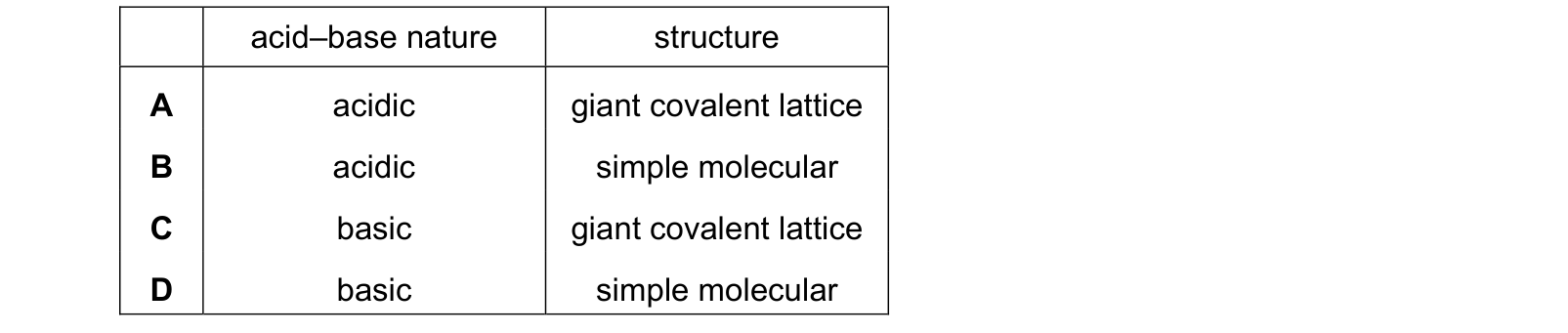
Answer: B.
Acid-base nature: acidic. Sulfur is a non-metal, and non-metal oxides are acidic. SO₂ dissolves in water to give sulfurous acid:
SO₂ + H₂O → H₂SO₃
and it reacts with alkalis to give sulfites. That removes C and D.
Structure: simple molecular. SO₂ is a gas at room temperature, boiling at −10 °C, which is only possible if the forces between its molecules are weak. A giant covalent lattice would have a very high melting point, as SiO₂ does at 1710 °C. So B.
The molecule itself is bent, with a sulfur carrying two bonding regions and one lone pair, and it is polar, so its molecules attract each other by permanent dipole forces as well as the weaker instantaneous ones. That is enough to make it a gas that liquefies easily but nothing like a lattice.
The contrast with silicon dioxide is the one worth holding. Both are non-metal oxides with a formula of the same shape, and both are acidic, but SiO₂ is giant covalent because silicon forms four single bonds to oxygen while sulfur forms two double bonds and stops there.
Question 5
Which row gives the best description of the variations in the melting points and the first ionisation energies of the elements in Period 3 from sodium to argon? Each answer gives, in order: melting points; first ionisation energies.
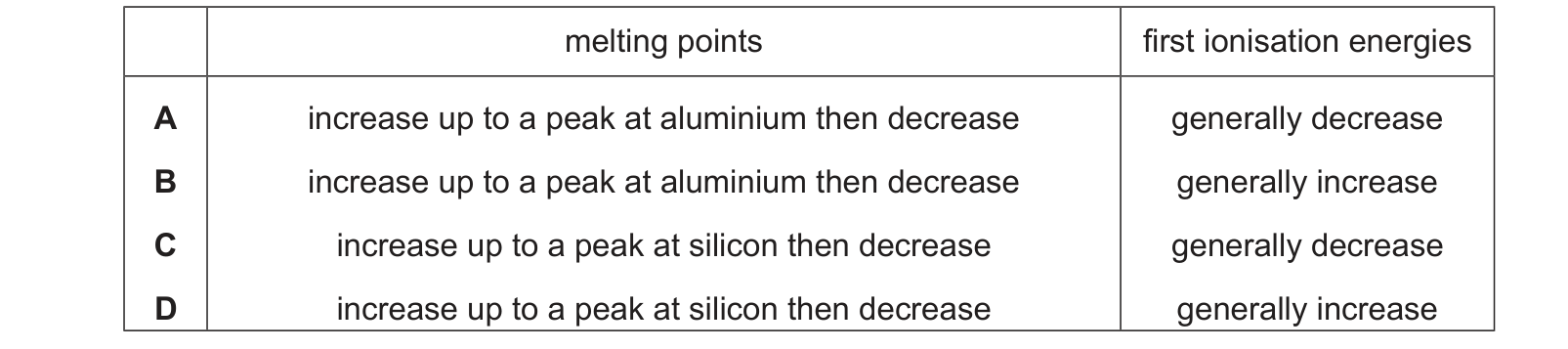
Answer: D.
Melting points peak at silicon. They rise from sodium to magnesium to aluminium as the metallic bonding strengthens, with more delocalised electrons per atom, and then jump sharply at silicon, which is giant covalent and needs covalent bonds broken to melt. After silicon they collapse, because phosphorus, sulfur and chlorine are all simple molecular. That removes A and B, which put the peak at aluminium.
First ionisation energies generally increase. Across the period the nuclear charge rises while the electrons enter the same shell, so the outer electron is held more tightly. That is D.
The word generally is doing careful work. There are two dips: aluminium is lower than magnesium, because its outer electron is in a 3p orbital which is higher in energy and slightly shielded by the full 3s; and sulfur is lower than phosphorus, because sulfur's fourth 3p electron has to pair up in an orbital that already has one, and the two repel.
So the melting points have a single dramatic peak and the ionisation energies a general rise with two small steps back, and knowing where each of those irregularities falls is what the question is testing.
What this practice covers
These questions are drawn from past CIE 9701 Chemistry papers. You answer, you find out immediately whether you were right, and you get the reasoning for the correct option and for each distractor. Wrong answers go to a mistakes locker so you can come back to exactly those.
Practice is free. You need an account only so your progress and your mistakes are still there next time.
What examiners see students get wrong here
These are the errors that cost marks on states of matter, taken from our own topic notes. Read them before you practise and you will recognise the traps in the questions.
- Substituting cm³ or kPa straight into pV = nRT. Convert to m³ and Pa first.
- Using °C in the equation. The temperature must be absolute.
- Saying a gas is ideal at high pressure. It is closest to ideal at low pressure and high temperature.
- Saying covalent bonds break when iodine sublimes. Only the intermolecular forces break.
- Saying ionic solids conduct. They do not, until the ions are free to move.
- Explaining metallic malleability by saying the bonds break. They do not; the delocalised electrons keep the bonding intact as layers slide.
Revise it first
If any of the above is unfamiliar, work through the notes before practising: States of matter revision notes.