Equilibria: five questions to try now
Real past-paper questions, the answer key from the mark scheme, and the explanation that goes with it. No account needed to answer them.
Question 1
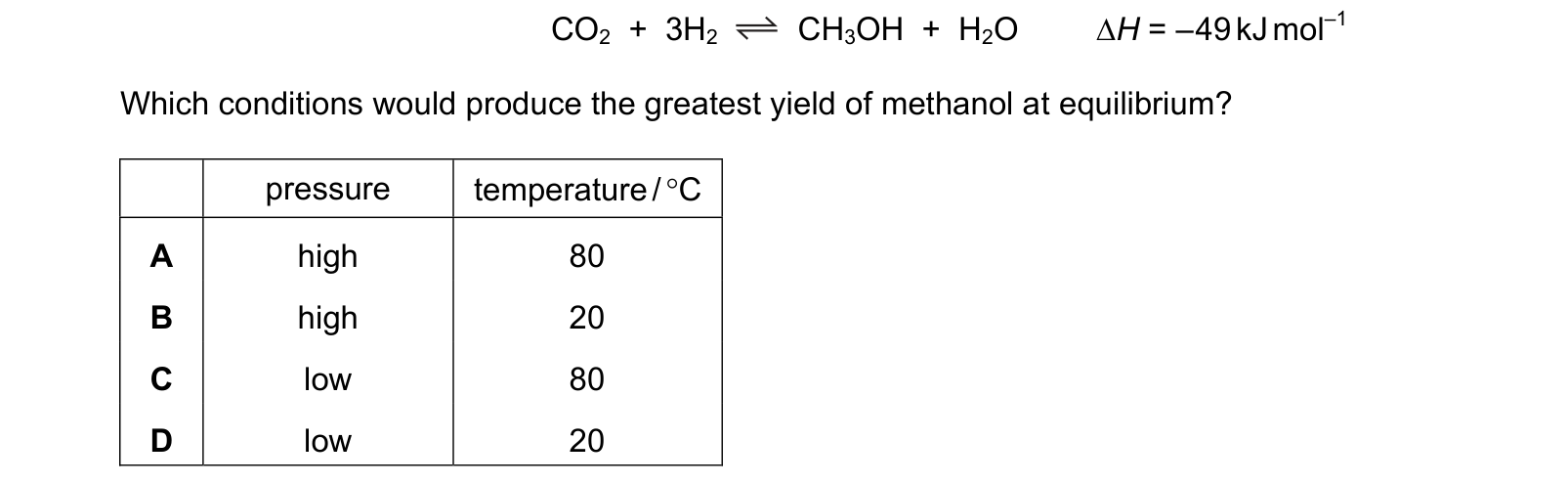
A synthesis for methanol is shown. Which conditions would produce the greatest yield of methanol at equilibrium? Each answer gives, in order: pressure; temperature / °C.
Answer: B.
CO(g) + 2H₂(g) ⇌ CH₃OH(g)
and the forward reaction is exothermic.
Pressure. There are 3 moles of gas on the left and 1 on the right, so raising the pressure shifts the equilibrium towards the side with fewer molecules, which is the product. High pressure gives the better yield. That removes C and D.
Temperature. The forward reaction is exothermic, so lowering the temperature shifts the equilibrium forwards and raises the yield. Of the two temperatures offered, 20 °C is the lower. That is B.
So high pressure and 20 °C.
The question asks specifically about the yield at equilibrium, which is why the answer is the cold, compressed option. In the real plant the temperature is far higher, around 250 °C, because at 20 °C the reaction would be impossibly slow whatever the equilibrium position. That trade-off between yield and rate is the same compromise made in the Haber and Contact processes.
A catalyst would help the rate without touching the yield, which is why one is always used alongside.
Question 2
When some solid Ca5(PO4)3OH is added to a beaker of water, an equilibrium is set up. Which compound, when added to the equilibrium mixture, increases the amount of Ca5(PO4)3OH(s) present?

Answer: A.
Ca5(PO4)3OH(s) ⇌ 5Ca²⁺(aq) + 3PO4³⁻(aq) + OH⁻(aq)
To get more solid, the equilibrium has to shift left, and the way to do that is to raise the concentration of one of the ions on the right. The hydroxide ion is the one the options can reach.
NH3 is a weak base. In water it produces OH⁻, and that extra hydroxide pushes the equilibrium back towards the solid.
B and C do the opposite, and both are worth naming. CH3CO2H is an acid, so its H⁺ removes OH⁻ by neutralising it, the equilibrium shifts right, and more of the solid dissolves. NH4Cl looks neutral but is not: the ammonium ion is the conjugate acid of a weak base, so its solution is acidic and it behaves the same way.
D, NaCl, contributes neither H⁺ nor OH⁻, and neither Na⁺ nor Cl⁻ is one of the ions in the equilibrium, so there is no common ion and no shift at all.
This is why tooth enamel, which is essentially this compound, dissolves in the acid produced by bacteria, and why fluoride works: it replaces the OH⁻ with F⁻ to give a mineral that is far less soluble in acid.
Question 3
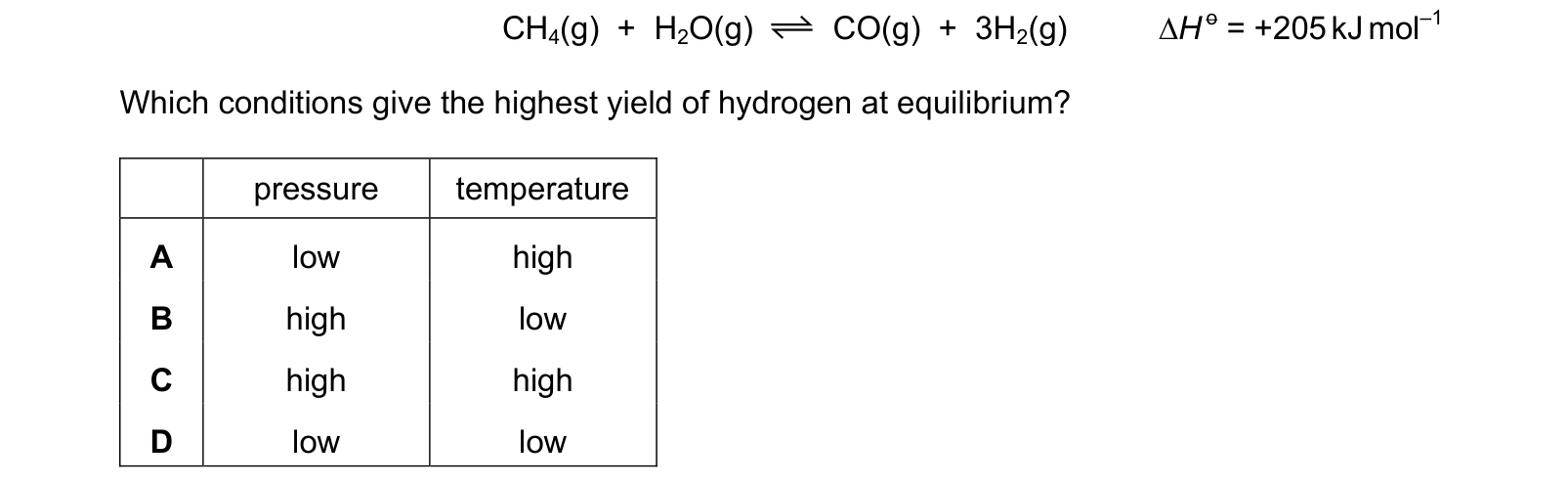
Hydrogen is produced industrially from methane as shown in the equation. Which conditions give the highest yield of hydrogen at equilibrium? Each answer gives, in order: pressure; temperature.
Answer: A.
CH4(g) + H2O(g) ⇌ CO(g) + 3H2(g), ΔH = +205 kJ mol⁻¹
Pressure. Count the gas moles: 2 on the left, 4 on the right. Lowering the pressure lets the system oppose the change by moving to the side with more gas molecules, which is the hydrogen side. Low pressure.
Temperature. ΔH is positive, so the forward reaction is endothermic. Raising the temperature makes the system oppose the heating by absorbing energy, which means going forwards. High temperature.
Every other row gets at least one of those backwards, and C, high and high, is the tempting one because high temperature and high pressure are what an industrial process usually wants. Here the pressure works against the yield.
Worth knowing that this reaction, steam reforming, is run at around 30 atm in practice rather than at the low pressure the yield alone would want. High pressure speeds the reaction up and makes the plant smaller, and the hydrogen is wanted at pressure anyway for the ammonia synthesis that usually follows. That is a compromise about cost and rate, not about yield, and this question asks only about yield at equilibrium.
Question 4
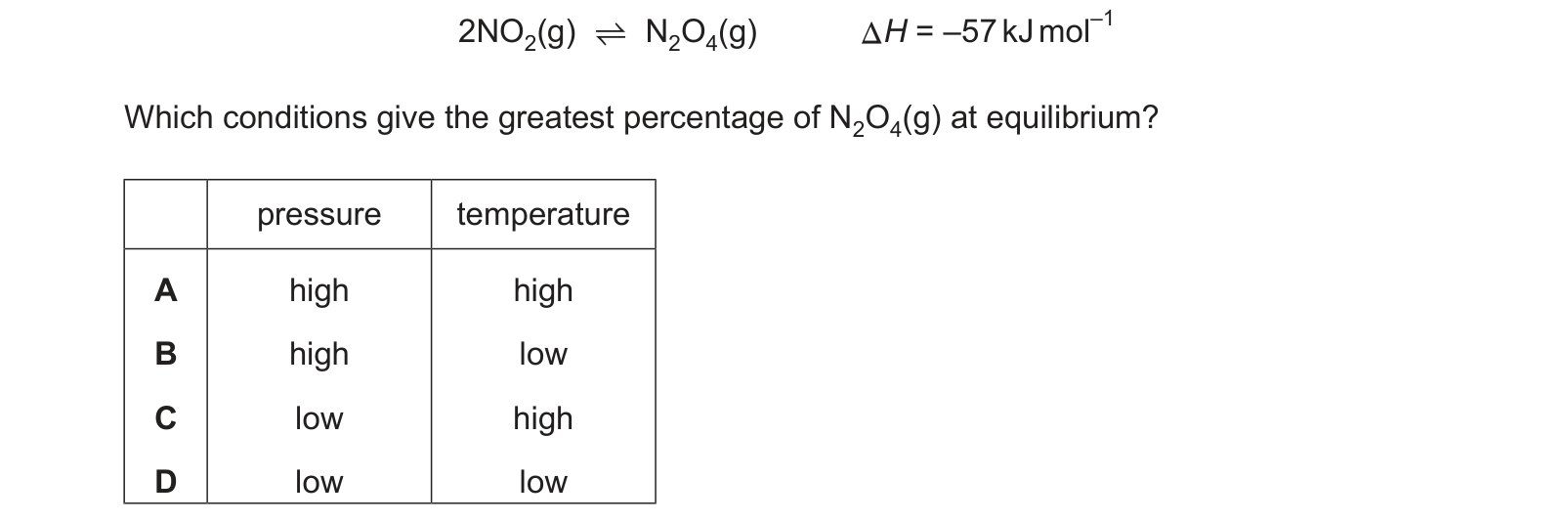
Nitrogen dioxide, NO2, exists in equilibrium with dinitrogen tetroxide, N2O4. Which conditions give the greatest percentage of N2O4(g) at equilibrium? Each answer gives, in order: pressure; temperature.
Answer: B.
Pressure. Two molecules of NO2 combine to give one of N2O4, so the right-hand side has fewer gas molecules. Raising the pressure makes the system oppose the change by moving to the side that occupies less volume, which is the N2O4 side. High pressure.
Temperature. Forming the N–N bond in N2O4 releases energy, so the dimerisation is exothermic. Cooling the mixture makes it oppose the loss of heat by moving in the exothermic direction, which is again towards N2O4. Low temperature.
This equilibrium is the standard demonstration for exactly that reason: NO2 is dark brown and N2O4 is colourless, so a sealed tube put into iced water visibly pales, and the same tube in hot water darkens.
The commonest error is treating the temperature rule as if it worked like the pressure rule. Both are Le Chatelier, but the pressure question is decided by counting gas moles and the temperature question by the sign of ΔH, and one tells you nothing about the other.
Question 5
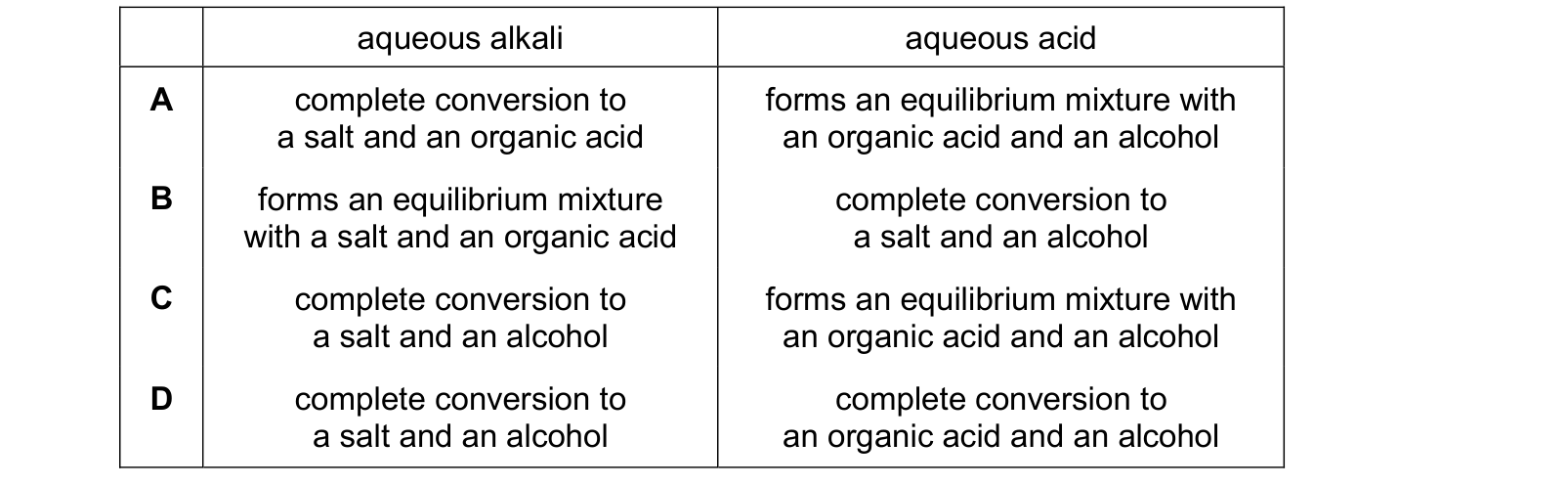
Esters can be hydrolysed with an aqueous alkali or an aqueous acid to form two products. The table compares the two methods. Which row is correct? Each answer gives, in order: aqueous alkali; aqueous acid.
Answer: C.
Aqueous alkali. The ester is split into the alcohol and the salt of the acid, not the acid itself, because the excess alkali immediately neutralises any acid formed. Removing a product that way makes the reaction irreversible, so it goes to completion.
Aqueous acid. The ester is split into the organic acid and the alcohol, and since the reverse reaction is esterification with the same catalyst, the mixture settles at an equilibrium containing all four species.
So complete conversion to a salt and an alcohol, against an equilibrium with an acid and an alcohol, which is C.
A pairs a salt with an organic acid, which cannot both come from one ester: the acid half of the molecule becomes one or the other, not both.
D makes the acid hydrolysis complete, which misses the whole distinction.
The alkaline route is the useful one in practice, both because it goes to completion and because the products separate easily. It is how soap is made, which is why it is called saponification.
What this practice covers
These questions are drawn from past CIE 9701 Chemistry papers. You answer, you find out immediately whether you were right, and you get the reasoning for the correct option and for each distractor. Wrong answers go to a mistakes locker so you can come back to exactly those.
Practice is free. You need an account only so your progress and your mistakes are still there next time.
What examiners see students get wrong here
These are the errors that cost marks on equilibria, taken from our own topic notes. Read them before you practise and you will recognise the traps in the questions.
- Saying the reaction stops at equilibrium, or that the concentrations become equal.
- Saying a catalyst increases the yield. It changes the rate only, and reaches the same position sooner.
- Applying the pressure rule when both sides have the same number of gas molecules.
- Confusing strong with concentrated. Strong is about dissociation; concentrated is about amount.
- Saying K changes when concentration or pressure changes. Only temperature changes K.
- Leaving the balancing numbers out as powers in the Kc expression.
Revise it first
If any of the above is unfamiliar, work through the notes before practising: Equilibria revision notes.