Question 1
Which one of the following government policies is most likely to reduce market failure and to improve the allocation of resources?
Answer: B.
Question 2
Figure 6 shows the marginal private and social benefit (MPB and MSB) curves and the marginal private and social cost (MPC and MSC) curves in the market for domestically produced solar panels. The initial market equilibrium is at E1. Figure 6 To correct the market failure, the government introduces a subsidy to domestic manufacturers of solar panels of £200 per unit produced. Which one of the following represents the total amount of subsidy payments made by the government in the first year of the scheme?
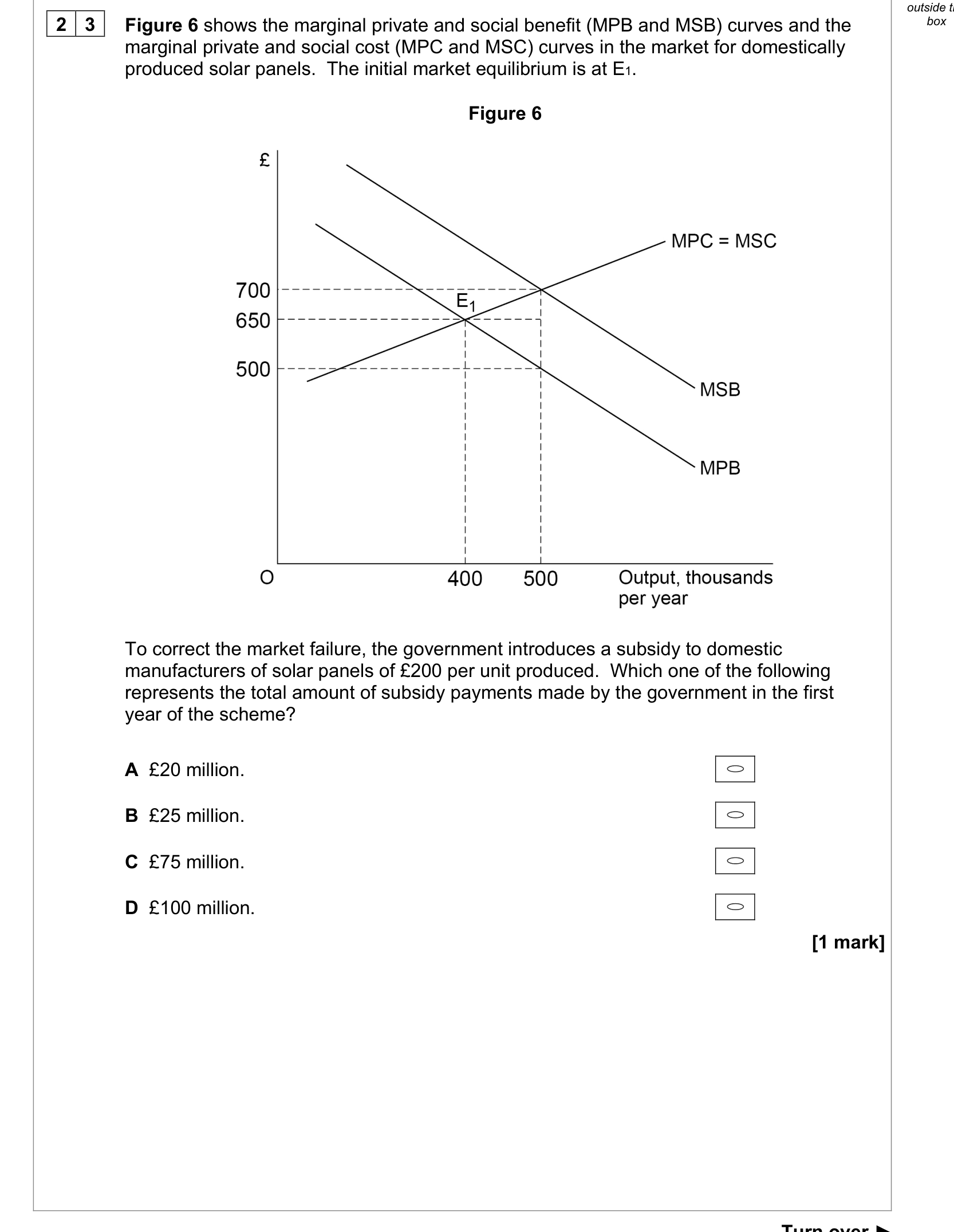
Answer: D.
Options A, B, and C are incorrect because they result from applying the subsidy to the wrong output levels or miscalculating the total expenditure. These figures simply do not match the product of the subsidy rate and the new equilibrium quantity produced by the solar panel manufacturers. In AQA economics, it is vital to always ensure you are using the post-subsidy equilibrium output to calculate total government expenditure, rather than the initial market equilibrium or another arbitrary point on the graph.
What this practice covers
Real past-paper questions, the answer key from the mark scheme, and the explanation that goes with it. Each one is marked the moment you pick, the correct option is shown whether or not you found it, and the full explanation opens either way. No account needed to answer them.
These questions are drawn from past AQA A-Level papers. You answer, you find out immediately whether you were right, and you get the reasoning for the correct option and for each distractor. Wrong answers go to a mistakes locker so you can come back to exactly those.
Practice is free. You need an account only so your progress and your mistakes are still there next time.
What examiners see students get wrong here
These are the errors that cost marks on government intervention and government failure, taken from our own topic notes. Read them before you practise and you will recognise the traps in the questions.
- Describing an intervention without showing it on a diagram or explaining how it moves output to the social optimum.
- Saying government failure means the policy did not work perfectly. It means a net welfare loss, worse than doing nothing.
- Forgetting the opportunity cost of subsidies and state provision.
- Discussing a maximum price without identifying the shortage it creates, or a minimum price without the surplus.
- Ignoring elasticity, an indirect tax on an inelastic good barely changes behaviour.
- Treating all stakeholders as one group.
Revise it first
If any of the above is unfamiliar, work through the notes before practising: Government Intervention and Government Failure revision notes.