Government Intervention and Government Failure
Contents: 10 sections
Methods of intervention
| Method | How it works | Main strength | Main weakness |
|---|---|---|---|
| Indirect tax | Raises MPC to equal MSC, internalising the external cost | Raises revenue; keeps the price mechanism working | Setting the right rate requires valuing the externality; regressive; may create black markets |
| Subsidy | Lowers MPC or raises effective MPB towards MSB | Raises output of merit goods | Opportunity cost; risk of producer inefficiency; hard to set the right level |
| Regulation | Bans, limits, standards, licences, age restrictions | Certain in effect; simple to understand | Enforcement costs; no incentive to reduce beyond the limit; blunt instrument |
| Tradable pollution permits | A cap on total emissions, with permits traded between firms | Guarantees the quantity of pollution; firms with low abatement costs cut most | Setting the cap correctly; permits can be over-issued; administrative complexity |
| State provision | Government supplies the good directly | Solves the free-rider problem for public goods; addresses equity | Funded by taxation with an opportunity cost; no profit motive → possible X-inefficiency |
| Information provision | Advertising campaigns, labelling, compulsory disclosure | Corrects the underlying information failure; preserves choice | Slow; may be ignored; costly |
| Property rights | Assigning ownership so the externality can be priced or litigated | Uses market incentives rather than replacing them | Impossible to assign for air, oceans, atmosphere |
| Behavioural nudges | Default choices, framing, choice architecture | Very cheap; preserves freedom to opt out (1.2) | Paternalism objection; effects can be modest |
| Competition policy | Merger control, price caps, breaking up monopolies | Reduces market power and deadweight loss | Regulatory capture; may reduce economies of scale and dynamic efficiency |
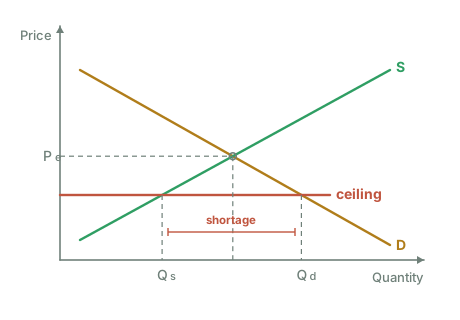
| Price controls | Maximum prices (below equilibrium) and minimum prices (above) | Directly targets affordability or producer incomes | Maximum price → shortage and black markets; minimum price → surplus to be bought up or destroyed |
Choosing between them
Two comparisons come up repeatedly and are worth having ready:
Tax versus regulation. A tax leaves firms free to choose how much to reduce, so those who can cut pollution cheaply do most of the cutting, an efficient outcome, and it raises revenue. Regulation gives certainty about the outcome, which matters where the harm is severe or irreversible, but gives no incentive to go beyond the limit and requires monitoring.
Tax versus tradable permits. A tax fixes the price of pollution and lets the quantity adjust; permits fix the quantity and let the price adjust. Where the target is a hard scientific threshold, permits are preferable because the quantity is guaranteed.
The impact on stakeholders
A strong answer never treats "society" as a single agent. Set out who gains and who loses:
- Consumers: higher prices from taxes and regulation; lower prices from subsidies; better information and quality.
- Producers: higher costs and lower profit from taxes and regulation; lower costs from subsidies; compliance costs falling hardest on small firms.
- Workers: employment effects where output changes; new jobs in compliance and abatement.
- The government: revenue from taxes and permits; spending on subsidies and provision; enforcement costs.
- Third parties: the external cost falls, which was the point of the intervention.
- Future generations: often the main beneficiaries of environmental intervention, and the reason discounting matters.
Note the distributional dimension: indirect taxes on necessities are regressive, hitting low-income households hardest, while subsidies for merit goods can be progressive.
Government failure
Government failure occurs when intervention leads to a net welfare loss, a worse allocation of resources than the market outcome it was meant to correct.
Causes:
- Information failure by the government. Valuing an externality precisely is often impossible, so the tax or subsidy is set at the wrong level, too low and the externality persists, too high and output is pushed below the optimum, creating a new welfare loss.
- Unintended consequences. Landfill taxes encourage fly-tipping; high tobacco duty creates smuggling; rent controls reduce the supply of rental housing and worsen the shortage they were meant to fix.
- Administrative and enforcement costs, which can exceed the welfare gain.
- Regulatory capture: the regulator comes to serve the industry's interests rather than the public's, because the industry holds the expertise and lobbies hardest.
- Political self-interest and short-termism: decisions timed to the electoral cycle rather than the economic case.
- Conflicting objectives: a tobacco tax that is good for health is bad for revenue if it works.
- Market distortions: subsidies keeping inefficient firms alive; price controls creating shortages or surpluses.
- Moral hazard: intervention that insures against risk encourages the risk.
Working the numbers
An indirect tax, with every area accounted for. A market sits at £20 with 4,000 units. A £5 per-unit tax raises the consumer price to £23; producers keep £18; quantity falls to 3,400.
Government revenue = £5 × 3,400 = £17,000
Consumer burden = (£23 − £20) × 3,400 = £10,200
Producer burden = (£20 − £18) × 3,400 = £6,800
Welfare loss = ½ × £5 × (4,000 − 3,400) = £1,500
Check the burdens sum to the revenue: £10,200 + £6,800 = £17,000. They must, every pound collected comes from one side or the other. If yours do not reconcile, a price has been read off the wrong curve.
Consumers bear 60%, so demand is the more inelastic side. And the consumer price rose £3, not the full £5: a price rise equal to the whole tax happens only under perfectly inelastic demand.
A subsidy is the mirror. A £4 subsidy on a good priced at £12 with 5,000 units sold might take the consumer price to £9 and raise quantity to 6,200:
Cost to government = £4 × 6,200 = £24,800
Note that the government pays the subsidy on every unit sold, including those that would have been bought anyway, which is why subsidies are expensive relative to the behaviour change they buy, and a standard evaluation point.
Government failure in figures. If the true external cost was £3 rather than £5, the £5 tax over-corrects: output falls below the social optimum and the intervention creates a welfare loss of its own. Getting the size wrong in either direction is government failure, and it follows directly from the measurement problem rather than from bad intentions.
Worked example
A city introduces a congestion charge to correct the external costs of driving: pollution, delay and accidents.
- Driving generates external costs
- MSC > MPC
- the market over-produces car journeys
- the charge raises the private cost of driving towards the social cost
- quantity of journeys falls towards the social optimum
- congestion, emissions and accidents all fall
- and the revenue can fund public transport, which reinforces the effect.
Stakeholders:
- Gainers: residents (cleaner air), remaining drivers (faster journeys), bus users, and the city authority (revenue).
- Losers: drivers who must pay or switch, businesses inside the zone that lose passing trade, and low-income drivers for whom the charge is a large share of income.
Evaluation, including the risk of government failure.
- Setting the right level requires valuing pollution, time and accident risk. Too low and behaviour does not change; too high and journeys with genuine social value are deterred, a new welfare loss.
- Demand for commuting is inelastic in the short run where no alternative exists, so the charge may raise revenue without reducing journeys, the classic gap between the revenue and the behavioural objective.
- The charge is regressive: wealthier drivers simply pay, so the reduction in journeys is achieved mainly by pricing poorer drivers off the road, which is an equity objection.
- Unintended consequences: traffic may divert onto residential roads just outside the zone, displacing rather than reducing the externality.
- Administrative costs of cameras, enforcement and billing are substantial and must be netted off the welfare gain.
- The policy works far better combined with improved public transport, because the alternative raises the elasticity of demand for driving.
Judgement: the charge is a well-targeted instrument, it prices the externality directly and preserves choice, but it only delivers a net welfare gain if the level is set with reasonable accuracy, a viable alternative exists, and the revenue is used to address the equity objection.
Common exam mistakes
- Describing an intervention without showing it on a diagram or explaining how it moves output to the social optimum.
- Saying government failure means the policy did not work perfectly. It means a net welfare loss, worse than doing nothing.
- Forgetting the opportunity cost of subsidies and state provision.
- Discussing a maximum price without identifying the shortage it creates, or a minimum price without the surplus.
- Ignoring elasticity, an indirect tax on an inelastic good barely changes behaviour.
- Treating all stakeholders as one group.
Exam technique
Structure any "evaluate this intervention" answer the same way: the market failure → how the policy corrects it, with a diagram → who gains and who loses → why it might fail.
Always name elasticity as a determinant of effectiveness, and the information problem as the central risk in setting the level.
Conclude with a genuine judgement, usually that the policy is justified if certain conditions hold (the right level, a viable alternative, revenue used well), rather than an unqualified yes or no. AQA rewards conditional conclusions supported by the analysis.
Quick revision
- Interventions: indirect tax, subsidy, regulation, tradable permits. State provision, information, property rights, nudges, competition policy, price controls.
- Tax fixes the price of pollution; permits fix the quantity.
- Maximum price → shortage and black markets. Minimum price → surplus.
- Always identify gainers and losers: consumers, producers, workers, government, third parties, future generations.
- Government failure = a net welfare loss from intervention.
- Causes: government information failure, unintended consequences, administrative costs, regulatory capture, political short-termism, conflicting objectives, moral hazard.
- Effectiveness depends on elasticity, the accuracy of the chosen level, and enforcement.
Check you have it
Question 1
Which one of the following government policies is most likely to reduce market failure and to improve the allocation of resources?
Answer: B.
Question 2
Figure 6 shows the marginal private and social benefit (MPB and MSB) curves and the marginal private and social cost (MPC and MSC) curves in the market for domestically produced solar panels. The initial market equilibrium is at E1. Figure 6 To correct the market failure, the government introduces a subsidy to domestic manufacturers of solar panels of £200 per unit produced. Which one of the following represents the total amount of subsidy payments made by the government in the first year of the scheme?
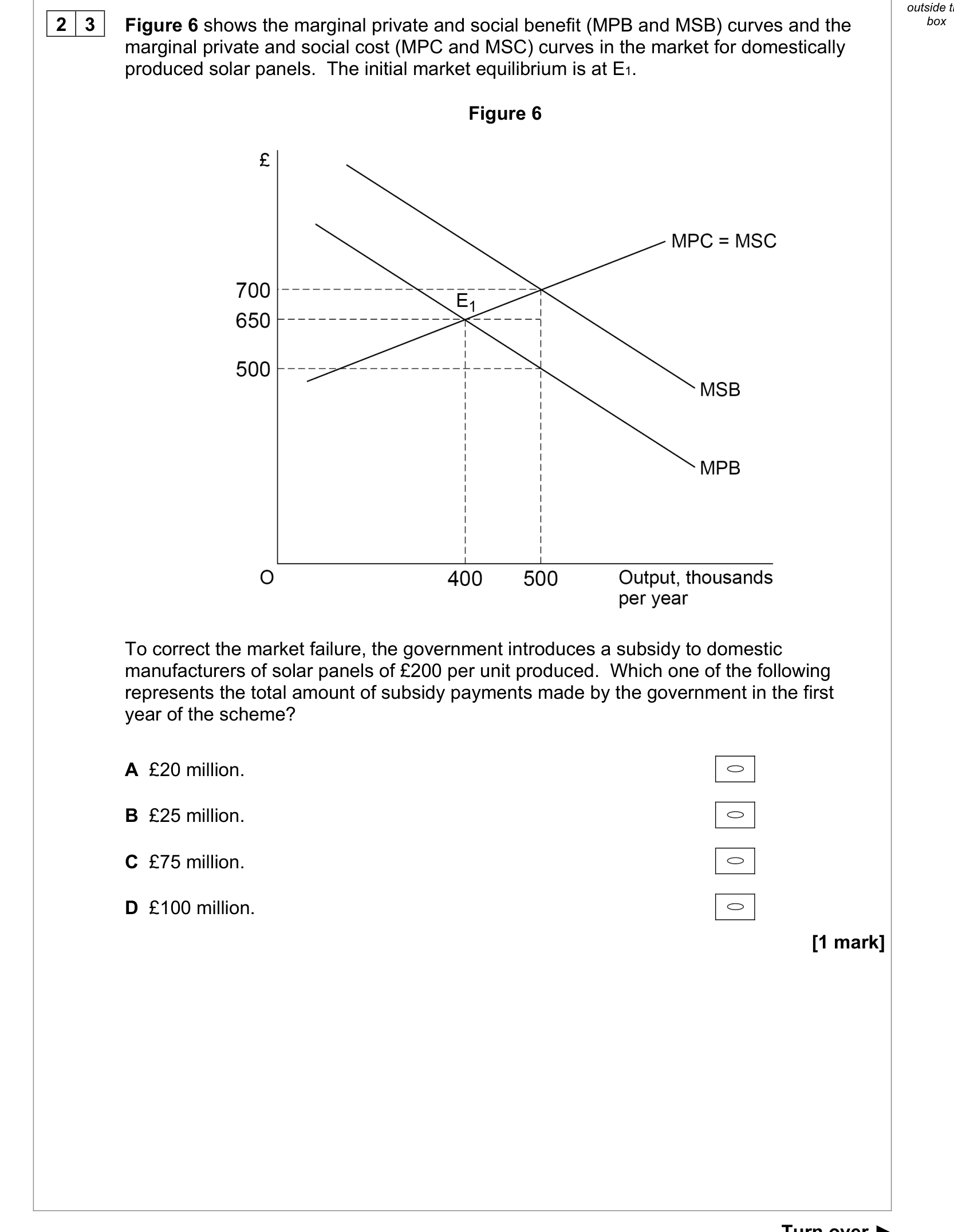
Answer: D.
Options A, B, and C are incorrect because they result from applying the subsidy to the wrong output levels or miscalculating the total expenditure. These figures simply do not match the product of the subsidy rate and the new equilibrium quantity produced by the solar panel manufacturers. In AQA economics, it is vital to always ensure you are using the post-subsidy equilibrium output to calculate total government expenditure, rather than the initial market equilibrium or another arbitrary point on the graph.
What the syllabus asks for on this topicSpecification points
Specification points
- Methods of government intervention to correct market failure.
- The impact of intervention on markets and stakeholders.
- Government failure and its causes.
Related AQA A-Level topics
Not the topic you were looking for? Describe what you are stuck on in your own words and we will take you to the notes that answer it.