Oligopoly
Contents: 11 sections
Characteristics of oligopoly
An oligopoly is a market dominated by a few large firms. Its defining feature is not the number of firms but interdependence: each firm's best action depends on what its rivals do, and it knows they are reasoning the same way.
- High concentration: a few firms hold most of the market.
- Interdependence: decisions are strategic, not independent.
- Barriers to entry, though usually lower than in monopoly.
- Differentiated products, sustained by branding.
- Price rigidity: prices change less often than costs do.
- Non-price competition dominates.
The concentration ratio measures how much of the market the largest firms hold. A 5-firm concentration ratio of 80% means the top five firms account for 80% of sales. It is the standard quantitative indicator, but it says nothing about contestability, a market can be highly concentrated and still behave competitively if entry is easy.
Worked calculation. A market has these shares:
| Firm | A | B | C | D | E | Others |
|---|---|---|---|---|---|---|
| Share | 32% | 24% | 14% | 8% | 6% | 16% |
3-firm CR = 32 + 24 + 14 = 70%
5-firm CR = 32 + 24 + 14 + 8 + 6 = 84%
Both readings say "oligopoly", but note how much the number hides. The same 84% could be five firms with roughly 17% each, which is a very different market from one where a single firm holds 32% and can act as price leader. Concentration ratios describe structure, not conduct, and an answer that treats a high ratio as proof of collusion has skipped the argument the question is asking for.
Why prices are rigid: the kinked demand curve
The kinked demand curve model assumes each firm believes:
- If it raises price, rivals will not follow, so it loses many customers → demand is elastic above the current price.
- If it cuts price, rivals will follow to protect their share, so it gains few customers → demand is inelastic below the current price.
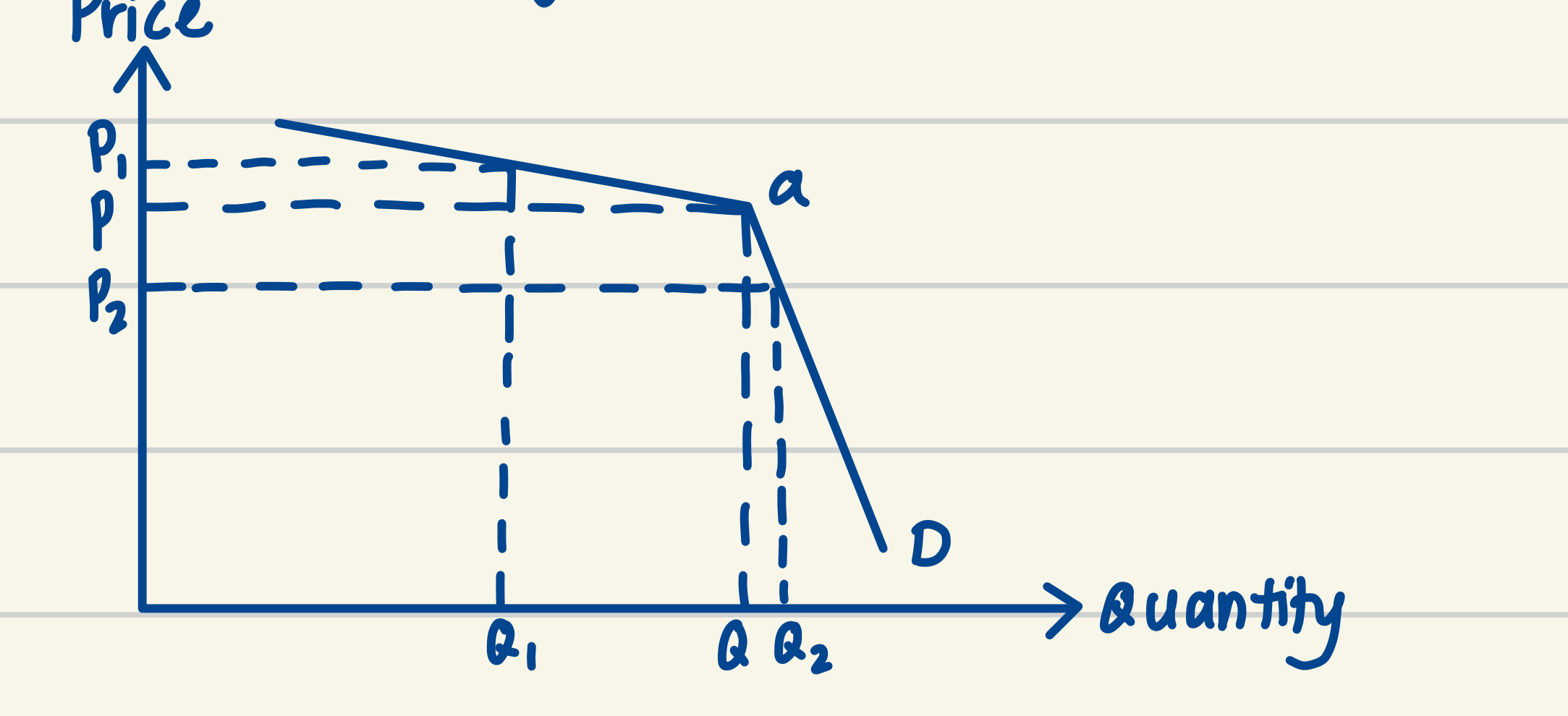
The two gaps along the quantity axis carry the whole argument, and they are deliberately unequal. Q to Q1 is long: a price rise that rivals ignore leaves the firm badly undercut, so it loses a lot of custom. Q to Q2 is short: a price cut that rivals match wins almost nothing, because no consumer has a reason to switch. Neither move is worth making, which is what price rigidity means.
- Demand is elastic above and inelastic below the kink
- the MR curve has a discontinuity (a vertical gap) at that output
- marginal cost can shift anywhere within that gap without changing the profit-maximising price
- so prices stay rigid even when costs change.
The model explains observed stickiness but is criticised for not explaining how the initial price was set, and it collapses when a firm decides to start a price war.
Collusion
Collusion is agreement between firms to restrict competition. A formal agreement to fix prices or output is a cartel, and it is illegal in the UK and EU.
- Overt collusion: an explicit agreement, such as OPEC's production quotas.
- Tacit collusion: no agreement, but firms follow an understood pattern, often through price leadership, where one dominant firm's price changes are matched by the rest.
Why firms collude: a successful cartel behaves like a monopoly, restricting total output and raising price, so joint profit is maximised. It also reduces uncertainty.
Why cartels break down:
- Each member has an incentive to cheat, secretly undercutting the cartel price wins market share at the high cartel price.
- More members make the agreement harder to police.
- Detection and fines are severe; competition authorities offer leniency to the first firm to confess, which makes betrayal individually rational.
- A recession or new entry destabilises the agreement.
Consequences for welfare: collusion raises price, restricts output and transfers consumer surplus to producers, creating deadweight loss. The counter-arguments are that the higher profit may fund R&D (dynamic efficiency), and that cooperation on standards or safety can be socially beneficial.
Game theory
Game theory models interdependence formally. The standard case is the prisoner's dilemma applied to pricing.
Two firms each choose a high or low price:
| Firm B: high | Firm B: low | |
|---|---|---|
| Firm A: high | Both earn £8m | A earns £2m, B earns £10m |
| Firm A: low | A earns £10m, B earns £2m | Both earn £4m |
Whatever B does, A earns more by pricing low, so low is A's dominant strategy. The same is true for B. Both therefore price low and earn £4m each, even though both would earn £8m by pricing high.
That outcome, low, low, is the Nash equilibrium: neither firm can improve its position by changing strategy alone. The dilemma is that the individually rational choice is jointly worse, which explains both the incentive to collude and the incentive to cheat once a cartel exists.
Repeated games change the result. If the firms interact indefinitely, punishing a defector in later rounds makes cooperation sustainable, which is why tacit collusion is more stable in mature markets with the same few players.
Price and non-price competition
Price competition: price wars, predatory pricing (pricing below cost to drive rivals out, then raising price, illegal), and limit pricing to deter entry.
Non-price competition dominates oligopoly precisely because price cuts are matched and simply lower everyone's profit:
- Advertising and branding, creating perceived differentiation and lowering PED.
- Product differentiation, quality and design.
- Loyalty schemes.
- Customer service, delivery and after-sales support.
Contestable markets
A market is contestable where entry and exit are cheap and easy. Contestability theory holds that what disciplines a firm is not the number of rivals but the threat of entry.
Conditions: low barriers to entry and exit, and above all low sunk costs, costs that cannot be recovered on leaving.
Where a market is perfectly contestable, the threat of hit-and-run entry forces even a single incumbent to price near normal profit → so a concentrated market can produce a competitive outcome.
The policy implication is significant: rather than breaking up large firms, a government can improve outcomes by lowering barriers to entry, deregulating, removing licensing restrictions, and preventing incumbents from raising artificial barriers.
Worked example
Two supermarkets dominate a national grocery market.
- They are interdependent
- if one cuts prices, the other matches immediately
- both lose margin and neither gains share
- so a price cut is self-defeating
- this is the Nash equilibrium logic, and it explains why prices stay rigid.
- Instead they compete on non-price terms
- loyalty cards, own-brand ranges, store openings, delivery slots and advertising
- these differentiate the offer and lower PED, so each firm retains customers even at a small price premium.
Evaluation.
- Consumers may still benefit: non-price competition raises quality, choice and convenience, and heavy investment in logistics lowers costs over time, a dynamic efficiency gain.
- But advertising is a cost ultimately paid in prices, and it may add no real value if it merely shifts share between two firms.
- The stable outcome is fragile. Entry by a discounter with a low-cost model changes the game entirely: it is not bound by the tacit understanding, so the incumbents are forced into genuine price competition. This shows the market was contestable after all.
- If instead the two firms tacitly collude through price leadership, price rises towards the monopoly level and consumer surplus is transferred to producers, the case for competition authority intervention.
Judgement: oligopoly outcomes are indeterminate, and the right answer depends on contestability. Where entry is genuinely possible, the threat disciplines pricing; where sunk costs are high and collusion stable, intervention is warranted.
Common exam mistakes
- Defining oligopoly by the number of firms rather than by interdependence.
- Saying oligopolists never compete on price; they do, in price wars and against new entrants.
- Confusing the Nash equilibrium with the best joint outcome; the point of the dilemma is that they differ.
- Treating the concentration ratio as proof of uncompetitive behaviour, ignoring contestability.
- Saying a cartel is stable, the incentive to cheat is built into it.
- Drawing the kinked demand curve without the discontinuity in MR, which is the entire point.
Exam technique
Establish interdependence in your first line, every subsequent argument depends on it.
Use a payoff matrix when game theory is relevant. Identify each firm's dominant strategy. State the Nash equilibrium, and say explicitly why it is jointly worse than collusion.
For evaluation, contestability is the single most powerful concept in this topic: it lets you argue that a concentrated market may still deliver competitive outcomes, and it points to a different policy conclusion from breaking up firms.
Quick revision
- Oligopoly = a few large firms, defined by interdependence; measured by the concentration ratio.
- Kinked demand curve: elastic above, inelastic below → discontinuous MR → price rigidity.
- Overt collusion = cartel (illegal). Tacit = price leadership.
- Cartels break down because each member has an incentive to cheat, and leniency programmes reward confession.
- Prisoner's dilemma: dominant strategies produce a Nash equilibrium worse for both than cooperation.
- Non-price competition dominates: advertising, branding, quality, loyalty schemes.
- Contestability depends on low sunk costs; the threat of entry disciplines incumbents.
What the syllabus asks for on this topicSpecification points
Specification points
- The characteristics of oligopoly and the concentration ratio.
- Collusive and non-collusive behaviour; game theory.
- Price and non-price competition; contestable markets.
Related AQA A-Level topics
Not the topic you were looking for? Describe what you are stuck on in your own words and we will take you to the notes that answer it.