Globalisation and Trade
Contents: 10 sections
Globalisation
Globalisation is the increasing integration of national economies through trade, capital flows, migration and the transfer of technology and ideas.
Causes:
- Falling transport costs, above all containerisation.
- Communications technology: the internet made services tradable across borders.
- Trade liberalisation through the WTO and regional agreements.
- Deregulation of capital markets, allowing money to move freely.
- The growth of multinational corporations and global supply chains.
- The opening of China, India and the former Soviet bloc, roughly doubling the effective world labour force.
Consequences, benefits: lower prices and greater choice; economies of scale from larger markets; technology transfer to developing countries; hundreds of millions lifted out of absolute poverty; and greater competition raising efficiency.
Consequences, costs: structural unemployment in industries exposed to import competition; widening inequality within countries, as returns accrue to capital and skilled labour; environmental damage from production and transport; loss of national policy autonomy; the risk that shocks transmit rapidly across borders; and exploitation of weak labour and environmental standards.
Absolute and comparative advantage
Absolute advantage, a country can produce more of a good with the same resources, or the same output with fewer resources.
Comparative advantage, a country can produce a good at a lower opportunity cost than another country. This is Ricardo's insight and the central idea of the topic.
The gains from trade come from comparative, not absolute, advantage. Even if one country is absolutely better at producing everything, both countries still gain by specialising in what they are relatively best at and trading.
Worked numerical illustration. Two countries each with the same resources:
| Wheat | Cloth | |
|---|---|---|
| Country A | 100 | 50 |
| Country B | 40 | 40 |
Country A has an absolute advantage in both. But consider opportunity cost:
- In A, 1 cloth costs 2 wheat; 1 wheat costs 0.5 cloth.
- In B, 1 cloth costs 1 wheat; 1 wheat costs 1 cloth.
- Cloth is cheaper in opportunity cost terms in B (1 wheat versus 2), and wheat is cheaper in A (0.5 cloth versus 1)
- so A specialises in wheat, B in cloth
- total world output rises
- provided the terms of trade lie between the two opportunity cost ratios (between 1 and 2 wheat per cloth), both countries consume beyond their own PPFs.
Assumptions of the model, and why they matter: no transport costs; constant returns to scale; perfectly mobile factors within countries; no trade barriers; and perfect information. Relaxing them weakens the case, significant transport costs can eliminate the gain entirely, and factor immobility means the workers displaced by specialisation do not smoothly move into the expanding sector, which is precisely the source of the political backlash against trade.
Gains from trade: lower prices, greater choice, economies of scale, competition and efficiency, access to goods that cannot be produced domestically, technology transfer, and higher world output.
Protectionism
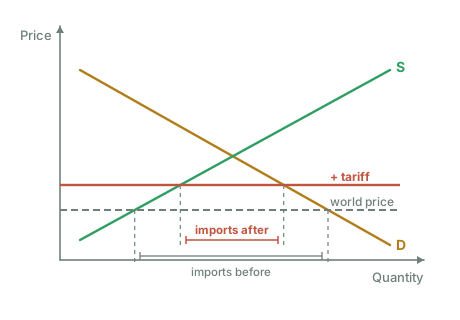
Methods:
| Method | What it is | Effects |
|---|---|---|
| Tariff | A tax on imports | Raises import prices; domestic output and price rise; government revenue; consumer surplus falls; deadweight welfare loss |
| Quota | A quantity limit | Restricts supply, raising price; no revenue for the government: the gain accrues to whoever holds the import licence |
| Subsidy to domestic producers | A payment to home firms | Lowers their costs so they undercut imports; cost falls on the taxpayer |
| Embargo | Total ban | Usually political |
| Administrative barriers | Standards, licensing, paperwork | Raises the cost and delay of importing; hard to challenge legally |
| Exchange rate manipulation | Keeping the currency undervalued | Makes exports cheap and imports dear |
Arguments for protection:
- Infant industry: new industries need shelter until they reach minimum efficient scale.
- Protecting employment in industries facing sudden import competition.
- Preventing dumping: foreign firms selling below cost to destroy domestic rivals.
- Strategic industries: food, energy, defence, where dependence is a national risk.
- Correcting a current account deficit.
- Sunset industries: slowing decline so workers can retrain rather than face mass unemployment.
- Standards: preventing a race to the bottom in labour and environmental conditions.
Arguments against:
- Higher prices and less choice for consumers; protection is a transfer from consumers to producers.
- Higher input costs for domestic firms that use imported components, so protecting one industry damages others.
- Inefficiency, since sheltered firms face less pressure to cut costs or innovate.
- Retaliation, so exports fall and the current account may not improve at all.
- Lower world output as specialisation is reduced.
- Infant industries may never mature if protection is never withdrawn.
- Government failure in choosing which industries to protect.
Trading blocs
| Type | Features |
|---|---|
| Free trade area | No internal tariffs; each member sets its own external tariffs |
| Customs union | Free internal trade plus a common external tariff |
| Single market | Customs union plus free movement of labour, capital and services, and harmonised regulation |
| Monetary union | Single market plus a common currency and single monetary policy |
Trade creation, a bloc shifts production from a higher-cost domestic producer to a lower-cost producer within the bloc. This is welfare-improving.
Trade diversion, the common external tariff shifts production from a lower-cost producer outside the bloc to a higher-cost producer inside. This is welfare-reducing.
Whether a bloc raises welfare depends on which effect dominates, a genuinely evaluative point rather than a description.
Working the numbers
Comparative advantage. With the same resources, two countries can produce:
| Machines | Textiles | |
|---|---|---|
| Country A | 60 | 120 |
| Country B | 20 | 80 |
A has an absolute advantage in both. Opportunity costs decide the pattern of trade anyway:
A: 120 ÷ 60 = 2 textiles per machine · 60 ÷ 120 = 0.5 machines per textile
B: 80 ÷ 20 = 4 textiles per machine · 20 ÷ 80 = 0.25 machines per textile
A gives up 2 textiles per machine against B's 4, so A has the comparative advantage in machines. B gives up 0.25 machines per textile against A's 0.5, so B specialises in textiles. The two calculations must agree; if they do not, a fraction is inverted.
Mutually beneficial terms of trade lie between 2 and 4 textiles per machine. At 3, A receives more than its own cost of 2 and B pays less than its own cost of 4.
A tariff, with the areas. The world price of steel is £400 a tonne; a £100 tariff raises it to £500. Domestic supply rises from 200 to 300 tonnes; domestic demand falls from 900 to 800.
Imports fall from 700 to 500 tonnes
Government revenue = £100 × 500 = £50,000
Production welfare loss = ½ × £100 × 100 = £5,000
Consumption welfare loss = ½ × £100 × 100 = £5,000
Consumer surplus lost = £100 × ½ × (900 + 800) = £85,000
Check they reconcile: consumer loss £85,000 = producer gain £25,000 + revenue £50,000 + welfare loss £10,000. £10,000 is simply destroyed, the two triangles, and that is the net cost of the tariff to the country imposing it.
Worked example
A government imposes a tariff on imported steel to protect its domestic steel industry.
- The tariff raises the price of imported steel
- domestic buyers switch to home-produced steel
- domestic output and employment in steel rise
- the government collects tariff revenue
- domestic producer surplus rises.
But following the chain further is what earns the higher marks:
- Steel-using industries: car manufacturing, construction, engineering, now pay more for a key input → their costs rise → their output prices rise and they become less competitive internationally → jobs are lost in those sectors.
- Consumers pay more for cars and buildings; consumer surplus falls by more than producer surplus and revenue rise, leaving a deadweight welfare loss.
- The protected firms face less competition, so X-inefficiency sets in and the industry becomes less able to compete when protection is eventually removed.
- Trading partners retaliate with tariffs on this country's exports → export industries lose sales and shed workers → the net employment effect may well be negative.
Evaluation.
- The case is strongest if the protection is genuinely temporary and accompanied by restructuring, the infant industry or sunset industry argument.
- It is weakest if the industry's cost disadvantage is permanent, in which case the tariff simply transfers income from consumers to producers indefinitely.
- Strategic considerations may justify maintaining domestic steel capacity regardless of the economic cost, which is a legitimate but normative argument.
- The adjustment cost argument has real force: the workers displaced are geographically and occupationally immobile, so the theoretical gains from trade are not costlessly realised. But retraining and regional support address that more cheaply than a tariff, and without the retaliation.
Judgement: the tariff protects a visible, concentrated group at a diffuse but larger cost to consumers and downstream industries. It is defensible only as a temporary, conditional measure; adjustment assistance is the better instrument for the underlying problem.
Common exam mistakes
- Explaining gains from trade using absolute advantage, the gains come from comparative advantage.
- Failing to compute opportunity cost ratios when data is given.
- Forgetting that the terms of trade must lie between the two opportunity cost ratios for both to gain.
- Confusing tariffs (a tax, generates revenue) with quotas (a quantity limit, no revenue).
- Discussing protection without mentioning retaliation or the effect on downstream firms.
- Confusing trade creation (welfare-improving) with trade diversion (welfare-reducing).
- Ignoring the assumptions of the comparative advantage model, especially factor immobility.
Exam technique
When numerical data is given, always calculate opportunity costs and state them explicitly, that computation is usually worth several marks on its own.
For protection questions, structure by stakeholder: domestic producers, consumers, downstream firms, exporters facing retaliation, the government, and foreign producers. Four or five developed points follow automatically.
For evaluation, use the assumptions of comparative advantage (especially transport costs and factor immobility), the distinction between short-run adjustment costs and long-run gains, and trade creation versus trade diversion for bloc questions.
Quick revision
- Globalisation driven by containerisation, communications, liberalisation, capital deregulation and MNCs.
- Absolute advantage = more output. Comparative advantage = lower opportunity cost.
- Gains from trade come from comparative advantage, even if one country is absolutely better at everything.
- The terms of trade must lie between the two opportunity cost ratios.
- Assumptions: no transport costs, constant returns, mobile factors, no barriers, factor immobility is the weakest.
- Protection: tariff (revenue), quota (no revenue), subsidy, embargo, admin barriers.
- Arguments for: infant industry, employment, dumping, strategic industries, sunset industries.
- Against: higher prices, higher input costs, inefficiency, retaliation, lower world output.
- Blocs: free trade area → customs union → single market → monetary union. Trade creation raises welfare; trade diversion lowers it.
What the syllabus asks for on this topicSpecification points
Specification points
- Globalisation: causes and consequences.
- Absolute and comparative advantage; the gains from trade.
- Protectionism and trading blocs.
Related AQA A-Level topics
Not the topic you were looking for? Describe what you are stuck on in your own words and we will take you to the notes that answer it.