Perfect Competition and Monopoly
Contents: 10 sections
The four types of efficiency
| Type | Condition | Meaning |
|---|---|---|
| Allocative | P = MC | Resources go where consumers value them most; the price paid equals the cost of the last unit |
| Productive | Output at minimum ATC | The good is produced at the lowest possible average cost |
| Dynamic | Falling costs and innovation over time | Requires retained profit to fund R&D and investment |
| X-inefficiency | Costs above the minimum attainable | Organisational slack from a lack of competitive pressure |
Static efficiency (allocative and productive) is measured at a point in time; dynamic efficiency is about improvement over time. The central tension of this topic is that competitive markets deliver static efficiency while concentrated markets may deliver dynamic efficiency, because supernormal profit funds R&D.
Perfect competition
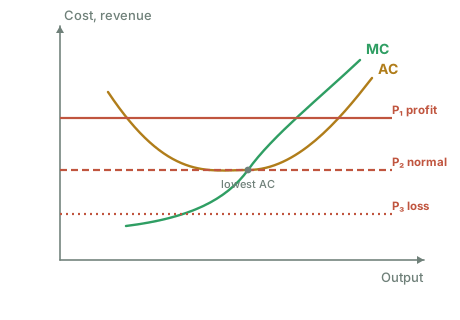
Assumptions: many buyers and sellers, each too small to affect price; a homogeneous product; perfect information; freedom of entry and exit; perfectly mobile factors.
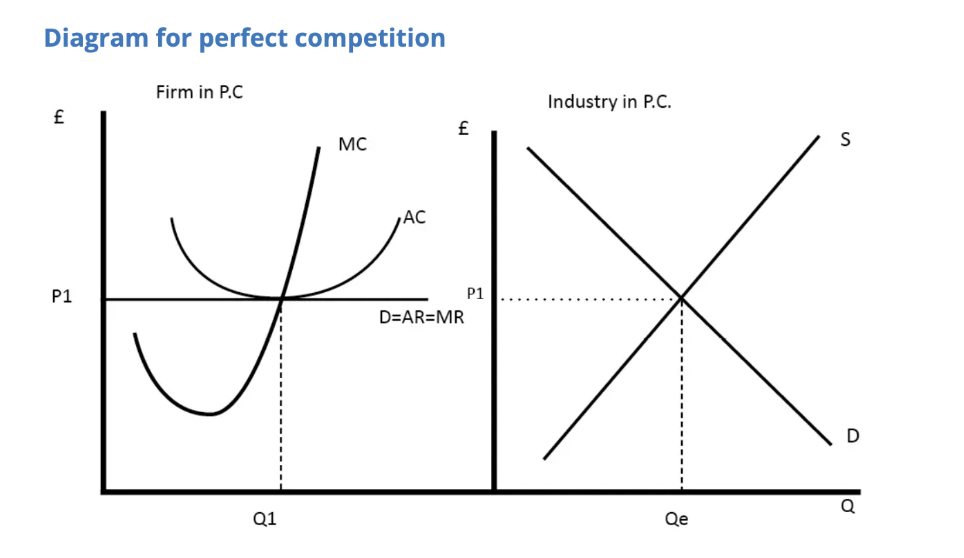
The firm is therefore a price taker facing a perfectly elastic demand curve, so AR = MR = price (3.2).
Short run: the firm produces where MC = MR. If the market price is above ATC it earns supernormal profit; if below, it makes a loss and continues only while covering AVC.
Long run: supernormal profit attracts entry, because there are no barriers.
- New firms enter
- market supply shifts right
- market price falls
- each firm's horizontal AR curve falls with it
- entry stops only when supernormal profit is competed away
- the firm earns exactly normal profit, where P = MC = MR = ATC at minimum ATC.
That single long-run condition delivers both allocative efficiency (P = MC) and productive efficiency (minimum ATC), which is why perfect competition is the efficiency benchmark.
But it is unlikely to be dynamically efficient: with only normal profit there are no retained earnings to fund R&D, and with perfect information any innovation is instantly copied, so there is no incentive to innovate in the first place.
Monopoly
A pure monopoly is a single seller; the UK threshold for investigating monopoly power is a 25% market share.
Sources of monopoly power (barriers to entry):
- Economies of scale and a large minimum efficient scale, the incumbent's costs are far below any entrant's (3.1).
- Legal barriers: patents, copyright, licences. State franchises.
- Control of an essential resource or distribution network.
- Brand loyalty and heavy sunk advertising costs.
- Limit pricing: deliberately setting price low enough to make entry unprofitable.
- High sunk costs, which cannot be recovered on exit and so deter entry.
The monopoly outcome. The monopolist is a price maker with MR below AR. Producing where MC = MR and reading price up to the AR curve gives:
- Higher price and lower output than the competitive equilibrium
- P > MC, so allocatively inefficient
- output is not at minimum ATC, so productively inefficient
- and the absence of competitive pressure permits X-inefficiency
- deadweight welfare loss, with consumer surplus transferred to producer surplus (2.3).
The case in defence of monopoly, which any 25-mark answer needs:
- Economies of scale may put the monopolist's ATC so far below a competitive firm's that price is actually lower despite the mark-up. Where scale economies are vast relative to the market, a natural monopoly exists and fragmenting it would raise costs, hence regulation rather than break-up for water and rail networks.
- Dynamic efficiency: supernormal profit funds R&D, and patent protection makes innovation worth undertaking.
- Cross-subsidisation allows unprofitable but socially valuable services to be maintained.
- Monopoly scale may support international competitiveness against foreign rivals.
Price discrimination
Price discrimination is charging different prices to different consumers for the same good, where the difference is not justified by cost.
Three conditions must all hold:
- The firm has price-setting power.
- It can separate consumers into groups with different PED.
- It can prevent resale (arbitrage) between the groups.
The firm charges more where demand is inelastic and less where it is elastic, peak rail fares, adult versus student cinema tickets, advance versus last-minute airline seats.
Effects: producer surplus rises and consumer surplus falls, since the firm captures some of what consumers were willing to pay. But output usually rises, because consumers with elastic demand who would not have bought at the single price now do, so some consumers gain access, and the extra revenue may cross-subsidise services or fund investment.
Working the numbers
A monopolist faces demand P = 200 − 4Q with constant MC = 40.
TR = 200Q − 4Q², so MR = 200 − 8Q, twice as steep as demand.
Set MR = MC: 200 − 8Q = 40 → Q = 20
Price: read up to demand. Never off MR → P = 200 − 4(20) = £120
Compare perfect competition, where price equals marginal cost:
200 − 4Q = 40 → Q = 40 at a price of £40
The monopolist sells half the competitive quantity at three times the price.
Deadweight loss = ½ × (120 − 40) × (40 − 20) = £800
And its profit. If average total cost at 20 units is £90:
Profit per unit = £120 − £90 = £30
Supernormal profit = £30 × 20 = £600, the rectangle between price and ATC.
Two habits this drills. Find quantity at MR = MC, then take price up to the demand curve, reading it off MR is the most common error in the topic. And the welfare-loss triangle has the price gap as its height and the withheld output as its base.
Worked example
A pharmaceutical firm holds a 20-year patent on a new drug.
- The patent is a legal barrier to entry
- the firm is a monopolist
- it produces where MC = MR
- price is set well above marginal cost
- output is below the allocatively efficient level
- deadweight welfare loss, and patients who value the drug above its marginal cost of production go without it.
The counter-argument, which is the heart of this question:
- Developing the drug cost hundreds of millions with a high failure rate
- without the prospect of supernormal profit, no firm would fund the research at all
- the patent creates dynamic efficiency: the drug exists because monopoly profit was available
- and retained profit funds the next generation of research.
Evaluation.
- The trade-off is static loss now against dynamic gain over time. Judging it depends on the horizon: over 20 years the static loss is real and measurable; over 50 years the innovation may be worth far more.
- The patent is temporary. On expiry, generic entry drives price towards marginal cost, so the deadweight loss is time-limited by design.
- Price discrimination between rich and poor countries lets the firm charge near marginal cost in low-income markets while recovering R&D in high-income ones, raising output and access without destroying the incentive to innovate.
- Monopoly may breed X-inefficiency: protected from competition, the firm's costs drift above the minimum, so part of the supernormal profit is dissipated rather than reinvested.
- Governments can instead fund research directly through grants or prizes, capturing the dynamic gain without the monopoly price, though this shifts the risk to the taxpayer.
Judgement: the monopoly is defensible where the innovation would not otherwise occur and the protection is genuinely temporary; it is not defensible where the barrier is permanent and the profit funds nothing.
Common exam mistakes
- Saying monopoly is "always bad" without the economies-of-scale and dynamic-efficiency counter-arguments.
- Confusing allocative (P = MC) with productive (minimum ATC) efficiency.
- Treating X-inefficiency as productive inefficiency, X-inefficiency means costs are above the cost curve entirely.
- Forgetting that perfect competition earns only normal profit in the long run, and why that undermines dynamic efficiency.
- Omitting one of the three conditions for price discrimination, especially preventing resale.
- Saying price discrimination always harms consumers, output usually rises.
Exam technique
Draw both diagrams properly. For perfect competition, show the industry alongside the firm and trace entry shifting supply and lowering the firm's AR. For monopoly, mark MC = MR, read price up to AR, and shade the deadweight loss triangle.
Use the four efficiencies as an evaluative framework: monopoly typically fails allocative and productive efficiency and permits X-inefficiency, but may deliver dynamic efficiency. That structure answers most 25-markers in this section.
Always question the assumptions, perfect competition's conditions are never met in reality, so it is a benchmark, not a description.
Quick revision
- Allocative: P = MC. Productive: minimum ATC. Dynamic: innovation over time. X-inefficiency: costs above the minimum.
- Perfect competition: many firms, homogeneous product, perfect information, free entry; the firm is a price taker, AR = MR = P.
- Long run: entry competes away supernormal profit → normal profit, P = MC = ATC at minimum → allocatively and productively efficient, but not dynamically.
- Monopoly barriers: economies of scale, patents, resource control, brand loyalty, limit pricing, sunk costs.
- Monopoly: higher price, lower output, P > MC, deadweight loss, possible X-inefficiency.
- Defences: economies of scale, natural monopoly, dynamic efficiency, cross-subsidy.
- Price discrimination needs price-setting power, separable PED groups, and no resale. It raises producer surplus and usually raises output.
What the syllabus asks for on this topicSpecification points
Specification points
- Efficiency: allocative, productive, dynamic and X-inefficiency.
- Perfect competition in the short and long run.
- Monopoly, monopoly power and price discrimination.
Related AQA A-Level topics
Not the topic you were looking for? Describe what you are stuck on in your own words and we will take you to the notes that answer it.