Economic Methodology and the Economic Problem
Contents: 9 sections
Economics as a social science
Economics studies human behaviour, so it cannot run controlled laboratory experiments. Instead it builds models, deliberate simplifications that isolate the relationship being examined.
Every model relies on _ceteris paribus_, "other things being equal". When we say a rise in price causes a fall in quantity demanded; we are holding income, tastes and the prices of other goods constant. In the real world they do not stay constant, which is why economic predictions are conditional rather than certain.
Why models are still useful: a model that captures the dominant forces gives reliable directional predictions even if it omits detail. The exam reward is for knowing which assumption is doing the work, and what happens when it fails.
Positive and normative statements
| Positive | Normative | |
|---|---|---|
| Nature | Objective, factual | Subjective, opinion |
| Testable? | Yes, against evidence | No |
| Signal words | "is", "will", "causes" | "should", "ought", "unfair", "too high" |
| Example | "A rise in the minimum wage raises unemployment among young workers." | "The government should raise the minimum wage." |
A positive statement can be wrong and still be positive, what matters is that evidence could in principle settle it.
Value judgements underlie normative economics. Two economists can agree completely on the positive analysis of a carbon tax and still disagree on whether it should be introduced, because they weigh the interests of present and future generations differently.
The economic problem
Human wants are unlimited but the resources to satisfy them are scarce. That forces choice, and every choice has an opportunity cost.
- **Scarcity
- choice
- opportunity cost.**
This chain is the foundation of everything else on the specification, and it applies to individuals, firms and governments alike.
| Term | Definition |
|---|---|
| Scarcity | Finite resources cannot satisfy unlimited wants |
| Opportunity cost | The value of the next best alternative forgone |
| _Ceteris paribus_ | The assumption that other variables are held constant |
| Factors of production | Land, labour, capital and enterprise |
Note that opportunity cost is the next best alternative, not the sum of all alternatives, and that it includes non-monetary costs such as time.
The three fundamental questions every economy must answer are what to produce, how to produce it, and for whom. Free-market systems answer them through the price mechanism, command systems through central planning, and mixed economies, which is what almost every real economy is, through both.
Production possibility diagrams
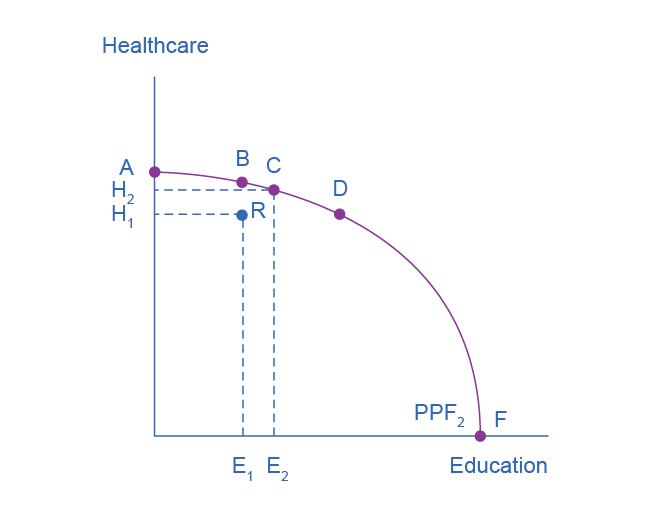
A PPF shows the maximum combinations of two goods an economy can produce when all resources are fully and efficiently employed.
| Position | Meaning |
|---|---|
| On the curve | Productively efficient: no output can rise without another falling |
| Inside the curve | Inefficient: unemployed or misallocated resources, spare capacity |
| Outside the curve | Currently unattainable |
- Movement along the curve shows opportunity cost, producing more of one good means less of the other.
- An outward shift shows economic growth: more or better resources, or improved technology.
- The curve is usually drawn concave to the origin, because resources are not equally suited to both uses. Shifting resources into a good they suit poorly means giving up progressively more of the other, increasing opportunity cost.
Worked example
A government reallocates resources from consumer goods towards capital goods, machinery, infrastructure and equipment.
- Resources move along the PPF towards capital goods
- consumption falls today, which is the opportunity cost
- but the extra capital raises the economy's productive capacity
- in future years the PPF shifts outward
- both consumption and capital output can be higher than before.
The evaluation. The gain is real but delayed, and it is not costless:
- The lost consumption falls on today's households, while the benefit accrues to a later period, an intergenerational trade-off, and a normative question about how much present welfare should be sacrificed.
- The gain depends on the capital being productive. Infrastructure built for political rather than economic reasons may not shift the PPF at all.
- If the economy was operating inside the PPF to begin with, output of both goods could have been raised without any sacrifice, so the trade-off only bites at full employment.
Judgement: the reallocation is justified if the discounted future gain exceeds the consumption forgone, but whether that trade is worth making is ultimately a value judgement, not a positive result.
Common exam mistakes
- Confusing positive (testable) and normative (opinion) statements. Check for "should" and "ought".
- Assuming a positive statement must be true. It only has to be testable.
- Treating a point inside the PPF as unattainable rather than inefficient.
- Saying resources are unlimited; it is wants that are unlimited.
- Defining opportunity cost as all forgone alternatives instead of the next best one.
- Forgetting ceteris paribus when explaining why a prediction did not come true.
Exam technique
Define terms with precision, AQA awards marks for the exact wording, especially "next best alternative forgone".
Use the PPF diagram wherever opportunity cost, efficiency or growth is at issue. Label the axes with the two goods, mark the movement or shift, and refer to specific points.
In evaluation, separate the positive analysis ("this policy will raise capacity") from the normative judgement ("this policy is desirable"). Saying explicitly which part of your answer is a value judgement is a mark-earning move.
Quick revision
- Economics uses models and _ceteris paribus_ because it cannot run experiments.
- Positive = objective and testable. Normative = value judgement, signalled by "should".
- Scarcity → choice → opportunity cost; opportunity cost is the next best alternative forgone.
- Factors of production: land, labour, capital, enterprise.
- Every economy answers what, how and for whom; most are mixed.
- PPF: on = efficient, inside = spare capacity, outside = unattainable.
- Movement along = opportunity cost; outward shift = growth.
- The concave shape shows increasing opportunity cost.
Check you have it
Question 1
The law of diminishing marginal utility states that
Answer: A.
What the syllabus asks for on this topicSpecification points
Specification points
- Economics as a social science; the use of models and ceteris paribus.
- Positive and normative statements; value judgements.
- The economic problem: scarcity, choice and opportunity cost.
- Production possibility diagrams; economic resources and their allocation.
Related AQA A-Level topics
Not the topic you were looking for? Describe what you are stuck on in your own words and we will take you to the notes that answer it.