The Price Mechanism and Market Equilibrium
Contents: 9 sections
Market equilibrium
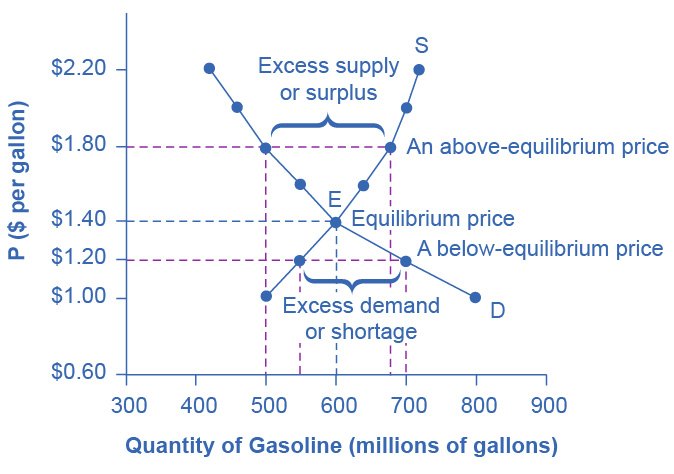
Equilibrium is the price at which the quantity demanded equals the quantity supplied. There is no tendency for price to change, because every buyer willing to pay that price finds a seller and every seller willing to accept it finds a buyer.
Disequilibrium and how it corrects:
| State | Condition | Adjustment |
|---|---|---|
| Excess supply (surplus) | Price above equilibrium: Qs > Qd | Unsold stock builds → firms cut price → demand extends, supply contracts → equilibrium restored |
| Excess demand (shortage) | Price below equilibrium: Qd > Qs | Queues and empty shelves → sellers raise price → demand contracts, supply extends → equilibrium restored |
The correction happens automatically, through the self-interested actions of buyers and sellers rather than any coordinating authority. This is the sense in which Adam Smith's "invisible hand" operates.
Note that the adjustment happens through movements along both curves, not shifts. Neither curve has moved; the market is simply travelling along them to the price where they cross. Drawing a shift to correct a shortage is one of the most common errors on this topic.
Finding equilibrium from equations
AQA sets this, and the method never varies: set Qd = Qs, solve for price, substitute back for quantity.
Suppose Qd = 200 − 4P and Qs = −40 + 6P.
200 − 4P = −40 + 6P → 240 = 10P → P = 24
Qd = 200 − 4(24) = 104; check Qs = −40 + 6(24) = 104 ✓
Substituting into both equations is the check worth doing every time, if they disagree, the algebra slipped.
Now test a disequilibrium price. At P = 20:
Qd = 200 − 80 = 120, Qs = −40 + 120 = 80 → excess demand of 40, so price is bid up.
At P = 30: Qd = 80, Qs = 140 → excess supply of 60, so price is pushed down. Both confirm that 24 is the only price at which the market clears.
When both curves shift
If demand and supply move together, one outcome becomes indeterminate, it depends on which shift is larger:
| Price | Quantity | |
|---|---|---|
| D right, S right | Indeterminate | Rises |
| D right, S left | Rises | Indeterminate |
| D left, S right | Falls | Indeterminate |
| D left, S left | Indeterminate | Falls |
The pattern rather than the table: where both shifts push a variable the same way it moves that way; where they push in opposite directions it cannot be determined without knowing the relative sizes. Saying "indeterminate, and it depends on which shift dominates" is the correct answer, not a hedge.
The three functions of the price mechanism
This is the core of the topic and the phrasing AQA expects.
1. Rationing. Scarce resources must be allocated among competing users. A rising price rations the good to those who value it most highly, measured by willingness and ability to pay. When a harvest fails, the price of wheat rises and consumption falls to match the smaller supply, without any queue, quota or ration book.
2. Incentive. A higher price raises profitability, giving producers an incentive to supply more of that good, and to enter the market. A lower price does the reverse. Prices therefore change behaviour without anyone being instructed.
3. Signalling. Prices carry information. A rising price tells producers that consumers want more of this good and tells consumers to economise on it. Prices are, in effect, a continuously updating summary of relative scarcity, condensing the knowledge of millions of dispersed buyers and sellers into a single number.
Together these three functions allocate resources: prices signal where resources are wanted, incentivise their movement there, and ration the resulting output.
How resources are reallocated
The mechanism is a chain, and reproducing it earns analysis marks:
- A change in consumer tastes towards good A
- demand for A rises
- its price rises
- producing A becomes more profitable
- firms move resources into A and new firms enter
- supply of A rises
- the price falls back towards the original level
- meanwhile the opposite happens in the market for good B
- resources have shifted from B to A in response to consumer wishes.
This is consumer sovereignty: in a free market, what gets produced is ultimately determined by what consumers choose to buy.
Where the mechanism fails
The price mechanism only allocates efficiently under demanding conditions, perfect information, no externalities, no market power, and mobile factors. When those fail, prices misallocate resources, which is market failure (5.1) and the case for intervention (5.2).
- Prices ignore external costs and benefits, so pollution is over-produced and education under-produced.
- Public goods carry no price at all, because of non-excludability, so the market supplies none.
- Rationing by ability to pay is efficient but says nothing about equity; it can leave people without necessities.
- Factors are immobile in the short run, so resources do not actually move as smoothly as the theory implies.
Worked example
A disease destroys a large share of the global cocoa crop.
- Supply of cocoa shifts left
- at the old price there is excess demand
- the price is bid up sharply.
Each function is doing work, and naming them is what the question rewards:
- Rationing: the higher price forces chocolate manufacturers to cut usage; the reduced supply is allocated to those willing to pay most.
- Signalling: the high price tells growers worldwide that cocoa is scarce and valuable, and tells manufacturers to economise or substitute.
- Incentive: the high price makes cocoa growing far more profitable, so existing farmers invest in disease-resistant stock and new land is planted.
- In the long run the incentive effect draws resources in
- supply rises
- the price falls back. The market has corrected the shortage without any authority directing it.
Evaluation.
- The adjustment is slow: cocoa trees take years to mature, so short-run supply is highly inelastic (2.1) and the price spike is severe and prolonged.
- The distributional effect is harsh, the price rise rations by ability to pay, and cocoa-dependent farming communities face volatile incomes.
- Speculation can amplify the movement: if traders expect further rises they buy and hold stock, raising the price beyond what fundamentals justify.
- Prices only convey private costs and benefits. If cocoa expansion causes deforestation, the price signal will draw in too many resources, because the external cost is not in the price.
Judgement: the price mechanism corrects the shortage efficiently and without central direction, but its speed depends on elasticity of supply, and it is silent on both equity and externalities.
Common exam mistakes
- Naming the three functions without explaining how each operates in the given market.
- Saying prices "cause" demand to change, a price change causes a movement along the demand curve, not a shift.
- Confusing excess demand with an increase in demand.
- Claiming the price mechanism always allocates efficiently, ignoring market failure.
- Forgetting that rationing by price is about ability as well as willingness to pay, an equity point.
- Describing the adjustment as instantaneous, ignoring elasticity of supply and time lags.
Exam technique
Draw the diagram and label the disequilibrium explicitly, mark the quantity demanded and quantity supplied at the disequilibrium price, and shade the surplus or shortage.
Name the three functions using AQA's own words, rationing, incentive, signalling, and apply each to the specific market in the question, not in the abstract.
For evaluation, the strongest angles are elasticity of supply (how fast the correction happens), equity (rationing by ability to pay), and externalities (prices reflect private, not social, costs).
Quick revision
- Equilibrium: Qd = Qs, no tendency to change.
- Price above equilibrium → excess supply → price falls. Below → excess demand → price rises.
- Three functions: rationing (allocates to those willing and able to pay), incentive (higher price → more supply), signalling (prices carry information about scarcity).
- Together they reallocate resources in line with consumer sovereignty.
- The mechanism fails where there are externalities, public goods, market power or immobile factors.
- Adjustment speed depends on elasticity of supply.
- Efficient allocation says nothing about equitable allocation.
Check you have it
Question 1
The diagram below shows two market demand curves (D 1 and D 2 ) and the market supply curve (S), for Good X. The price elasticity of supply of Good X when the demand curve shifts from D 1 to D 2 is
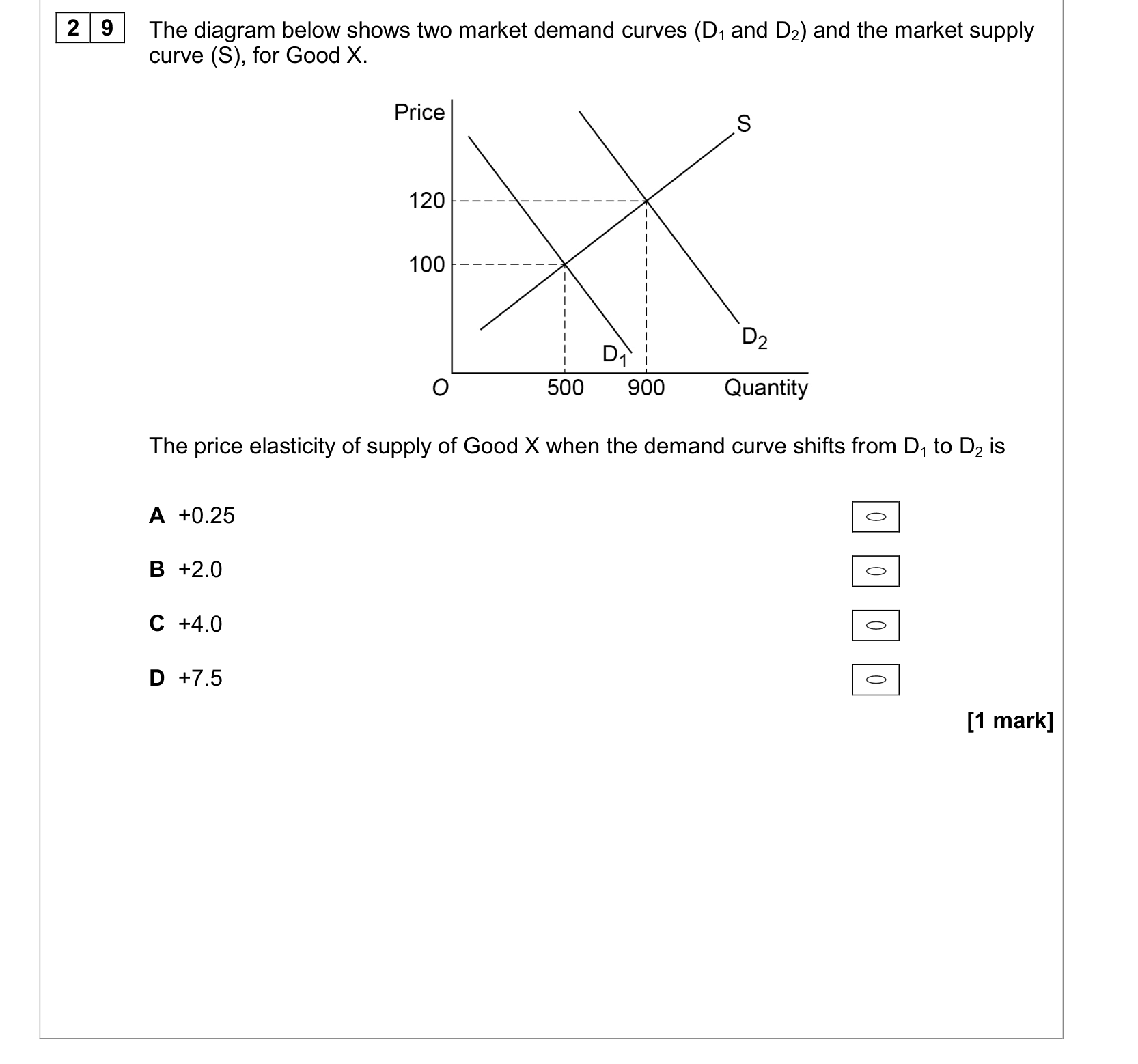
Answer: C.
Question 2
Table 3 shows the demand for and supply of oranges at a range of prices between 10 pence and 30 pence. Table 3 Price (pence) Quantity supplied (000s) Quantity demanded (000s) 10 100 125 15 120 120 20 122 108 25 125 100 30 128 88 As a result of an increase in consumers’ incomes, the demand for oranges increases by 25% at each of the prices shown in Table 3. After the rise in incomes:
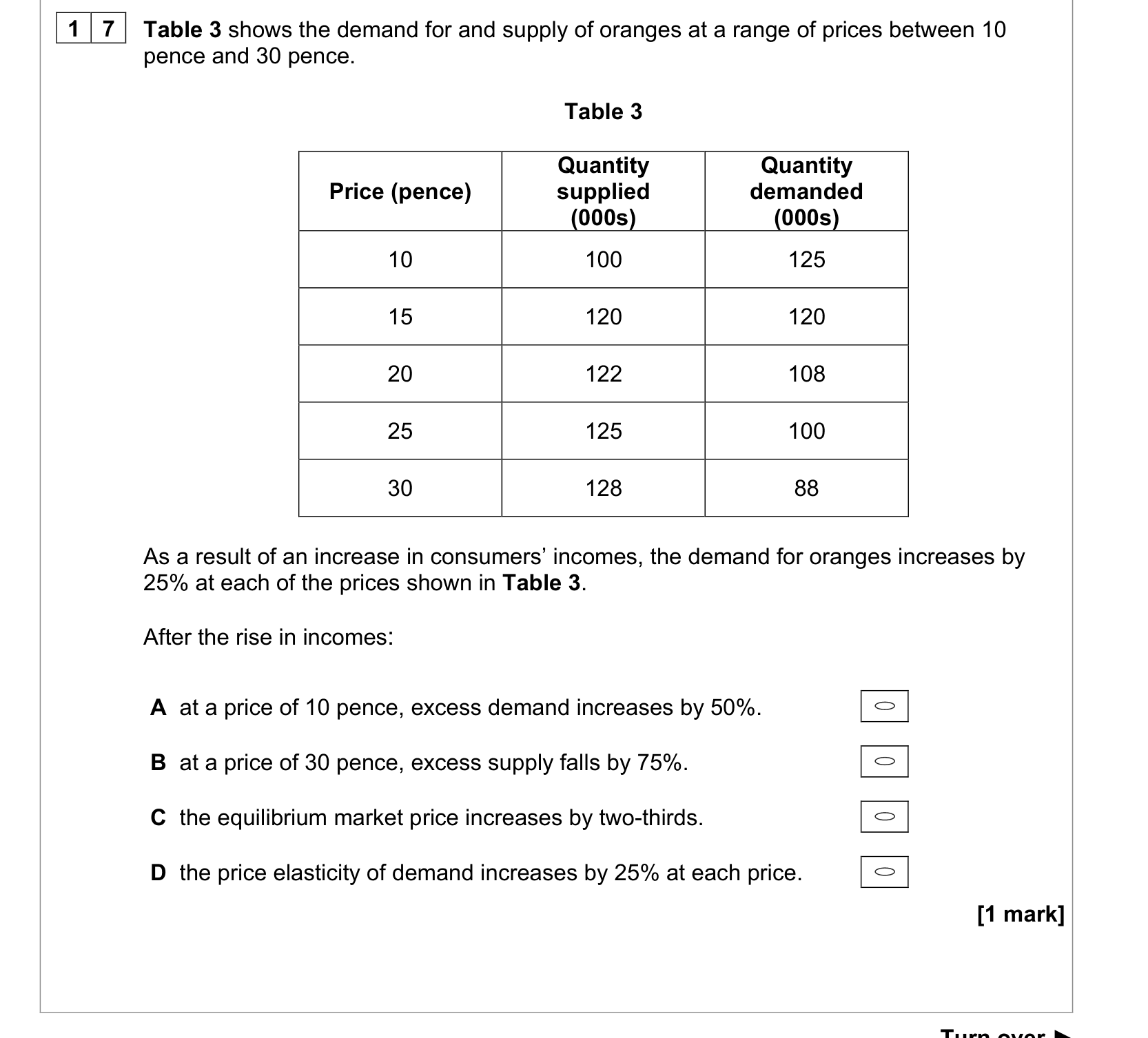
Answer: C.
What the syllabus asks for on this topicSpecification points
Specification points
- The determination of equilibrium market prices.
- The functions of the price mechanism: rationing, incentive and signalling.
- How markets and prices allocate resources.
Related AQA A-Level topics
Not the topic you were looking for? Describe what you are stuck on in your own words and we will take you to the notes that answer it.