Supply-Side Policies
Contents: 10 sections
What supply-side policy is
Supply-side policies aim to increase the economy's productive potential by raising the quantity or quality of the factors of production, or the efficiency with which they are used. They shift LRAS to the right and the PPF outward.
This is the decisive contrast with demand-side policy:
| Demand-side (9.1, 9.2) | Supply-side | |
|---|---|---|
| Targets | AD | LRAS |
| Effect on the price level | Expansion raises it | Lowers it |
| Speed | Months | Years |
| Tackles | Cyclical unemployment | Structural unemployment and the natural rate |
| Sustainable? | Temporary without capacity growth | Raises the trend growth rate |
Supply-side policy is the only category that can raise output and reduce inflation simultaneously, because it increases what the economy is capable of producing. That single property is why it can relax several policy conflicts at once (8.1).
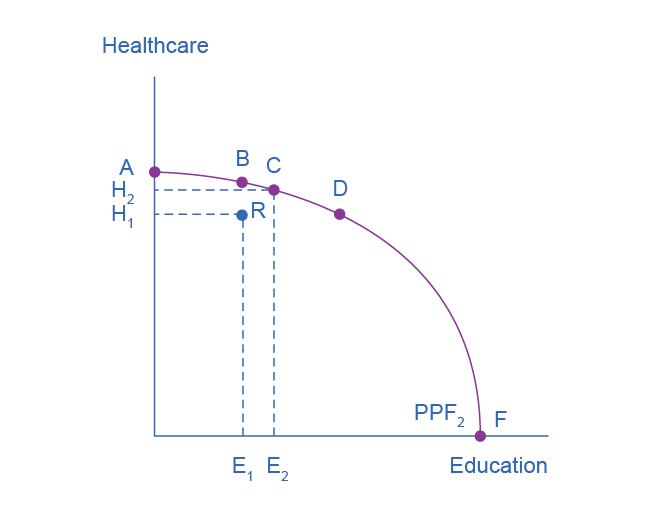
Successful supply-side policy shifts the whole frontier outward. That is the diagram to draw, and it is the one that distinguishes this topic from demand-side policy: moving from a point inside the curve back onto it is a recovery using idle resources, not an increase in capacity, and drawing that instead concedes the entire argument.
The tax-cut argument, examined rather than assumed. Market-based supply-side policy usually rests on the claim that lower income tax raises work effort. It has two opposing effects:
- The substitution effect makes an extra hour more rewarding relative to leisure, encouraging work.
- The income effect means the same take-home pay can be earned in fewer hours, encouraging less work.
Which dominates is an empirical question, not a theoretical one. So "tax cuts increase the labour supply" is an assumption to be tested, and saying so is the evaluation AQA is looking for, not a hedge.
Market-based policies
These aim to remove obstacles to the free operation of markets and sharpen incentives.
Labour market:
- Cutting income tax and national insurance: raises the return to work, encouraging participation and hours.
- Reducing unemployment and out-of-work benefits: widens the gap between benefits and wages, sharpening the incentive to take a job.
- Reducing trade union power: more flexible wage-setting and working practices.
- Reducing employment protection: cheaper hiring and firing, so firms take on more workers.
Product and capital markets:
- Privatisation: transferring state-owned firms to private ownership, on the argument that the profit motive drives efficiency and reduces X-inefficiency (4.1).
- Deregulation: removing barriers to entry so markets become more contestable (4.2).
- Competition policy: preventing abuse of market power.
- Trade liberalisation: exposing domestic firms to international competition.
- Cutting corporation tax: raising post-tax returns to investment.
- Financial deregulation: improving access to capital for firms.
Interventionist policies
These involve the government acting directly, on the grounds that markets under-provide certain things because of positive externalities and long payback periods.
- Education and training: the single most important, raising human capital, productivity and occupational mobility.
- Infrastructure investment: transport, energy, broadband. Lowers costs for every firm and generates large positive externalities.
- Subsidies and tax credits for R&D, addressing the under-provision of innovation.
- Regional policy: grants and relocation assistance to address geographical immobility.
- Industrial strategy: targeted support for strategic sectors.
- Immigration policy: expanding the labour force and filling skills gaps.
- Childcare provision, raising labour force participation.
The ideological divide is examinable in itself: market-based policies rely on incentives and tend to increase inequality (benefit cuts and weaker employment protection fall on the low-paid); interventionist policies require government spending with an opportunity cost and risk government failure (5.2), but tend to reduce inequality by raising the skills of those at the bottom.
Effects on the macroeconomy
| Objective | Effect | Mechanism |
|---|---|---|
| Economic growth | Improves | LRAS shifts right, raising the sustainable trend rate |
| Inflation | Improves | Greater capacity and lower unit costs reduce price pressure |
| Unemployment | Improves | Tackles structural unemployment by fixing the skills and mobility mismatch; lowers the natural rate |
| Balance of payments | Improves | Higher productivity and quality raise price and non-price competitiveness, so exports rise |
| Government budget | Mixed | Interventionist policies cost money up front, but higher growth raises revenue later |
| Income distribution | Mixed | Education and training reduce inequality; benefit cuts and weaker union power increase it |
Limitations
- Very long time lags. Education takes a generation to work through the workforce. Supply-side policy is no answer to a recession that needs a response this year.
- Cost and opportunity cost: interventionist measures are expensive.
- Uncertain effectiveness: whether tax cuts actually increase work effort is empirically contested; income and substitution effects pull in opposite directions.
- No help against a demand-deficient recession. Raising capacity is pointless when existing capacity is idle for lack of demand. Indeed, expanding LRAS when AD is the binding constraint does nothing at all.
- Equity effects of market-based measures.
- Government failure: the state may pick the wrong sectors or misallocate the spending.
- Privatisation may simply convert a public monopoly into a private one.
Worked example
An economy has persistent structural unemployment: a declining manufacturing region where workers' skills no longer match vacancies in growing service sectors elsewhere.
Why demand-side policy fails here:
- Fiscal or monetary expansion raises AD
- but the unemployed lack the skills the vacancies require and live in the wrong region
- vacancies remain unfilled while unemployment persists
- so the extra demand pushes up prices rather than output. The economy is already at its natural rate; the problem is a mismatch, not a shortage of demand.
The interventionist supply-side response:
- A government-funded retraining programme teaches these workers the skills service employers need
- occupational mobility improves
- the mismatch narrows
- structural unemployment falls
- the natural rate of unemployment falls
- the effective labour supply rises
- LRAS shifts right
- output can rise without inflationary pressure, and the long-run Phillips curve shifts left.
Pairing it with relocation assistance addresses geographical immobility, and infrastructure investment in the region raises the returns to staying.
Evaluation.
- Time lags are the central weakness: retraining takes years, during which unemployment and its hysteresis effects continue.
- It is expensive, with an opportunity cost in other public spending, and the benefit accrues over decades while the cost is immediate.
- It may fail if the training does not match actual employer demand, which is a form of government failure. Involving employers in designing the courses mitigates this.
- Workers may still be unable to afford to move to where the jobs are, so training alone is insufficient.
- The market-based alternative: cutting benefits to sharpen incentives, is cheaper and works faster, but does nothing about the skills gap itself and causes real hardship, worsening inequality. It moves people into low-paid work rather than into the vacancies that exist.
- Supply-side policy raises capacity, but if AD does not also grow, the extra capacity goes unused. The policies are complements.
Judgement: for structural unemployment, supply-side policy is the only category that addresses the actual cause, and the interventionist version does so more durably than the market-based one. Its weakness is speed, which argues for using it alongside, not instead of, demand management during the transition.
Common exam mistakes
- Confusing supply-side policy with fiscal policy. Both involve tax changes; the difference is whether the target is AD or LRAS.
- Claiming supply-side policy fixes a recession quickly, its lags are the longest of any policy.
- Shifting AD instead of LRAS on the diagram.
- Listing measures without explaining how each raises productive capacity.
- Ignoring the equity effects of market-based measures.
- Saying privatisation always improves efficiency, without the private-monopoly risk.
- Forgetting that supply-side policy is ineffective when the binding constraint is deficient demand.
Exam technique
Draw LRAS shifting right and comment on the result: higher output and a lower price level. Showing that combination is the clearest way to demonstrate why supply-side policy is distinctive.
Classify each measure as market-based or interventionist and give the mechanism: "training raises workers' skills, so output per worker rises, so the economy can produce more at any price level."
For evaluation, use time lags, cost and opportunity cost, equity effects, government failure, and, the strongest point, the fact that supply-side policy is useless when the economy is demand-constrained. Conclude that supply-side and demand-side policies are complements.
Quick revision
- Supply-side policy raises productive potential; shifts LRAS right and the PPF outward.
- Uniquely, it raises output and lowers the price level.
- Market-based: tax cuts, benefit reform, weaker unions, privatisation, deregulation, trade liberalisation.
- Interventionist: education and training, infrastructure, R&D support, regional policy, industrial strategy, childcare.
- Tackles structural unemployment and lowers the natural rate, which demand policy cannot.
- Improves growth, inflation, unemployment and competitiveness together.
- Limits: very long lags, cost, uncertainty, equity effects, government failure.
- Ineffective when the constraint is deficient demand, the two policy types are complements.
What the syllabus asks for on this topicSpecification points
Specification points
- Market-based and interventionist supply-side policies.
- The effects of supply-side policies on the macroeconomy.
Related AQA A-Level topics
Not the topic you were looking for? Describe what you are stuck on in your own words and we will take you to the notes that answer it.