Economic Growth and the Economic Cycle
Contents: 10 sections
Measuring economic growth
Economic growth is an increase in real output, measured by the percentage change in real GDP.
| Measure | What it is | Why it matters |
|---|---|---|
| Nominal GDP | Output valued at current prices | Rises with inflation even if output is unchanged |
| Real GDP | Output valued at constant prices | Strips out inflation: the only valid growth measure |
| GDP per capita | Real GDP ÷ population | The measure relevant to living standards |
| GNI | GDP plus net income from abroad | Better for countries with large remittance or profit flows |
| PPP-adjusted | Corrected for price-level differences | Needed for international comparisons |
Two distinctions AQA tests directly:
- Actual growth: an increase in real output, moving the economy towards or along the PPF. It can come from raising aggregate demand when spare capacity exists.
- Potential (trend) growth: an increase in the economy's productive capacity, shifting the PPF and LRAS outward. It requires more or better factors of production.
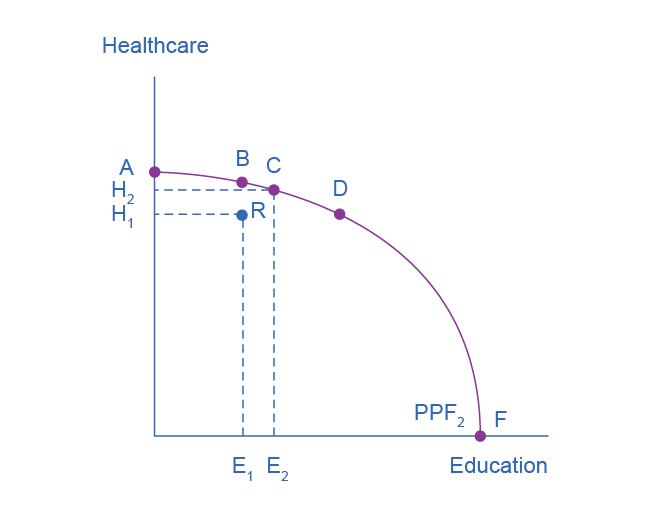
The frontier makes the difference unmistakable: moving from a point inside the curve towards it is actual growth using idle resources, while shifting the whole curve outward is potential growth. Drawing the first when a question asks for the second is the single most common error here.
Working the numbers
Real growth from nominal. Nominal GDP rises from £1,800bn to £1,890bn while the price index rises from 100 to 104.
Real GDP now = (1,890 ÷ 104) × 100 = £1,817.3bn
Real growth = (1,817.3 − 1,800) ÷ 1,800 × 100 = 1.0%
Nominal growth was 5%; real growth was 1.0%. Four-fifths of the headline was inflation.
Per capita. With population growth of 0.6%:
Real GDP per capita growth ≈ 1.0% − 0.6% = 0.4%
Barely any improvement in average living standards, from a figure that looked like 5%. Doing both steps, deflate, then subtract population, is what the data-response question is testing.
Only potential growth is sustainable indefinitely. Actual growth beyond capacity produces inflation, not lasting output.
Determinants of potential growth: investment in physical capital, the size and skill of the labour force, technological progress, the discovery of resources, and institutional quality.
The economic cycle
The economic cycle is the fluctuation of actual output around the underlying trend.
| Phase | Characteristics |
|---|---|
| Boom | Output above trend, low unemployment, rising inflation, high confidence, current account often deteriorating |
| Downturn | Growth slowing, confidence falling, investment postponed |
| Recession | Two consecutive quarters of negative real GDP growth; rising unemployment, falling inflation, spare capacity |
| Recovery | Growth resuming, unemployment falling, confidence returning |
Causes of the cycle: swings in confidence ("animal spirits") driving consumption and investment; the multiplier and accelerator interacting (7.1); credit cycles; external shocks such as oil prices or pandemics; and policy errors.
The output gap
The output gap is the difference between actual and potential output.
- Negative output gap: actual output is below potential. Spare capacity, unemployment above its natural rate, downward pressure on inflation. This is a recession.
- Positive output gap: actual output is above potential. The economy is running beyond its sustainable capacity, with labour and material shortages and demand-pull inflationary pressure.
The output gap is the key diagnostic for policy: a negative gap calls for demand stimulus, while a positive gap calls for restraint. Its practical weakness is that potential output cannot be observed; it is estimated, and estimates are revised substantially after the event, which is a serious evaluation point against fine-tuning.
Benefits of growth
- Higher incomes and living standards, and materially more goods and services per person.
- Employment rises as firms expand.
- Higher tax revenue at unchanged tax rates, funding healthcare, education and infrastructure, and reducing the budget deficit.
- Lower absolute poverty; growth is historically the main driver of poverty reduction.
- Investment and dynamic efficiency: profitable firms invest, raising future capacity, a virtuous circle.
- Growth can fund environmental protection; richer countries can afford cleaner technology.
Costs of growth
- Inflation, if demand grows faster than capacity (a positive output gap).
- Environmental damage: pollution, congestion and resource depletion, which are negative externalities (5.1).
- Resource depletion, particularly of non-renewables, imposing costs on future generations.
- Inequality may widen if the gains accrue to capital owners and the highly skilled.
- Current account deficit, as rising incomes pull in imports.
- Structural unemployment, since growth is disruptive: new industries displace old ones, and workers' skills do not transfer (6.2).
- Opportunity cost: growth through investment requires forgoing present consumption (1.1).
Sustainable growth is growth that meets present needs without compromising the ability of future generations to meet theirs. The distinction between growth that depletes natural capital and growth built on productivity is the strongest evaluative frame here.
Worked example
An economy has been in recession, with a negative output gap of 3% and unemployment well above its natural rate. The government raises spending on infrastructure.
- Higher government spending raises AD
- because there is substantial spare capacity, firms respond by raising output rather than prices
- real GDP rises and unemployment falls
- the multiplier amplifies the initial injection as the newly employed spend their incomes (7.1)
- the negative output gap closes, with only modest inflation.
- The infrastructure itself raises productive capacity
- LRAS shifts right
- so the policy delivers actual growth now and potential growth later.
Evaluation.
- The outcome depends critically on the size of the output gap. If the gap were smaller than believed, and estimates are unreliable, the same stimulus would be largely inflationary rather than expansionary.
- Time lags are long. Infrastructure takes years to plan and build, so the demand stimulus may arrive after the recovery has begun, adding to demand in a boom.
- The spending must be financed: higher borrowing raises the deficit and, in the long run, debt interest. If it causes crowding out by raising interest rates, private investment falls and the net effect is smaller.
- The multiplier's size is uncertain and is reduced by leakages into saving, taxation and imports, the more open the economy, the smaller the multiplier.
- Whether growth is sustainable depends on what is built: transport and broadband raise long-run capacity; projects with no productive return raise debt without raising LRAS.
Judgement: with a genuine negative output gap, demand stimulus raises output at little inflationary cost, and capacity-raising spending is the best form of it. The risks are lags and the unreliability of the output gap estimate itself.
Common exam mistakes
- Using nominal GDP to discuss growth. Always specify real.
- Confusing actual growth (towards the PPF) with potential growth (shifting the PPF).
- Saying negative growth means a recession, a recession requires two consecutive quarters.
- Getting the output gap sign backwards. Negative = spare capacity; positive = overheating.
- Saying growth always raises living standards, ignoring population growth (use per capita) and distribution.
- Treating growth as automatically unsustainable, without distinguishing productivity-driven growth from resource depletion.
Exam technique
Use an AD/AS diagram for any growth question. Show a rightward AD shift for actual growth and a rightward LRAS shift for potential growth, the two carry different implications for the price level, and showing both is what separates good answers.
Anchor every judgement in the output gap: the same policy has opposite effects depending on whether there is spare capacity.
For "are the benefits of growth greater than the costs", organise by stakeholder, households, firms, government, future generations, the environment, and conclude on sustainability and distribution rather than on growth in the abstract.
Quick revision
- Growth = % change in real GDP; use per capita for living standards and PPP for comparisons.
- Actual growth moves output towards the PPF; potential growth shifts it out.
- Cycle: boom → downturn → recession (two consecutive quarters of negative growth) → recovery.
- Negative output gap = spare capacity, deflationary pressure. Positive = overheating, demand-pull inflation.
- Potential output is estimated, not observed, a key limitation.
- Benefits: incomes, employment, tax revenue, lower poverty, investment.
- Costs: inflation, environmental damage, resource depletion, inequality, current account deficit, structural unemployment.
- Sustainable growth meets present needs without compromising future generations.
What the syllabus asks for on this topicSpecification points
Specification points
- The measurement of economic growth; real and nominal GDP, GDP per capita.
- The economic cycle and the output gap.
- The costs and benefits of growth.
Related AQA A-Level topics
Not the topic you were looking for? Describe what you are stuck on in your own words and we will take you to the notes that answer it.