Economic Growth and Development
Contents: 10 sections
Growth and development are not the same
| Economic growth | Economic development | |
|---|---|---|
| Definition | An increase in real GDP | An improvement in welfare and quality of life |
| Nature | Quantitative | Qualitative and quantitative |
| Measured by | Real GDP, real GDP per capita | HDI, literacy, life expectancy, poverty rates, access to clean water and sanitation |
Growth usually enables development, by raising incomes and the tax revenue that funds schools and hospitals. But growth without development is entirely possible: where the gains from a resource boom accrue to a small elite or to foreign investors, GDP rises while most people's lives do not improve. Opening with this distinction frames every answer in this topic.
Measures of development
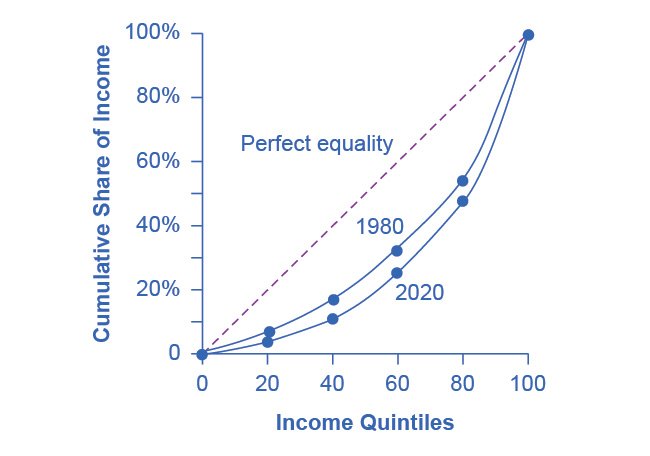
Distribution is the first thing any average conceals, and the Lorenz curve is how it is shown: cumulative income share against cumulative population, ranked poorest first. The 45° line is perfect equality, and the further the curve bows away from it, the more unequal the distribution. The Gini coefficient compresses that gap into a number from 0 to 1, where higher means more unequal.
Two countries can share an identical GDP per capita and sit far apart on this diagram, which is precisely why development is measured with more than one indicator.
GDP per capita is the starting point but a poor welfare measure. It ignores distribution (it is an average), unpaid work and the informal economy, the composition of output, externalities such as pollution, and leisure, and international comparisons need PPP adjustment.
The Human Development Index combines three dimensions into a single figure between 0 and 1:
| Dimension | Indicator |
|---|---|
| A long and healthy life | Life expectancy at birth |
| Knowledge | Mean years of schooling and expected years of schooling |
| A decent standard of living | GNI per capita (PPP-adjusted) |
Strengths: broader than income alone; captures the outcomes income is supposed to buy; comparable across countries and over time; and two countries with similar income can have very different HDI, revealing how effectively income is converted into wellbeing.
Limitations: still an average, so it hides inequality within a country; ignores the environment and sustainability; ignores political freedom, human rights and safety; ignores gender inequality unless a separate index is used; and data quality varies.
Other indicators: the Gini coefficient and Lorenz curve for inequality; the Multidimensional Poverty Index; infant and maternal mortality; access to clean water and sanitation; the Inequality-adjusted HDI; and the Gender Inequality Index. Using several indicators together is a reliable concluding recommendation.
Barriers to growth and development
- The savings gap. Poor households cannot save → little domestic capital for firms to borrow → low investment → low productivity → low income → still no saving. This is the Harrod–Domar logic and the poverty cycle at national level.
- Low human capital: poor education and health, so productivity stays low.
- Poor infrastructure: unreliable power, poor roads and ports raise firms' costs and deter investment.
- Rapid population growth, so output per head barely rises even when total output does.
- Primary product dependency: volatile world prices, income-inelastic demand, and a long-run tendency for the terms of trade to deteriorate against primary producers (the Prebisch–Singer hypothesis).
- Debt, where servicing costs absorb revenue that could fund development.
- Corruption, weak institutions and political instability, which deter investment and misdirect resources.
- Weak property rights and rule of law, so entrepreneurs cannot rely on contracts.
- Capital flight and the brain drain of skilled workers.
- Geography: landlocked status, drought, disease burden.
- Trade barriers in developed countries restricting market access.
Strategies for development
| Strategy | Mechanism | Drawbacks |
|---|---|---|
| Foreign direct investment | Brings capital, technology, jobs and management skills | Profits repatriated; MNCs may exploit weak standards and can leave |
| Aid | Fills the savings gap; funds infrastructure and health | Dependency; may be tied or misappropriated; can distort local markets |
| Debt relief | Frees revenue for development spending | Moral hazard; does nothing about the underlying causes |
| Investment in education and health | Raises human capital and productivity; attacks the root cause | Very slow: a generation; expensive |
| Infrastructure investment | Lowers costs for all firms; large positive externalities | High upfront cost; risk of corruption in procurement |
| Diversification | Reduces exposure to primary price volatility; raises value added | Needs skills and capital the country may lack; takes years |
| Microfinance | Credit for small enterprises where banks will not lend | Small scale; high interest rates |
| Trade liberalisation / export-led growth | Access to world markets and economies of scale | Vulnerable to world demand; may expose infant industries |
| Import substitution | Protects domestic industry to build capacity | Inefficiency; retaliation; historically poor results |
| Institutional reform | Property rights, anti-corruption, rule of law | Politically difficult; slow |
| Tourism | Foreign exchange, employment | Seasonal, low-skilled, environmentally damaging, volatile |
Market-led versus state-led development is the underlying debate. Market-led strategies (FDI, liberalisation, deregulation) mobilise private capital but risk inequality and volatility; state-led strategies (industrial policy, public investment) can address market failure directly but risk government failure and corruption. The successful East Asian economies used both.
Working the numbers
GNI per capita, and why the denominator matters. A country's GNI is $96bn with a population of 32m.
GNI per capita = 96,000 ÷ 32 = $3,000
If GNI grows 4% while population grows 2.5%:
GNI per capita growth ≈ 4.0 − 2.5 = 1.5%
Total income rose by nearly twice as much as income per person. Where population grows faster than GNI, income per head falls even as the economy expands, the situation of several low-income countries, and the reason development is measured per capita.
GDP against GNI. If foreign-owned firms repatriate $8bn of profit while residents abroad send home $3bn:
GNI = GDP − 8 + 3, so GNI is $5bn below GDP
A country whose growth comes from foreign-owned extraction can therefore post strong GDP while its residents' income lags, which is exactly the criticism made of FDI-led development, and it is visible only if you use the right measure.
Reading a Lorenz curve. A point at (40, 14) means the poorest 40% of households receive 14% of total income. Always cumulative, always poorest-first. The further the curve bows from the 45° line, the more unequal the distribution; the Gini coefficient compresses that gap into a figure from 0 to 1, where higher is more unequal.
Note that two Lorenz curves which cross cannot be ranked: one country may be more unequal at the bottom and the other at the top. A single Gini number hides that, which is a limitation worth stating rather than a detail.
Worked example
A low-income country depends on exporting a single primary commodity.
- Its export earnings depend on one volatile world price
- demand for primary products is income-inelastic, so earnings do not rise with world growth
- and supply is price-inelastic in the short run, so price swings are severe
- export revenue and government revenue are therefore unpredictable
- planning long-term investment in schools and hospitals becomes impossible
- development stalls.
Compounding this, the terms of trade tend to move against primary producers over time (Prebisch–Singer), so a given volume of exports buys progressively fewer imported manufactures.
Strategy 1, attract FDI into manufacturing.
- FDI brings capital, technology and management skills the country lacks
- employment and incomes rise
- workers acquire transferable skills
- export earnings diversify
- the savings gap is partly filled without borrowing.
But: profits are repatriated rather than reinvested; MNCs may use transfer pricing to minimise tax; jobs may be low-skilled with managers brought in from abroad; and the firm can relocate if conditions change elsewhere, leaving the country exposed again.
Strategy 2, invest in education and infrastructure.
- Human capital and productivity rise
- firms can produce higher-value goods
- diversification becomes feasible on the country's own terms
- the gains are retained domestically and are durable.
But: the payoff is a generation away, the cost is large relative to the tax base, and the money must come from borrowing or aid, both of which carry their own problems.
Evaluation.
- The two strategies are complements: FDI is far more likely to arrive, and to bring higher-value activity, where the workforce is educated and the infrastructure works. Education without capital produces emigration; capital without education produces low-skilled assembly work.
- Institutions are the binding constraint in many cases. Without property rights and control of corruption, neither investment nor aid translates into development.
- Diversification is the real long-run solution, but it must be financed and staffed, which is why the sequencing matters.
Judgement: no single strategy is sufficient. The defensible package is institutional reform to make investment safe, education and infrastructure to raise capacity, and FDI to supply the capital in the interim, with diversification as the objective rather than the starting point.
Common exam mistakes
- Treating growth and development as the same thing.
- Using GDP per capita as a development measure without listing its limitations.
- Naming only two HDI components, or citing GDP rather than GNI per capita at PPP.
- Listing barriers without a mechanism. Say why each holds development back.
- Presenting FDI or aid as unambiguously good, without repatriated profits or dependency.
- Ignoring population growth when comparing living standards.
- Treating all developing countries as alike.
Exam technique
Open by distinguishing growth from development, it frames everything and is frequently worth marks in itself.
Group barriers into economic (savings gap, primary dependency, debt), social, education, health, population growth, and institutional/political (corruption, property rights, instability). Three grouped headings beat a list.
For strategies, evaluate on time horizon, who captures the gains, and feasibility given the country's constraints. Conclude that strategies are complements and that institutions often determine whether any of them work; that is the highest-level judgement available.
Quick revision
- Growth = more real GDP. Development = better living standards. Growth without development is possible.
- GDP per capita ignores distribution, unpaid work, the informal economy, externalities and leisure; needs PPP.
- HDI = life expectancy + schooling (mean and expected) + GNI per capita at PPP, scored 0–1.
- HDI ignores inequality, the environment, political freedom and gender.
- Barriers: savings gap, low human capital, poor infrastructure, population growth, primary product dependency, debt, corruption, weak institutions, capital flight, brain drain.
- Prebisch–Singer: the terms of trade tend to move against primary producers.
- Strategies: FDI, aid, debt relief, education, infrastructure, diversification, microfinance, trade liberalisation, institutional reform.
- Judge strategies on time horizon, who captures the gains, and institutional capacity.
Check you have it
Question 1
Which one of the following is a role of the World Trade Organisation?
Answer: A.
The other options are incorrect as they describe the functions of different international organisations. Lending money to countries experiencing balance of payments problems (B) and monitoring the stability of the international monetary system (C) are the primary responsibilities of the International Monetary Fund (IMF). Meanwhile, providing low-interest loans to low-income countries (D) for development projects is the main function of the World Bank. While these institutions often work together, they have distinct mandates, and only the WTO focuses specifically on regulating and arbitrating international trade rules.
What the syllabus asks for on this topicSpecification points
Specification points
- The difference between economic growth and development.
- Measures of development, including the Human Development Index.
- Factors and strategies influencing growth and development.
Related AQA A-Level topics
Not the topic you were looking for? Describe what you are stuck on in your own words and we will take you to the notes that answer it.