Exchange Rates and the Balance of Payments
Contents: 11 sections
Exchange rate systems
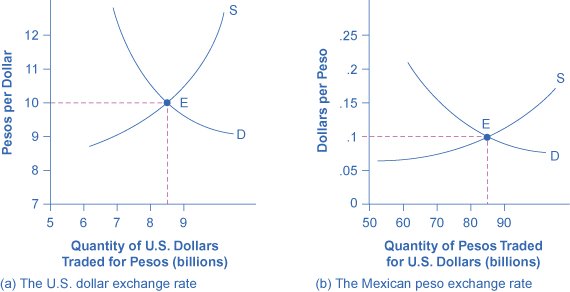
The exchange rate is the price of one currency in terms of another.
| System | How it works | Terms used |
|---|---|---|
| Floating | Set by demand and supply in the foreign exchange market | Appreciation / depreciation |
| Fixed | The central bank maintains a set rate using reserves and interest rates | Revaluation / devaluation |
| Managed float | Mainly market-determined, with occasional intervention | Both, depending on the cause |
Using "devaluation" for a market-driven fall is the most common terminology error in this topic.
Floating rates give monetary policy independence, the central bank can set interest rates for domestic conditions, and provide automatic adjustment of the current account. The cost is volatility, which creates uncertainty for traders and investors.
Fixed rates give certainty for trade and investment and impose discipline on inflation, but require large reserves, sacrifice monetary policy independence (rates must be set to defend the peg), and are vulnerable to speculative attack.
Determination of a floating rate
The rate settles where demand for the currency equals supply.
Demand for the currency comes from: foreigners buying exports; inward foreign direct investment; speculators expecting appreciation; and inbound tourism.
Supply of the currency comes from: residents buying imports; outward investment; and outbound tourism.
Causes of movement:
| Change | Effect |
|---|---|
| Exports rise | Appreciation |
| Imports rise | Depreciation |
| Domestic interest rates rise | Appreciation: "hot money" inflows |
| Domestic inflation above trading partners' | Depreciation: competitiveness falls |
| Inward FDI rises | Appreciation |
| Speculation on a rise | Appreciation, and it can be self-fulfilling |
| Central bank buys its own currency | Appreciation |
Speculation deserves emphasis: daily foreign exchange turnover vastly exceeds the value of trade, so short-run movements are driven far more by capital flows and expectations than by trade fundamentals.
Effects of exchange rate changes
A depreciation: exports cheaper abroad, imports dearer at home.
- Domestic goods cost less in foreign currency
- export volumes rise
- foreign goods cost more at home
- import volumes fall
- net exports rise
- AD shifts right
- output and employment rise
- and the current account improves.
But two offsetting effects must be included:
- Imported inflation. Imported raw materials, components and energy all cost more → SRAS shifts left → cost-push inflation (6.2). The competitiveness gain erodes over time as domestic costs rise.
- The Marshall–Lerner condition. The current account only improves if PEDx + PEDm > 1, the combined price elasticities of demand for exports and imports must exceed one. If demand is inelastic in the short run, the higher cost of the same volume of imports worsens the current account initially.
The J-curve follows directly: after a depreciation the current account first deteriorates, because contracts are fixed and consumers take time to switch, then improves as elasticities rise over time. Naming the J-curve and Marshall–Lerner together is the highest-value analysis in this topic.
An appreciation is the mirror image: exports dearer, imports cheaper, so net exports and AD fall, output and employment in export sectors fall, but imported inflation eases and the cost of imported inputs falls, shifting SRAS right.
SPICED, Stronger Pound, Imports Cheaper, Exports Dearer.
The balance of payments
The balance of payments records all transactions with the rest of the world and always balances overall, because a current account deficit must be financed by a surplus on the financial account.
- Current account: trade in goods, trade in services, primary income (profits, interest, dividends, wages), secondary income (transfers, aid, remittances).
- Capital account: small; transfers of capital assets.
- Financial account: FDI, portfolio investment, and reserve movements.
A current account deficit is financed by a financial account surplus: the country sells assets or borrows from abroad.
Causes of a deficit: loss of international competitiveness, a strong exchange rate, strong domestic growth pulling in imports, a narrow export base, and structural decline in exporting industries.
Consequences: a leakage from the circular flow reducing AD and employment; the accumulation of foreign liabilities and future income outflows; downward pressure on the currency, which is partly self-correcting; and, if severe, loss of confidence.
But the significance depends on the cause. A deficit financed by inward FDI, or caused by importing capital goods that raise future capacity, differs fundamentally from one funding consumption on borrowed money.
International competitiveness
- Price competitiveness: relative unit labour costs, relative inflation, the exchange rate, taxation, energy costs.
- Non-price competitiveness: quality, design, reliability, branding, after-sales service, delivery times, innovation.
Improving it: raising productivity is the fundamental answer, since it lowers unit costs without lowering wages. Investment in skills, infrastructure and R&D, plus competition policy, are the durable measures, all supply-side (9.3). A depreciation improves competitiveness immediately but does not raise productivity, so its effect erodes.
Working the numbers
Converting at an exchange rate, which decides who gains from a movement.
Sterling depreciates from $1.50 to $1.20.
For an exporter: a good priced at £200 cost an American buyer 200 × 1.50 = $300 before, and now costs 200 × 1.20 = $240, a 20% fall in its dollar price, so it is more competitive.
For an importer: a component invoiced at $600 cost 600 ÷ 1.50 = £400 before, and now costs 600 ÷ 1.20 = £500, a 25% rise in sterling cost, feeding straight into cost-push inflation.
Note the asymmetry: the same depreciation cuts the export price by 20% while raising the import cost by 25%. That is arithmetic, not opinion, and it is why a depreciation is never simply good news.
Whether it improves the current account depends on the Marshall–Lerner condition:
The balance improves only if PEDexports + PEDimports > 1
If PEDx = 0.4 and PEDm = 0.5, the sum is 0.9, below 1, so the deficit widens: volumes barely move while the import bill rises immediately. Over time elasticities rise above the threshold and the balance improves, tracing the J-curve. Judging a depreciation on its first quarter is therefore a mistake.
Reading the balance of payments. In billions: goods −60, services +28, primary income −9, secondary income +6.
Current account = −60 + 28 − 9 + 6 = −£35bn
By the identity, the capital and financial accounts must show +£35bn, the country is a net seller of assets or net borrower by exactly that amount. A deficit is not merely a shortfall; it is financed, and how it is financed is the analysis.
Worked example
A country's currency depreciates by 15% against its trading partners.
- Exports are 15% cheaper in foreign currency
- export demand rises
- imports are 15% dearer
- import demand falls
- net exports rise
- AD shifts right
- output and employment rise, and the current account improves.
The complications, which the question is really testing:
- In the short run, PEDx + PEDm is likely to be less than 1: contracts are already signed, supply chains cannot be reconfigured quickly, and consumers take time to switch. The Marshall–Lerner condition fails, so the current account worsens initially: the same volume of imports simply costs more. Over time, as elasticities rise, it improves, the J-curve.
- Imported inflation: energy, food and components all cost more → SRAS shifts left → cost-push inflation. If workers secure compensating wage rises, unit labour costs rise and the competitiveness gain is fully eroded within a few years.
- The distributional effect is uneven: exporters and domestic producers competing with imports gain; importers, and consumers of imported necessities, lose.
- If the economy is near full capacity, the AD increase raises the price level rather than output.
Evaluation.
- The gain is temporary unless productivity improves. A depreciation buys competitiveness; it does not create it.
- It may reduce the pressure on firms to become efficient, weakening long-run competitiveness, a moral hazard argument.
- If the depreciation was caused by a loss of confidence; it may overshoot and become destabilising, raising the cost of servicing foreign-currency debt.
Judgement: a depreciation improves the current account only if the Marshall–Lerner condition holds, and only durably if the inflationary consequences are contained. It is a short-run adjustment mechanism, not a substitute for the supply-side measures that raise productivity.
Common exam mistakes
- Using devaluation for a market-driven fall; that is depreciation.
- Asserting a depreciation improves the current account without the Marshall–Lerner condition.
- Omitting imported inflation and the leftward SRAS shift.
- Saying the balance of payments does not balance; it always does; it is the current account that can be in deficit.
- Treating a current account deficit as automatically harmful, without asking about the cause and how it is financed.
- Confusing demand for and supply of the currency, imports supply the domestic currency.
- Discussing competitiveness only in price terms, ignoring non-price factors.
Exam technique
Use a foreign exchange demand-and-supply diagram for exchange rate determination, and an AD/AS diagram for the macro consequences, a depreciation shifts AD right and SRAS left, and showing both is what distinguishes a top answer.
Name Marshall–Lerner and the J-curve whenever a depreciation and the current account are involved. They are the two pieces of technical apparatus the examiner is looking for.
For evaluation, use elasticities and the time period, imported inflation, the cause of any deficit, and the distinction between a depreciation (temporary) and productivity growth (durable).
Quick revision
- Floating: appreciation/depreciation, set by demand and supply. Fixed: revaluation/devaluation, maintained with reserves.
- Demand for the currency: exports, FDI, speculation. Supply: imports, outward investment.
- Higher interest rates → appreciation. Higher relative inflation → depreciation.
- SPICED: Strong Pound, Imports Cheaper, Exports Dearer.
- Depreciation → AD right, but also SRAS left through imported input costs.
- Marshall–Lerner: the current account improves only if PEDx + PEDm > 1.
- J-curve: the current account worsens before it improves.
- Balance of payments always balances; a current account deficit is financed on the financial account.
- Competitiveness: price, unit labour costs, inflation, exchange rate, and non-price (quality, design, reliability). Productivity is the durable route.
Check you have it
Question 1
Which one of the following is a role of the World Trade Organisation?
Answer: A.
The other options are incorrect as they describe the functions of different international organisations. Lending money to countries experiencing balance of payments problems (B) and monitoring the stability of the international monetary system (C) are the primary responsibilities of the International Monetary Fund (IMF). Meanwhile, providing low-interest loans to low-income countries (D) for development projects is the main function of the World Bank. While these institutions often work together, they have distinct mandates, and only the WTO focuses specifically on regulating and arbitrating international trade rules.
Question 2
When using data to make international comparisons of the standard of living, purchasing power parity (PPP) exchange rates are more useful than market exchange rates. This is because PPP exchange rates take into account differences in countries’
Answer: C.
Options A, B, and D are incorrect because they focus on secondary factors. While income distribution (A), taxation levels (B), and population growth (D) are all vital for evaluating a country's overall economic welfare, none of these are accounted for by the technical adjustment of PPP exchange rates. PPP specifically corrects for price level disparities to ensure that a basket of goods costs the same in each currency.
What the syllabus asks for on this topicSpecification points
Specification points
- Exchange-rate systems and the determination of exchange rates.
- The effects of exchange-rate changes.
- The balance of payments and international competitiveness.
Related AQA A-Level topics
Not the topic you were looking for? Describe what you are stuck on in your own words and we will take you to the notes that answer it.