Monetary Policy
Contents: 10 sections
What monetary policy is
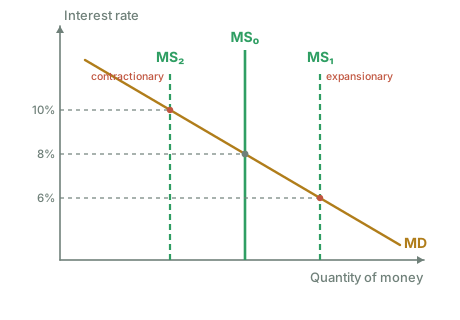
Monetary policy is the manipulation of interest rates, the money supply and the exchange rate to influence aggregate demand and inflation.
In the UK it is set by the Monetary Policy Committee (MPC) of the Bank of England, which has been operationally independent since 1997. The government sets the target; the Bank decides how to meet it.
The target is 2% CPI, and it is symmetric, inflation 1 percentage point either side requires the Governor to write an open letter of explanation. Symmetry matters: undershooting is treated as a failure just as overshooting is, because deflation is dangerous (6.2).
Why independence matters: an elected government has an incentive to stimulate demand before an election, which raises inflation expectations. Delegating the decision to a body with a clear mandate makes the commitment to low inflation credible, so expectations stay anchored and inflation can be kept low at a lower cost in lost output.
- Expansionary (loose): lower interest rates, expanded money supply
- AD right.
- Contractionary (tight): higher rates, restricted money supply
- AD left.
The transmission mechanism
This is the analytical core of the topic. A change in Bank Rate reaches inflation through five channels, and naming them is what earns the analysis marks.
Bank Rate falls →
- Market rates: banks' borrowing and savings rates fall, so borrowing is cheaper and saving less rewarding.
- Consumption: households borrow more, save less, and those with variable-rate mortgages have more disposable income → C rises.
- Investment: the cost of finance falls, so more projects clear the required rate of return → I rises.
- Asset prices and wealth: lower rates raise house and share prices → a wealth effect raises consumption, and higher collateral values ease borrowing.
- The exchange rate: lower returns on domestic assets reduce capital inflows → the currency depreciates → exports become cheaper and imports dearer → net exports rise (10.2).
- **All five raise AD
- AD shifts right
- with spare capacity, real output and employment rise; near capacity, the price level rises.**
The exchange rate channel has a second effect that examiners look for: a depreciation raises imported input costs, shifting SRAS left and adding to cost-push inflation. So loosening policy raises inflation through two routes, not one.
Time lags: monetary policy takes roughly 18 months to two years to have its full effect on inflation. The MPC must therefore set policy on a forecast, not on today's data, which is why it can appear to be tightening while inflation is already falling.
Quantitative easing
QE is used when interest rates are already near their zero lower bound and cannot be cut further.
- The central bank creates central bank reserves electronically
- uses them to buy government bonds (and some corporate bonds) from financial institutions
- the increased demand for bonds raises their price, and since price and yield move inversely, long-term yields fall
- borrowing costs across the economy fall
- and the institutions that sold bonds hold cash they seek to invest, pushing them into other assets
- asset prices rise, generating a wealth effect
- banks have more reserves to lend
- AD rises.
Criticisms of QE:
- It works largely through asset prices, which are held disproportionately by the wealthy, so it widens wealth inequality.
- Banks may simply hold the reserves rather than lend, especially when demand for credit is weak, "pushing on a string".
- It risks asset price bubbles rather than real investment.
- Unwinding it (quantitative tightening) is untested at scale and may be disruptive.
- It blurs the line between monetary and fiscal policy, since the central bank ends up holding a large share of government debt.
Other instruments: forward guidance (signalling the likely future path of rates, to shape expectations); funding schemes offering banks cheap finance conditional on lending; and macroprudential regulation, capital requirements, loan-to-value and loan-to-income limits, used by the Financial Policy Committee to control credit growth without changing Bank Rate.
Effectiveness and limitations
Strengths: faster to implement than fiscal policy (a decision can be taken at any MPC meeting); politically independent and therefore credible; and flexible, since it can be adjusted incrementally.
Limitations:
- Long and variable time lags.
- The zero lower bound, rates cannot fall far below zero, so conventional policy runs out of room precisely when it is most needed.
- Liquidity trap: at very low rates, further cuts do not stimulate borrowing because confidence, not the interest rate, is the binding constraint.
- Banks may not pass on rate cuts to borrowers.
- It is a blunt instrument: a single rate applies to the whole economy, hitting mortgaged households and manufacturers hardest while barely affecting others.
- It is ineffective against cost-push inflation, since the cause is on the supply side.
- Conflicts with other objectives: tightening raises unemployment and appreciates the exchange rate, harming exporters.
Working the numbers
The real interest rate is what actually drives behaviour, and the arithmetic is where most answers go wrong.
Real interest rate ≈ nominal interest rate − inflation rate
Bank Rate is 4.0% while CPI inflation runs at 6.5%.
Real interest rate = 4.0 − 6.5 = −2.5%
Negative. Policy is still loose in real terms despite a nominal rate that sounds restrictive, savers are losing purchasing power, and borrowing is effectively being subsidised. That is why a central bank facing high inflation often raises rates repeatedly: the first moves only remove stimulus rather than applying brakes.
Now suppose Bank Rate rises to 5.5% and inflation falls to 3.0%:
Real interest rate = 5.5 − 3.0 = +2.5%
Only now is policy genuinely restrictive. The nominal rate rose by 1.5 percentage points, but the real rate swung by 5.0, because inflation fell at the same time. Quoting the nominal change alone understates what happened to the stance by more than three times.
Expected versus actual inflation. Contracts are written on expected inflation, but the real rate that materialises depends on actual inflation:
- Actual inflation above expected → the real rate paid is lower than planned → borrowers gain, lenders lose.
- Actual below expected → lenders gain, borrowers lose.
Unanticipated inflation therefore transfers wealth from lenders to borrowers, which is why fixed-rate debtors benefit from an inflation surprise and why the distinction earns marks.
Worked example
Inflation is running at 6%, well above target, and the MPC raises Bank Rate.
- Market rates rise
- borrowing is dearer and saving more attractive
- consumption falls, particularly among mortgaged households
- the cost of finance rises so marginal investment projects are shelved
- I falls
- asset prices fall, so the wealth effect reverses
- higher returns attract capital inflows, appreciating the currency
- exports become dearer and imports cheaper, so net exports fall.
- AD shifts left
- the positive output gap closes
- demand-pull inflationary pressure eases
- inflation falls back towards the 2% target.
The appreciation adds a second disinflationary effect: imported goods and inputs are cheaper, which shifts SRAS right, reinforcing the fall in inflation.
Evaluation.
- The cause of the inflation is decisive. If it is demand-pull, this works. If it is cost-push, an energy or supply shock, raising rates reduces output and employment without addressing the cause, and risks recession.
- Time lags of 18 months to two years mean the full effect arrives long after the decision, so the MPC may over-tighten before it can see the results.
- Distributional effects are severe and uneven: mortgaged households and small firms bear far more of the adjustment than savers and outright homeowners, who gain.
- The appreciation improves the inflation outlook but damages exporters and worsens the current account, an objective conflict (8.1).
- Much of the effect operates through expectations. If the MPC's commitment is credible, a smaller rise in rates achieves the same disinflation, which is the practical value of independence.
- Unemployment rises as AD falls: the short-run Phillips curve trade-off.
Judgement: where inflation is demand-pull and expectations are at risk of becoming unanchored, tightening is the correct instrument despite the output and distributional costs, because the cost of allowing an inflation psychology to take hold is higher still. Where the inflation is a temporary supply shock, holding rates steady and allowing it to pass is more defensible.
Common exam mistakes
- Listing only the consumption channel, the transmission mechanism has five routes, and the exchange rate channel is the most commonly forgotten.
- Forgetting that a depreciation raises imported input costs, shifting SRAS left.
- Saying the Bank of England sets the inflation target; the government sets it, the Bank meets it.
- Treating QE as simply "printing money" without the bond price → yield mechanism.
- Ignoring time lags, which explain most apparent policy errors.
- Recommending monetary tightening for cost-push inflation without acknowledging the output cost.
Exam technique
Walk through the transmission mechanism explicitly. Bank Rate → market rates → the four demand channels plus the exchange rate → AD → output and prices. Chains of reasoning are where the analysis marks live.
Draw AD/AS and, where the exchange rate matters, comment on the SRAS effect too.
For evaluation, use time lags, the cause of the inflation, the zero lower bound where relevant, distributional effects, and the role of credibility and expectations.
Quick revision
- Set by the MPC, operationally independent since 1997; 2% CPI symmetric target set by the government.
- Transmission: Bank Rate → market rates → consumption, investment, asset prices/wealth, the exchange rate → AD.
- A depreciation also raises imported input costs → SRAS left.
- Time lags of roughly 18 months to two years; policy is set on a forecast.
- QE: buy bonds → bond prices rise → yields fall → borrowing cheaper, asset prices and wealth rise → AD rises.
- QE criticisms: widens wealth inequality, banks may not lend, bubble risk, untested unwinding.
- Other tools: forward guidance, funding schemes, macroprudential regulation.
- Limits: lags, zero lower bound, liquidity trap, blunt instrument, useless against cost-push inflation.
What the syllabus asks for on this topicSpecification points
Specification points
- Monetary policy: interest rates, the money supply and quantitative easing.
- The role of the central bank (Bank of England) and the inflation target.
- The transmission mechanism and effects of monetary policy.
Related AQA A-Level topics
Not the topic you were looking for? Describe what you are stuck on in your own words and we will take you to the notes that answer it.