Aggregate Demand and the Multiplier
Contents: 10 sections
Aggregate demand
Aggregate demand is total planned expenditure on an economy's output at each price level.
AD = C + I + G + (X − M)
Typical UK shares: consumption is much the largest component at roughly 60%, investment around 15–18%, government spending around 20%, and net exports usually slightly negative. Because consumption dominates, anything that moves consumer confidence moves AD.
Why the aggregate demand curve (AD curve) slopes downwards, three effects, and AQA expects them named:
- The real balance (wealth) effect: a lower price level raises the real value of money holdings, so spending rises.
- The interest rate effect: a lower price level reduces the demand for money, lowering interest rates and stimulating consumption and investment.
- The international trade effect: a lower domestic price level makes exports more competitive and imports dearer, raising net exports.
A change in the price level causes a movement along AD. A change in anything else shifts it.
Consumption (C)
Determinants:
- Real disposable income: the dominant influence.
- Interest rates: higher rates raise the return to saving and the cost of borrowing, and raise mortgage payments, cutting discretionary income.
- Consumer confidence: expectations of future income and job security.
- Wealth: house and share prices generate a wealth effect.
- Availability of credit.
- Taxation: income tax changes disposable income directly.
- Distribution of income: poorer households have a higher MPC, so redistribution towards them raises consumption.
The marginal propensity to consume (MPC) is the fraction of each extra pound of income that is spent. It is higher for low-income households, which is why targeted transfers stimulate demand more effectively per pound than tax cuts for high earners.
Investment (I)
Investment is spending by firms on capital goods. It is the most volatile component of AD, which is why it drives the economic cycle.
Determinants:
- Interest rates: the cost of borrowing and the opportunity cost of using retained profit.
- Business confidence: Keynes's "animal spirits"; expectations of future demand.
- Retained profit, the main source of investment finance.
- Technological change, creating new investment opportunities.
- Corporation tax and investment allowances.
- Spare capacity: firms already operating below capacity have no reason to invest.
The accelerator states that investment depends on the rate of change of national income, not its level. A slowdown in the growth of demand can therefore cause investment to fall absolutely, which amplifies the cycle. Combined with the multiplier, this explains why booms and recessions are self-reinforcing.
Government spending (G) and net exports (X − M)
G is determined by policy priorities, the stage of the economic cycle (automatic stabilisers raise benefit spending in a recession), and political choices about the size of the state.
Net exports depend on:
- The exchange rate: a depreciation raises X and reduces M (10.2).
- Relative inflation rates and international competitiveness.
- Productivity and non-price competitiveness: quality, design, reliability.
- Incomes abroad (determining export demand) and incomes at home (determining import demand).
- Protectionism and trade agreements.
The multiplier
The multiplier is the process by which an initial injection into the circular flow leads to a larger eventual increase in national income, because one person's spending is another person's income.
- An injection of £100m
- recipients spend a fraction of it
- that becomes income for others
- who spend a fraction again
- each round is smaller than the last
- the total increase in income exceeds the original injection.
Calculating it:
Multiplier k = 1 ÷ (1 − MPC), or equivalently k = 1 ÷ MPW
where the marginal propensity to withdraw is the sum of the leakages:
MPW = MPS + MPT + MPM, saving, taxation and imports.
Worked arithmetic: if MPC = 0.8, then MPW = 0.2 and k = 1 ÷ 0.2 = 5. An injection of £100m raises national income by £500m.
The multiplier is larger when leakages are small: a low propensity to save, low tax rates, a low propensity to import (so a relatively closed economy), and, critically, substantial spare capacity, so that the extra demand raises output rather than prices.
The multiplier works in reverse. A withdrawal, such as a cut in government spending, causes a larger fall in national income. This is the core argument against sharp fiscal contraction during a recession.
Worked example
A government increases infrastructure spending by £10bn. The economy has a negative output gap, MPS = 0.1, MPT = 0.2 and MPM = 0.1.
- MPW = 0.1 + 0.2 + 0.1 = 0.4
- k = 1 ÷ 0.4 = 2.5
- national income rises by £10bn × 2.5 = £25bn.
Tracing the mechanism:
- The government pays construction firms
- they hire workers and buy materials
- those workers receive wages and spend 60p of each extra pound domestically
- that spending is income for retailers and their suppliers
- who spend again
- each round is 60% of the previous one
- the increments sum to £25bn.
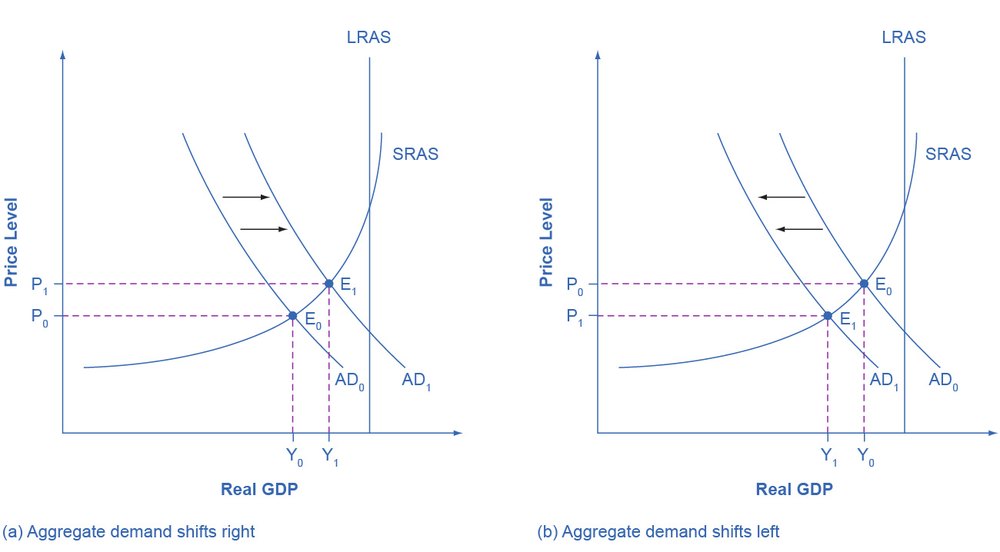
On the diagram, AD shifts right by the full £25bn, not by the initial £10bn. With spare capacity, output rises substantially and the price level rises only modestly.
Evaluation.
- The size of k is uncertain and is usually smaller in practice than the formula suggests, because it assumes stable propensities. In an open economy like the UK, a high MPM makes the multiplier modest.
- If there is little spare capacity, the extra demand raises the price level rather than real output, and the real multiplier approaches zero.
- Crowding out: government borrowing may raise interest rates, reducing private investment and consumption and offsetting the injection. This is a much weaker objection when interest rates are at their floor and private demand is depressed.
- Time lags: recognition, decision, implementation and impact lags mean the stimulus may arrive after recovery has begun.
- The accelerator may reinforce the effect: rising demand encourages firms to invest, adding a second injection.
- The financing matters. A spending rise funded by higher taxation has a much smaller net effect, since taxation withdraws from the circular flow.
Judgement: the multiplier makes fiscal stimulus more powerful than its headline cost, but only where spare capacity exists and leakages are limited. The same logic makes fiscal contraction in a recession correspondingly more damaging than its headline saving.
Common exam mistakes
- Forgetting that imports are subtracted in AD.
- Confusing a movement along AD (caused by the price level) with a shift (caused by anything else).
- Using 1 ÷ MPS as the multiplier in an economy with taxes and imports; it must be 1 ÷ MPW.
- Shifting AD by the size of the initial injection rather than the multiplied amount.
- Ignoring spare capacity, the multiplier's real effect depends on it entirely.
- Treating investment as a stable component; it is the most volatile.
Exam technique
Show the multiplier calculation whenever data allows: state MPW, compute k, and apply it. That is often several marks on its own.
On the AD/AS diagram, shift AD by the multiplied amount and comment on how the split between output and price level depends on the slope of AS at that point.
For evaluation, the reliable angles are the size of the output gap, leakages (especially MPM in an open economy), crowding out, and time lags.
Quick revision
- AD = C + I + G + (X − M); C is about 60%.
- AD slopes down because of the real balance, interest rate and international trade effects.
- Consumption depends on real disposable income, interest rates, confidence, wealth, credit and tax.
- Investment is the most volatile component; the accelerator links it to the rate of change of income.
- k = 1 ÷ (1 − MPC) = 1 ÷ MPW, where MPW = MPS + MPT + MPM.
- MPC = 0.8 → MPW = 0.2 → k = 5.
- The multiplier is larger with small leakages and spare capacity; it works in reverse for withdrawals.
- Limits: crowding out, time lags, and a high marginal propensity to import.
What the syllabus asks for on this topicSpecification points
Specification points
- The components of aggregate demand (AD).
- The determinants of consumption, investment, government spending and net exports.
- The multiplier process.
Related AQA A-Level topics
Not the topic you were looking for? Describe what you are stuck on in your own words and we will take you to the notes that answer it.