Accounting principles: five questions to try now
Real past-paper questions, the answer key from the mark scheme, and the explanation that goes with it. No account needed to answer them.
Question 1
How can a business comply with the accounting principle of prudence? Use the complete source image for the question and answer choices. Source reference: W20 Paper 12, Q34.
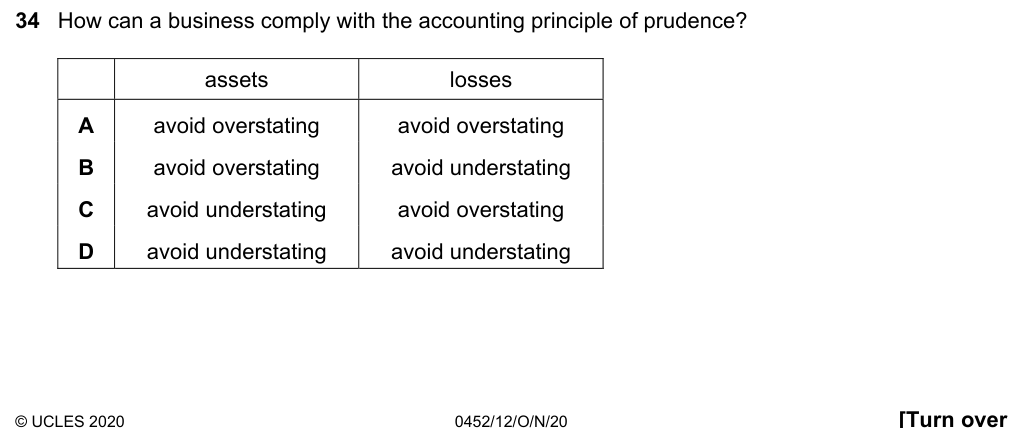
Answer: B.
Question 2
The financial statements of a business are prepared on the basis that it will continue to operate for many years into the future.
Which accounting principle is being applied?
Answer: B.
Question 3
When Marina opened a business she purchased a stapler for the office.
She recorded this as office expenses rather than as office equipment.
Which accounting principle did Marina apply?
Answer: C.
Question 4
At the end of the financial year, a company did not account for the unused stationary valued at $50.
Which accounting principle did the company apply?
Answer: B.
Question 5
Amaira depreciates her non-current assets by the same rate and using the same method every year.
Which group of accounting principles is she applying?
Answer: C.
What this practice covers
These questions are drawn from past CIE 0452 Accounting papers and filtered to accounting principles. You answer, you find out immediately whether you were right, and you get the reasoning for the correct option and for each distractor. Wrong answers go to a mistakes locker so you can come back to exactly those.
Practice is free. You need an account only so your progress and your mistakes are still there next time.
What examiners see students get wrong here
These are the errors that cost marks on accounting principles, taken from our own topic notes. Read them before you practise and you will recognise the traps in the questions.
- Saying prudence means deliberately understating profit. It means not overstating it.
- Defining the principle in the abstract when the question gives a scenario. Apply it to the scenario.
- Using going concern to justify the accruals adjustments. Matching is the principle behind those.
- Confusing realisation with the receipt of cash.
- Naming business entity when the answer is money measurement, or the reverse. Business entity is about whose transaction it is; money measurement is about whether it can be measured.
- Giving two principles and hoping one is right. Choose the one the treatment actually rests on.
Revise it first
If any of the above is unfamiliar, work through the notes before practising: Accounting principles revision notes.