Accounting principles
Contents: 6 sections
How these are examined
Questions rarely ask for a definition on its own. They describe a treatment and ask which principle supports it, or which one it breaks. So learn each principle attached to the treatment it produces.
The principles
Business entity. The business is treated as separate from its owner. Only business transactions are recorded. The owner's private car is not an asset of the business, and money taken out is drawings rather than an expense.
Money measurement. Only items with a monetary value are recorded. This is why the skill of the workforce, the loyalty of customers and the reputation of the business never appear in the accounts, even when they matter more than the things that do.
Going concern. The business is assumed to continue for the foreseeable future. This is why non-current assets are shown at cost less depreciation rather than at what they would fetch in a forced sale.
Matching, also called accruals. Income and expenses belong to the period they relate to, not the period the cash moved. Every year-end adjustment comes from this principle: accruals, prepayments, depreciation and closing inventory.
Consistency. The same treatment is used year after year, so results can be compared. A change of method is allowed if there is a good reason, and it must be disclosed.
Prudence. Do not overstate assets or profit, and do not understate liabilities or losses. Provide for a foreseeable loss as soon as it is likely; recognise a gain only when it is realised. This gives the allowance for irrecoverable debts and the lower of cost and net realisable value.
Materiality. An item matters if leaving it out would change a user's decision. A $9 stapler with a five-year life is technically a non-current asset, but writing it off as an expense is acceptable because the amount changes nothing.
Realisation. Revenue is recognised when the goods or services pass to the customer, not when the order is placed and not when the cash arrives. A signed order for next year is not this year's revenue.
Duality. Every transaction has two effects of equal value. This is the basis of double entry.
Historic cost. Assets are recorded at what was paid for them. It is objective and can be verified, which is its strength, and it means the statement of financial position does not show current values, which is its weakness.
Substance over form. Record the commercial reality rather than the legal form.
Matching the treatment to the principle
| Treatment | Principle |
|---|---|
| Closing inventory at the lower of cost and net realisable value | Prudence |
| Rent paid in advance carried forward | Matching |
| Owner's private holiday not recorded | Business entity |
| Non-current assets depreciated rather than written off at once | Matching |
| Same depreciation method used each year | Consistency |
| Skilled staff not shown as an asset | Money measurement |
| Small tools charged to the income statement | Materiality |
| Deposit received for goods not yet delivered treated as a liability | Realisation |
| Assets shown at cost less depreciation, not at sale value | Going concern |
| Allowance for irrecoverable debts created | Prudence |
| Every transaction has a debit and a credit | Duality |
When principles conflict
Naming the tension earns more than reciting the principles.
- Prudence against matching. Matching says recognise the income in the period it was earned; prudence says wait until it is reasonably certain. Where there is doubt, prudence wins.
- Prudence against consistency. Being more cautious than last year makes the two years harder to compare.
- Materiality against matching. Strict matching says accrue the $4 of unused stationery; materiality says do not bother.
- Historic cost against usefulness. Cost is reliable and can be checked, and it can also be badly out of date.
Common mistakes
- Saying prudence means deliberately understating profit. It means not overstating it.
- Defining the principle in the abstract when the question gives a scenario. Apply it to the scenario.
- Using going concern to justify the accruals adjustments. Matching is the principle behind those.
- Confusing realisation with the receipt of cash.
- Naming business entity when the answer is money measurement, or the reverse. Business entity is about whose transaction it is; money measurement is about whether it can be measured.
- Giving two principles and hoping one is right. Choose the one the treatment actually rests on.
Check you have it
Question 1
Which accounting principle requires profit to be recognised as earned when the legal ownership of goods passes to the purchaser? Use the complete source image for the question and answer choices. Source reference: M19 Paper 12, Q1(j).
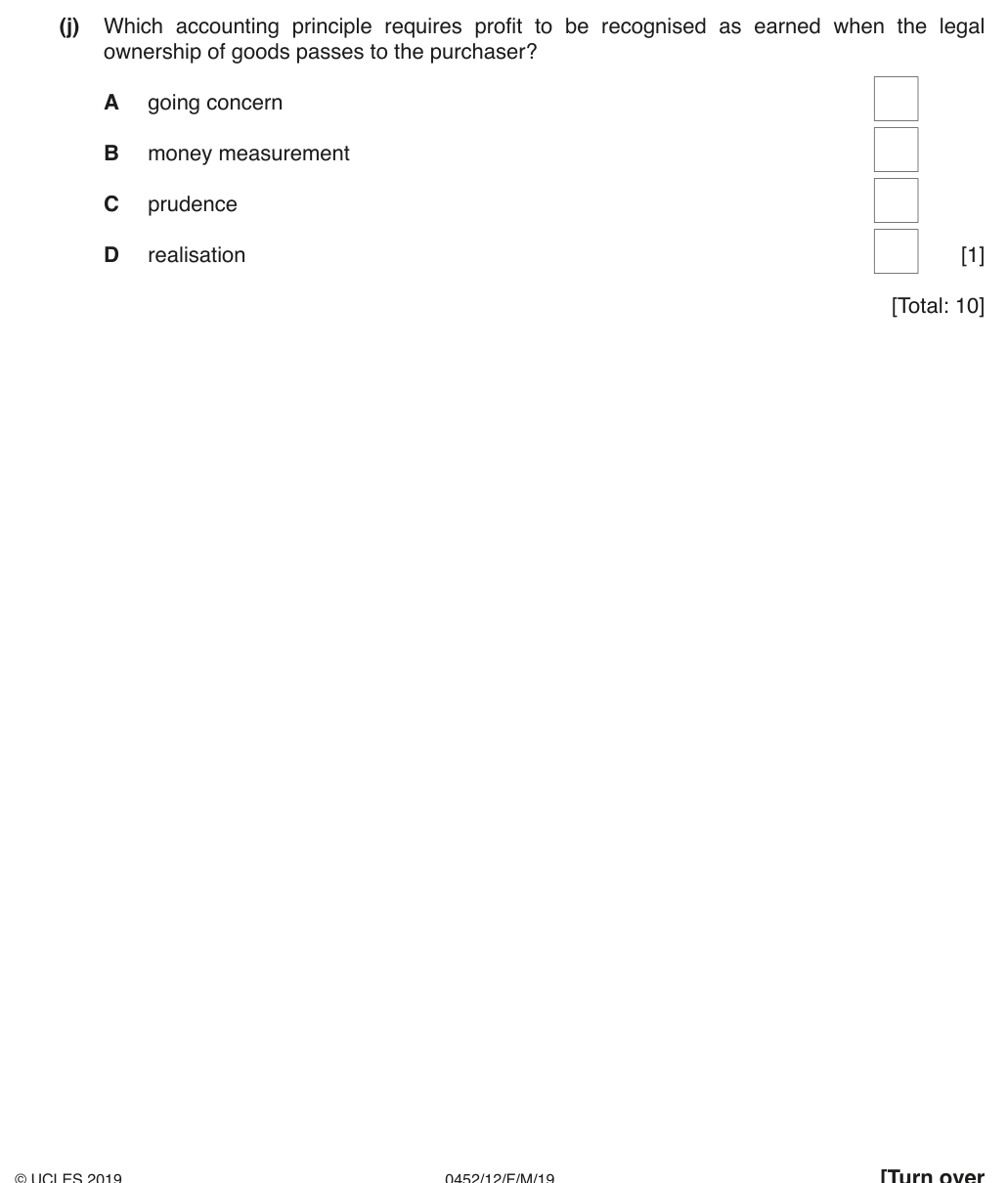
Answer: D.
Question 2
A café owner made no entry in her accounts for increased competition when another café opened nearby.
Which accounting principle was applied?
Answer: C.
Question 3
The special skills of the employees are not recorded in the financial statements of a business.
Which accounting principle is being applied?
Answer: C.
What the syllabus asks for on this topicSyllabus points
Syllabus points
- Explain the accounting principles.
- Recognise the application of each principle in given situations.
- Identify which principle a stated treatment follows or breaks.
Related CIE 0452 Accounting topics
Not the topic you were looking for? Describe what you are stuck on in your own words and we will take you to the notes that answer it.