Clubs and societies
Contents: 8 sections
Different words, same accounting
A club exists to serve its members, not to make a profit, so the vocabulary changes even though the accounting does not.
| A business says | A club says |
|---|---|
| Capital | Accumulated fund |
| Profit for the year | Surplus of income over expenditure |
| Loss for the year | Deficit |
| Income statement | Income and expenditure account |
| Cash book | Receipts and payments account |
Receipts and payments against income and expenditure
This distinction is the heart of the topic.
A receipts and payments account is a summary of the cash book. It records all money in and out, whatever period it belongs to and whatever it was for. It includes capital items such as buying equipment, and it ignores all adjustments.
An income and expenditure account is the club's income statement. It records the income earned and the expenditure incurred in the year, whatever cash moved. It excludes capital items and applies every accrual, prepayment and depreciation adjustment.
| Receipts and payments | Income and expenditure | |
|---|---|---|
| Basis | Cash | Accruals |
| Capital items included? | Yes | No |
| Depreciation included? | No | Yes |
| Accruals and prepayments? | Ignored | Adjusted for |
| Result | Closing cash balance | Surplus or deficit |
So buying a new lawnmower for $1 200 appears in full in the receipts and payments account, and appears in the income and expenditure account only as that year's depreciation.
Subscriptions
Subscriptions are the club's main income and are examined every year, because members pay late and pay early.
The subscriptions account works like any income account with adjustments:
- Subscriptions owing by members at the year end (in arrears) are accrued income, a current asset.
- Subscriptions paid in advance for next year are prepaid income, a current liability.
Prepaid subscriptions being a liability is the point most often marked wrong. The club has been paid for a membership year it has not yet provided, so it owes the member something.
A worked subscriptions account. Subscriptions received during the year were $8 400. At the start of the year $300 was owing by members and $500 had been paid in advance. At the end of the year $450 is owing and $600 has been paid in advance.
The income for the year is the cash received of 8 400, less the 300 that belonged to last year, plus the 500 received last year for this year, plus the 450 owing for this year, less the 600 received for next year.
That is 8 400 minus 300 plus 500 plus 450 minus 600, which is $8 450.
Many clubs also write off subscriptions in arrears that will not be collected, exactly like an irrecoverable debt.
Trading activities
A club often runs a bar, a café or a shop, and the profit from it is a separate calculation feeding into the income and expenditure account.
Prepare a small trading account: sales, less cost of sales (opening inventory plus purchases less closing inventory), giving the profit on the bar. Only that profit figure goes into the income and expenditure account, as income. Wages of the bar staff are usually deducted in the trading account too, if the question says so.
Bar sales of $14 000, opening inventory $900, purchases $8 600, closing inventory $1 100, bar staff wages $2 400.
Cost of sales is 900 plus 8 600 less 1 100, which is $8 400. Gross profit is 14 000 minus 8 400, which is $5 600, less wages of 2 400, giving a bar profit of $3 200 to carry into the income and expenditure account.
Putting the whole bar sales figure into the income and expenditure account, instead of the profit, is a standard error.
Other items
- Life membership is received once for many years' membership. Credit it to a separate account and transfer a portion to income each year rather than treating it all as this year's income.
- Donations are usually income of the year received, unless they are large and for a specific purpose, in which case they may be credited to a fund.
- Sale of refreshments at a single event is often shown net: takings less the cost of the refreshments.
The accumulated fund
The accumulated fund at the start of the year is found the same way capital is: assets less liabilities at that date. Questions often require this calculation before anything else can be done.
closing accumulated fund = opening accumulated fund + surplus (or − deficit)
Common mistakes
- Including the purchase of equipment in the income and expenditure account.
- Including depreciation in the receipts and payments account.
- Treating subscriptions in advance as an asset.
- Using the cash received as the subscriptions income without adjusting.
- Putting bar takings, rather than bar profit, into the income and expenditure account.
- Calling the result a profit instead of a surplus.
- Forgetting to calculate the opening accumulated fund when the question needs it.
Check you have it
Question 1
Use the complete source image for the question and answer choices. Source reference: W21 Paper 11, Q23.
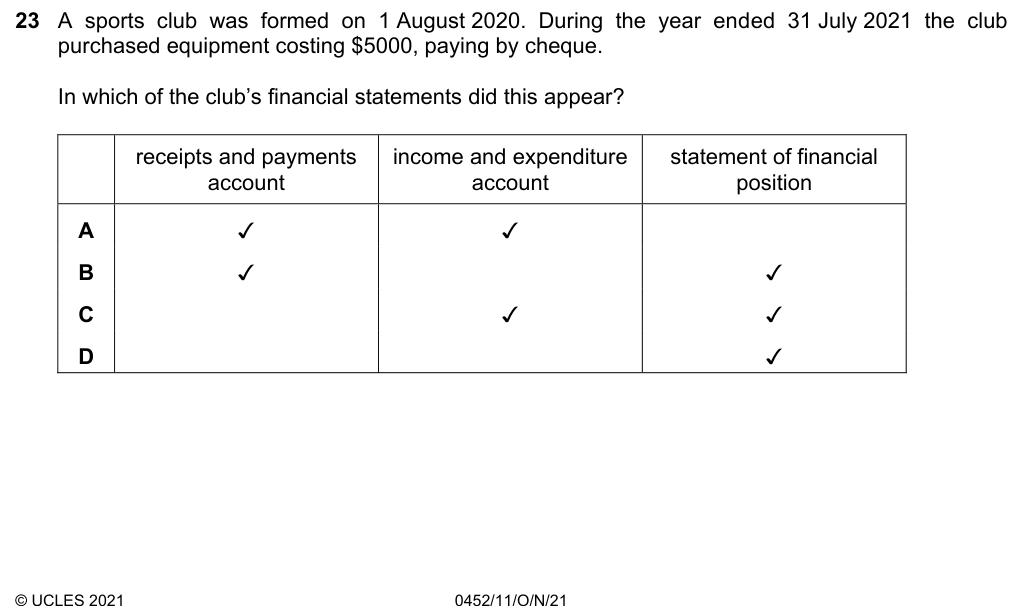
Answer: B.
Question 2
Use the complete source image for the question and answer choices. Source reference: W21 Paper 12, Q25.
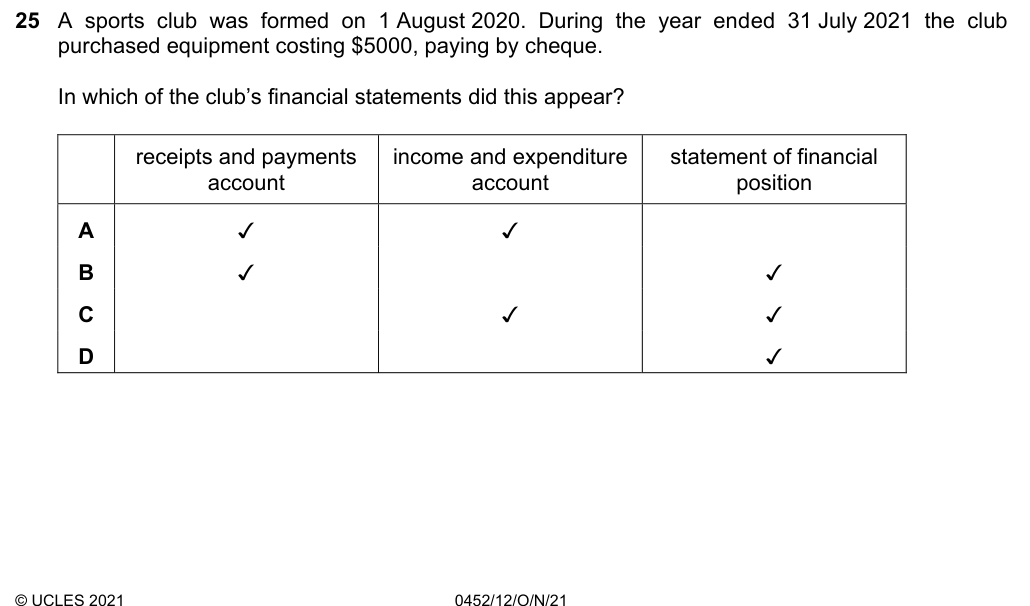
Answer: B.
Question 3
Use the complete source image for the question and answer choices. Source reference: W21 Paper 13, Q23.
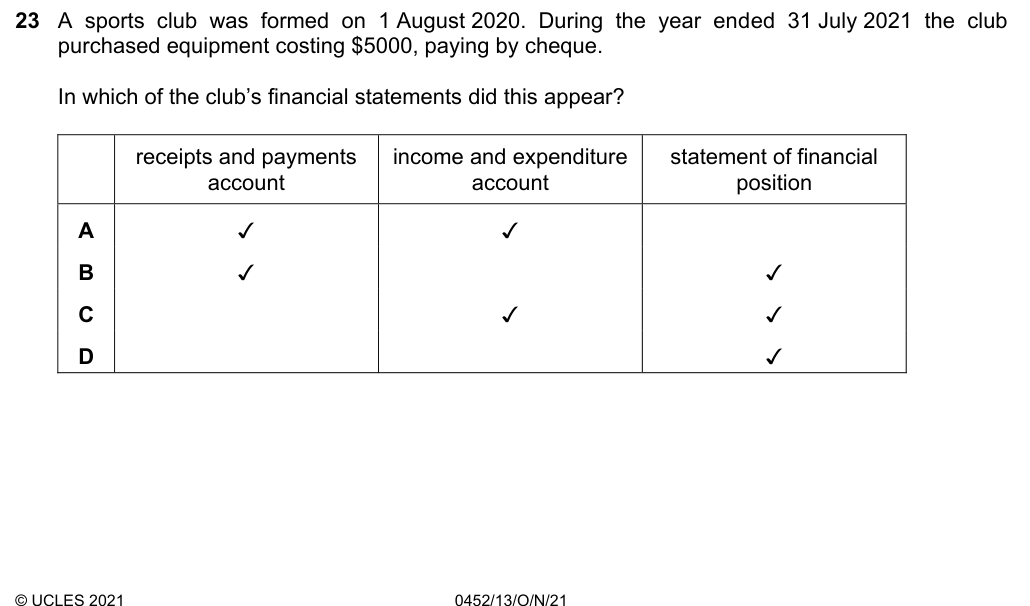
Answer: B.
What the syllabus asks for on this topicSyllabus points
Syllabus points
- Distinguish between receipts and payments accounts and income and expenditure accounts.
- Prepare a receipts and payments account.
- Prepare accounts for subscriptions and for a trading activity.
- Prepare an income and expenditure account and a statement of financial position.
Related CIE 0452 Accounting topics
Not the topic you were looking for? Describe what you are stuck on in your own words and we will take you to the notes that answer it.