Manufacturing accounts
Contents: 9 sections
Why a manufacturer needs an extra statement
A trader buys finished goods and sells them, so purchases is a single figure. A manufacturer makes them, so the equivalent figure has to be built up from raw materials, wages and factory costs. That build-up is the manufacturing account, and it sits in front of the income statement.
The manufacturing account produces one number, the cost of production, which then replaces purchases in the trading section.
Direct and indirect costs
Direct costs can be traced to the product: raw materials used, the wages of the workers who make the goods, and any direct expense such as a royalty paid per unit.
Indirect costs, called factory overheads, are factory costs that cannot be traced to one unit: factory rent, the supervisor's wage, machine depreciation, factory power, factory insurance.
Only factory costs belong in the manufacturing account. Office rent, sales staff wages, office equipment depreciation and carriage outwards are not factory costs and stay in the income statement.
Where a cost such as rent covers both the factory and the office, the question gives a basis for splitting it. Put the factory share in the manufacturing account and the office share in the income statement.
The layout
| $ | $ | |
|---|---|---|
| Opening inventory of raw materials | 4 000 | |
| Purchases of raw materials | 38 000 | |
| Carriage inwards on raw materials | 900 | |
| Less closing inventory of raw materials | (5 200) | |
| Cost of raw materials used | 37 700 | |
| Direct wages | 26 000 | |
| Direct expenses (royalties) | 1 300 | |
| Prime cost | 65 000 | |
| Factory overheads | ||
| Factory rent | 7 000 | |
| Factory supervisor's wages | 9 500 | |
| Depreciation of machinery | 3 500 | |
| Factory power | 2 800 | 22 800 |
| 87 800 | ||
| Add opening work in progress | 2 400 | |
| Less closing work in progress | (3 100) | |
| Cost of production | 87 100 |
Check it: 4 000 plus 38 000 plus 900 less 5 200 is $37 700 of raw materials used. Prime cost is 37 700 plus 26 000 plus 1 300, which is $65 000. Adding overheads of 22 800 gives $87 800, and adjusting for work in progress gives $87 100.
Prime cost is direct costs only. Adding factory overheads into prime cost is the single most common error in the topic, so identify the prime cost line before writing anything else.
Work in progress
Work in progress is partly finished goods, and it is adjusted at the end of the manufacturing account, after the overheads.
The direction follows the same logic as any inventory adjustment. Goods started last year and finished this year add to this year's cost, so opening work in progress is added. Goods started this year and not finished are not part of this year's production, so closing work in progress is deducted.
The three inventories
A manufacturer holds three kinds, and each is adjusted in a different place:
| Inventory | Adjusted | Appears in the statement of financial position |
|---|---|---|
| Raw materials | At the top of the manufacturing account | Current asset |
| Work in progress | At the bottom of the manufacturing account | Current asset |
| Finished goods | In the trading section of the income statement | Current asset |
All three appear as current assets, usually listed together as inventory with the three figures shown.
Adjusting finished goods inside the manufacturing account, or raw materials inside the trading account, is a frequent slip. Each inventory belongs where its own cost was built up.
The income statement that follows
The trading section then reads:
Revenue, less cost of sales, where cost of sales is opening inventory of finished goods, plus cost of production, less closing inventory of finished goods.
Cost of production has taken the place of purchases. If the business also buys in some finished goods to resell, those purchases are added alongside the cost of production.
Below gross profit, the income statement carries the non-factory costs: office and administration expenses, selling and distribution expenses, carriage outwards, and any office depreciation.
Factory profit
Some businesses transfer goods to the trading section at a price above cost, to see whether making is cheaper than buying. The mark-up is the factory profit, and it is added to the manufacturing account's total and then shown as income.
Where this happens, an unrealised profit arises on the closing inventory of finished goods, because that inventory is held at transfer price rather than at cost. The provision for unrealised profit must be adjusted, and only the change in it goes to the income statement, exactly like the allowance for irrecoverable debts.
Common mistakes
- Including factory overheads in prime cost.
- Putting office or selling costs in the manufacturing account.
- Adjusting work in progress at the top rather than at the bottom.
- Adding closing inventory and deducting opening inventory.
- Using raw materials inventory in the trading section, or finished goods in the manufacturing account.
- Forgetting to split a cost that covers both the factory and the office.
- Forgetting that cost of production, not purchases, goes into cost of sales.
Check you have it
Question 1
The work in progress of ZT Manufacturers on 1 January was valued at $6200. At the end of the year it was valued at $5400.
What was the effect on the cost of production for the year?
Answer: C.
Question 2
Hamid purchased a motor vehicle from an overseas motor manufacturer.
Which expenditure relating to the motor vehicle is capital expenditure?
Answer: A.
Question 3
What is shown in a manufacturing account? 1 cost of material consumed 2 purchases of finished goods 3 cost of production 4 cost of sales Use the complete source image for the question and answer choices. Source reference: M22 Paper 12, Q29.
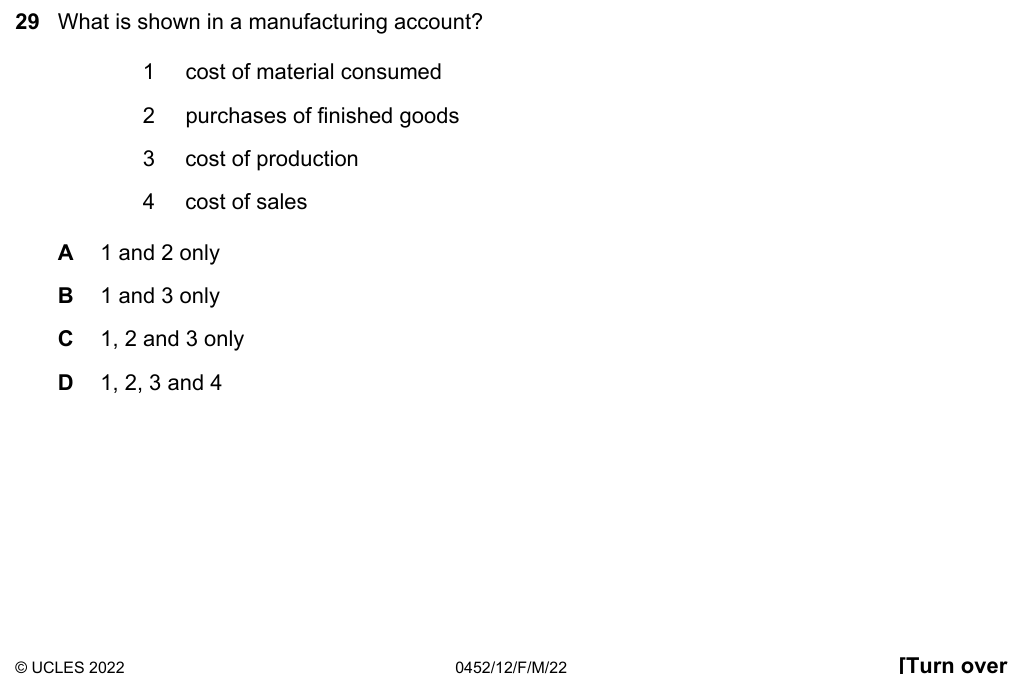
Answer: B.
What the syllabus asks for on this topicSyllabus points
Syllabus points
- Distinguish between direct and indirect costs.
- Prepare a manufacturing account showing prime cost and cost of production.
- Prepare the financial statements of a manufacturing business.
- Account for the three types of inventory.
Related CIE 0452 Accounting topics
Not the topic you were looking for? Describe what you are stuck on in your own words and we will take you to the notes that answer it.