Depreciation and disposal of non-current assets
Contents: 8 sections
Why depreciation is charged
Depreciation is the spreading of the cost of a non-current asset over its useful life. It is not a valuation, and it is not money put aside to buy a replacement.
It is charged because of the matching principle: the asset helps earn revenue over several years, so its cost must be shared across those years. Charging the whole cost in year one would make that year's profit far too low and every later year's far too high.
Depreciation involves no cash. The cash left when the asset was bought.
The causes are wear and tear, obsolescence (a better model appears), the passage of time (a lease that runs out), and depletion (a mine or quarry runs out).
Straight line
An equal charge each year.
annual depreciation = (cost − residual value) / expected useful life
Sometimes a fixed percentage of cost is given instead.
A machine costs $24 000, will last 6 years and is expected to be worth $3 000 at the end. The annual charge is 21 000 divided by 6, which is $3 500 every year.
After 4 years the accumulated depreciation is 4 times 3 500, which is $14 000, and the carrying amount is 24 000 minus 14 000, which is $10 000.
Straight line suits assets used evenly, and assets whose life is set by time: fixtures, fittings, a lease.
Reducing balance
A fixed percentage of the carrying amount, so the charge falls each year.
A vehicle costs $20 000 and is depreciated at 25% reducing balance.
| Year | Opening carrying amount | Charge at 25% | Closing carrying amount |
|---|---|---|---|
| 1 | 20 000 | 5 000 | 15 000 |
| 2 | 15 000 | 3 750 | 11 250 |
| 3 | 11 250 | 2 812.50 | 8 437.50 |
The percentage is applied to the carrying amount, not to cost, from year 2 onwards. Applying 25% to $20 000 every year is the most common error in the whole topic.
Reducing balance suits assets that lose value fastest early and cost more to repair later, such as vehicles and machinery. The higher depreciation in early years balances the lower repair bills, so the total cost per year is more even.
Revaluation
Used for many small items that would be impractical to track individually, such as loose tools.
depreciation = opening valuation + purchases during the year − closing valuation
Loose tools valued at $2 800 at the start, with $600 bought in the year and a closing valuation of $2 500, give a charge of 2 800 plus 600 minus 2 500, which is $900.
The ledger entries
Depreciation is recorded so that the asset account continues to show cost.
- Debit depreciation (an expense), credit provision for depreciation.
- The depreciation expense goes to the income statement.
- The provision for depreciation is a credit balance, deducted from cost in the statement of financial position.
| Cost | Provision | Carrying amount | |
|---|---|---|---|
| Machinery | 24 000 | 14 000 | 10 000 |
The cost column never changes because of depreciation.
Disposal
profit or loss on disposal = proceeds − carrying amount
Everything about the asset is cleared out through a disposal account, in three steps:
- Transfer the cost: debit disposal, credit the asset account.
- Transfer the accumulated depreciation: debit provision for depreciation, credit disposal.
- Record the proceeds: debit bank, credit disposal.
The balance left is the profit or loss, transferred to the income statement. Step 2 is the one most often forgotten, and leaving it out turns a modest profit into a large loss.
A vehicle costing $16 000 with accumulated depreciation of $9 700 is sold for $5 500.
The carrying amount is 16 000 minus 9 700, which is $6 300. The proceeds are $800 less than that, so there is a loss on disposal of $800, charged as an expense.
A loss on disposal means the depreciation charged over the asset's life was too little; a profit means it was too much. Saying that, rather than just calculating the figure, is what an explanation question wants.
Common mistakes
- Applying the reducing-balance rate to cost every year.
- Deducting residual value in a reducing-balance calculation. Residual value belongs to the straight-line formula only.
- Saying depreciation saves money to replace the asset.
- Crediting the asset account instead of the provision account.
- Forgetting to transfer accumulated depreciation to the disposal account.
- Comparing proceeds with cost instead of with carrying amount.
- Ignoring the business's stated policy on part years.
Check you have it
Question 1
A trader always depreciates his motor vehicles using the reducing (diminishing) balance method. Which accounting principle is he applying? Use the complete source image for the question and answer choices. Source reference: W19 Paper 12, Q1(d).
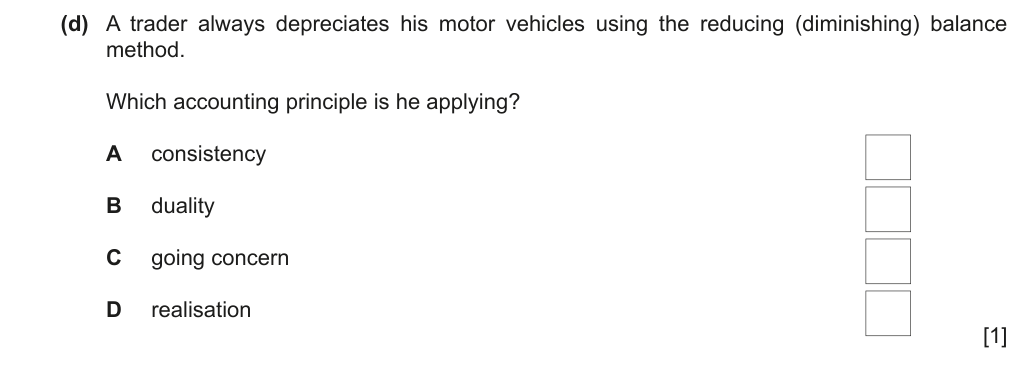
Answer: A.
Question 2
A machine which cost $32 000 was sold for $14 000. The total depreciation at the date of disposal was $15 000.
What was the profit or loss on disposal?
Answer: B.
Question 3
Machinery which had cost $6290 was sold for $3100. The disposal account showed a profit on disposal of $584.
How much was the depreciation up to the date of disposal and on which side of the disposal account was it recorded?
Answer: C.
What the syllabus asks for on this topicSyllabus points
Syllabus points
- Explain the reasons for accounting for depreciation.
- Calculate depreciation using the straight-line, reducing-balance and revaluation methods.
- Record depreciation in the ledger and in the financial statements.
- Record the disposal of a non-current asset and calculate the profit or loss on disposal.
Related CIE 0452 Accounting topics
Not the topic you were looking for? Describe what you are stuck on in your own words and we will take you to the notes that answer it.