Books of prime entry
Contents: 7 sections
Why they exist
A book of prime entry is a list, not a ledger account. Transactions of the same kind are listed as they happen, and the totals are posted to the ledger periodically. This keeps the ledger short, groups similar items together, and gives one place to look when something needs checking.
The order is always: source document, then book of prime entry, then ledger account, then trial balance.
The books
| Book | Records | Posting |
|---|---|---|
| Sales journal | Credit sales | Debit each customer; credit sales with the total |
| Purchases journal | Credit purchases | Credit each supplier; debit purchases with the total |
| Sales returns journal | Goods returned by customers | Credit each customer; debit sales returns with the total |
| Purchases returns journal | Goods returned to suppliers | Debit each supplier; credit purchases returns with the total |
| Cash book | All money in and out | It is a ledger account as well |
| Petty cash book | Small cash payments | Credit petty cash; debit each expense |
| General journal | Everything else | As stated in the entry |
Only credit transactions go in the sales and purchases journals. A cash sale goes straight into the cash book and never touches the sales journal. This is the most common error in the topic.
The general journal takes anything the other books do not cover: opening entries, the purchase or sale of a non-current asset on credit, correction of errors, year-end adjustments, transfers, and writing off an irrecoverable debt. Every journal entry needs a narrative, a short explanation of what it is for.
The cash book
The cash book is unusual: it is a book of prime entry and a ledger account, so its balance appears in the trial balance directly.
A three-column cash book has columns for discount, cash and bank on each side.
- The discount column on the debit side records discount allowed to customers.
- The discount column on the credit side records discount received from suppliers.
The discount columns are memorandum totals, not part of double entry. At the end of the period the debit column total is posted to the debit of discount allowed, and the credit column total to the credit of discount received. They are not balanced like the cash and bank columns.
A contra entry is money moved between cash and bank: cash banked, or cash drawn from the bank for the till. Both entries are in the cash book, so it is marked with a C in the folio column and no other ledger account is involved.
The petty cash book and the imprest system
Petty cash handles small payments such as postage, stationery, cleaning and bus fares, so that the main cash book is not cluttered.
Under the imprest system, the petty cashier starts each period with a fixed amount, the imprest. At the end of the period the cashier is reimbursed with exactly what was spent, restoring the float to the imprest amount.
An imprest of $200, with $147 spent during the month, is restored by a reimbursement of $147, bringing the float back to $200.
The system's advantages are worth knowing: the amount held is limited, so a loss is small; the cashier must account for the spending before being reimbursed; and at any moment the cash in the tin plus the vouchers should equal the imprest, which makes checking instant.
The petty cash book has analysis columns, one for each type of expense, so the totals can be posted to the right expense accounts at the end of the period.
A worked posting
The sales journal for the month lists three invoices: A Patel $400, B Chen $650, C Diallo $250.
Each customer is debited individually in the sales ledger: Patel $400, Chen $650, Diallo $250.
The total of $1 300 is credited to the sales account in the general ledger. Note that only one figure goes to sales, not three.
Debiting each customer and then also debiting the total somewhere is a way of doubling the entry, and it is a common slip.
Common mistakes
- Putting cash sales in the sales journal.
- Calling a book of prime entry a ledger.
- Balancing the discount columns of the cash book as though they were part of double entry.
- Reimbursing petty cash with the full imprest instead of with the amount spent.
- Posting the journal total to each personal account as well as to the nominal account.
- Writing a journal entry with no narrative.
- Recording a contra entry twice by posting it to another ledger account.
Check you have it
Question 1
The analysis columns of a petty cash book show the following totals. $ postage 20
stationery 31
How should these totals be posted to the ledger?
Answer: D.
Question 2
A trader kept a petty cash book using the imprest system. He provided the following information. How much was needed to restore the imprest on 1 April? Use the complete source image for the question and answer choices. Source reference: W24 Paper 11, Q4.
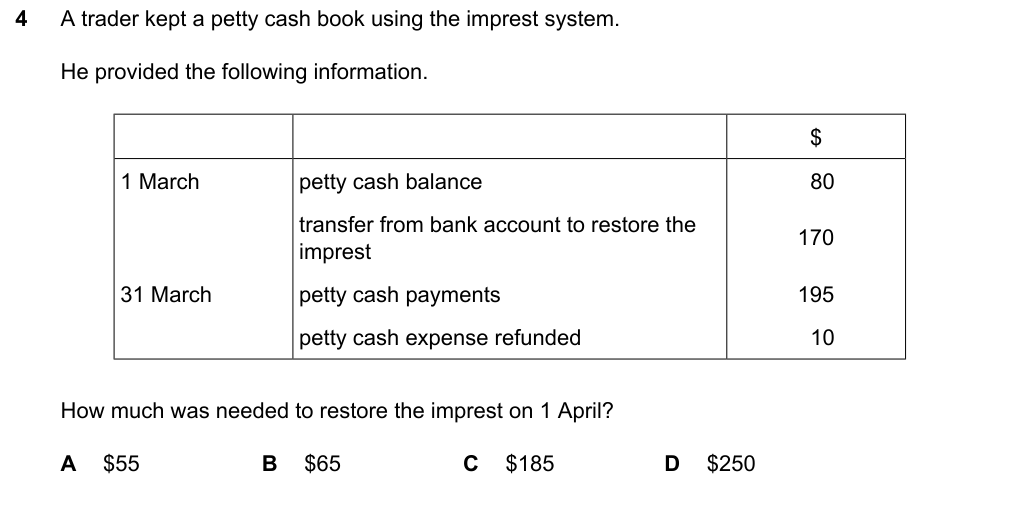
Answer: C.
Question 3
A trader kept a petty cash book using the imprest system. He provided the following information. How much was needed to restore the imprest on 1 April? Use the complete source image for the question and answer choices. Source reference: W24 Paper 13, Q4.
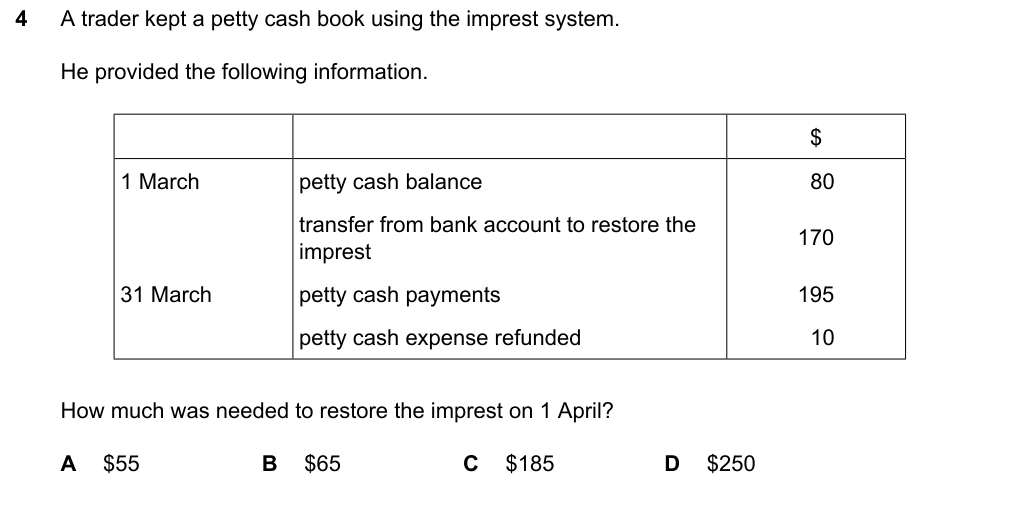
Answer: C.
What the syllabus asks for on this topicSyllabus points
Syllabus points
- Explain the purpose of the books of prime entry.
- Enter transactions in the sales, purchases and returns journals, the cash book, the petty cash book and the general journal.
- Post from the books of prime entry to the ledgers.
- Operate a petty cash book using the imprest system.
Related CIE 0452 Accounting topics
Not the topic you were looking for? Describe what you are stuck on in your own words and we will take you to the notes that answer it.