Partnerships
Contents: 7 sections
What a partnership is
Two or more people, usually between 2 and 20, in business together with a view to profit. Like a sole trader, the partners have unlimited liability and the partnership has no separate legal identity.
Advantages over a sole trader: more capital, shared workload, shared responsibility for decisions, and a wider range of skills and experience.
Disadvantages: profits are shared, decisions must be agreed, one partner's actions bind the others, and liability remains unlimited. The partnership also ends when a partner leaves or dies unless the agreement provides otherwise.
The partnership agreement
The agreement sets out how the partners will work together, and above all how profits are divided. It normally covers the profit-sharing ratio, partners' salaries, interest on capital, interest on drawings, and what happens when a partner joins or leaves.
Its purpose is to prevent disputes by settling in advance the questions most likely to cause them.
Where there is no agreement, the Partnership Act supplies default terms, and these are examined directly:
- Profits and losses shared equally, however much capital each partner contributed.
- No partners' salaries.
- No interest on capital.
- No interest on drawings.
- Interest of 5% per year on a loan from a partner.
The last term is different from the others. A partner's loan is not capital: the interest on it is an expense in the income statement, and the loan is a liability of the partnership.
The appropriation account
Profit for the year is not divided directly. It first goes through the appropriation account, which shares it out according to the agreement.
Start with profit for the year, then:
- Add interest on drawings, because it is charged to the partners.
- Deduct partners' salaries.
- Deduct interest on capital.
- Share the remainder in the profit-sharing ratio.
Nothing in this account is an expense. Partners' salaries and interest on capital are appropriations of profit, because partners are owners and not employees. Putting a partner's salary in the income statement changes the profit before the sharing even begins, and it is the costliest error in the topic.
A worked appropriation. Kwame and Lena share profits 2:1. Profit for the year is $45 000. Kwame has a salary of $9 000. Interest on capital is $2 000 for Kwame and $1 500 for Lena. Interest on drawings is $400 for Kwame and $300 for Lena.
The profit available is 45 000 plus interest on drawings of 700, which is $45 700. Deduct the salary of 9 000 and interest on capital of 3 500, leaving $33 200 to share. Kwame takes two thirds, which is $22 133, and Lena takes one third, which is $11 067, to the nearest dollar.
Capital and current accounts
Partnerships normally keep fixed capital accounts with a separate current account for each partner.
| Capital account | Current account |
|---|---|
| The permanent investment | The year-to-year movements |
| Changes only when capital is introduced or withdrawn | Changes every year |
| Credited with salary, interest on capital, share of profit | |
| Debited with drawings and interest on drawings |
Both normally carry credit balances. A debit balance on a current account means the partner has taken out more than they have earned. It is shown as a deduction within the capital section, never as an asset.
The financial statements
The income statement is exactly the same as a sole trader's, right down to profit for the year. Only what happens below that line differs, and only the capital section of the statement of financial position differs.
| Kwame | Lena | Total | |
|---|---|---|---|
| Capital accounts | 40 000 | 30 000 | 70 000 |
| Current accounts | 6 500 | (1 200) | 5 300 |
| 75 300 |
Lena's current account is overdrawn by $1 200, so it is deducted. Total capital is 70 000 plus 5 300, which is $75 300.
Common mistakes
- Treating a partner's salary or interest on capital as an expense in the income statement.
- Deducting interest on drawings instead of adding it.
- Sharing the profit in the ratio of the capital balances when a profit-sharing ratio is given.
- Applying the Partnership Act defaults when there is an agreement, or forgetting them when there is not.
- Sharing the whole profit before deducting salaries and interest on capital.
- Putting a debit balance on a current account among current assets.
- Charging interest on a partner's loan in the appropriation account. It is an expense.
Check you have it
Question 1
Use the complete source image for the question and answer choices. Source reference: W24 Paper 12, Q23.
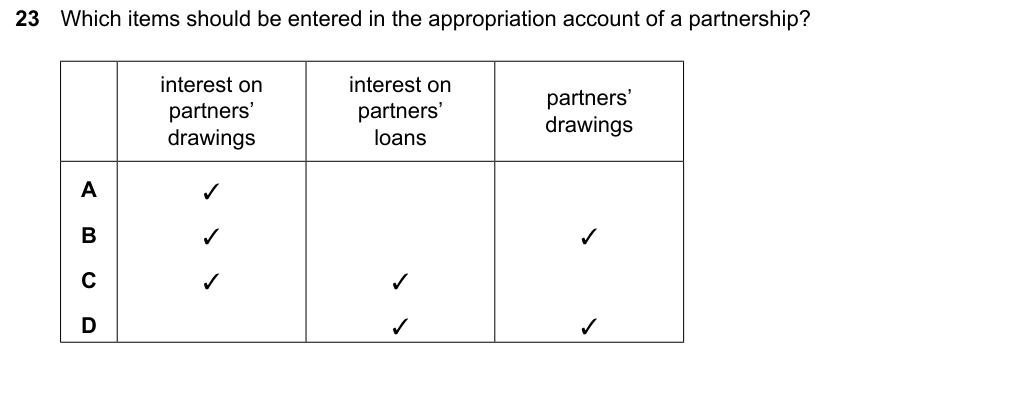
Answer: A.
Question 2
Use the complete source image for the question and answer choices. Source reference: W21 Paper 11, Q20.
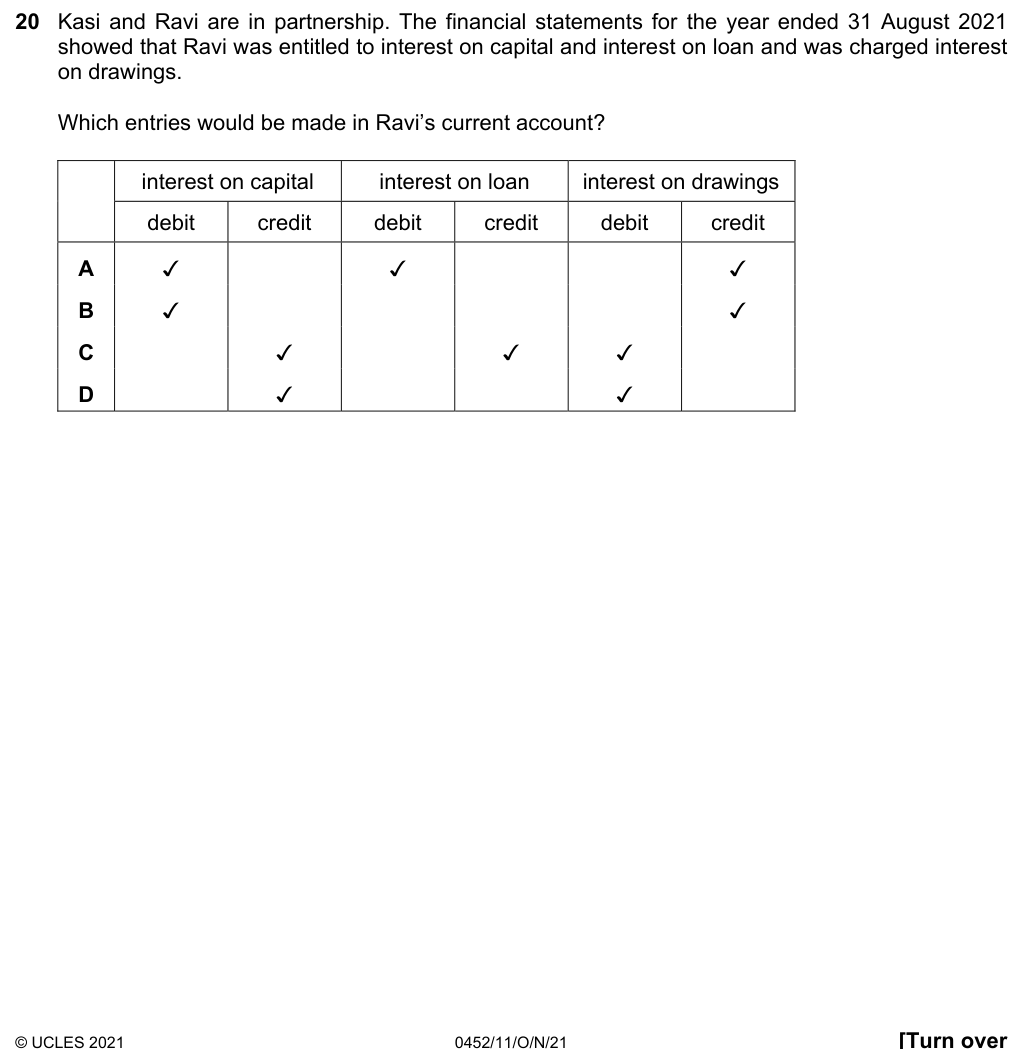
Answer: C.
Question 3
Use the complete source image for the question and answer choices. Source reference: W21 Paper 13, Q20.
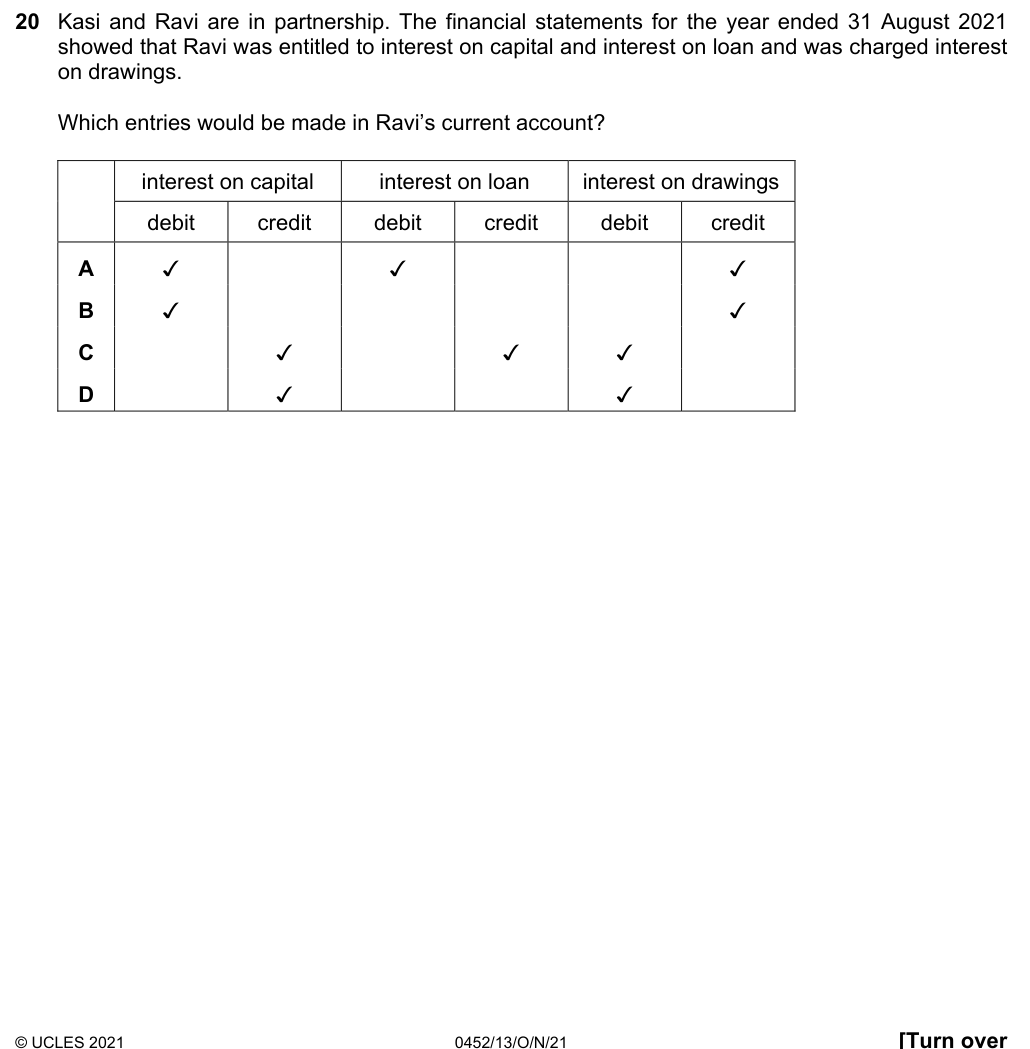
Answer: C.
What the syllabus asks for on this topicSyllabus points
Syllabus points
- Explain the advantages and disadvantages of forming a partnership.
- Explain the importance and the contents of a partnership agreement.
- Prepare an appropriation account and partners' capital and current accounts.
- Prepare the financial statements of a partnership.
Related CIE 0452 Accounting topics
Not the topic you were looking for? Describe what you are stuck on in your own words and we will take you to the notes that answer it.