Limited companies
Contents: 7 sections
What a limited company is
A company is a separate legal identity from its owners. It owns the assets, owes the debts, and can sue and be sued in its own name. That single fact drives everything else in this topic.
Because the company is separate, the shareholders have limited liability: they can lose at most what they agreed to pay for their shares. Once the shares are fully paid, the shareholder owes nothing more, however much the company owes.
Two things this does not mean, and both are examined:
- The company's liability is not limited. The company owes its debts in full. It is the shareholders who are protected.
- Limited liability does not make the company safe. It transfers risk from the shareholders to the creditors, which is exactly why companies must publish accounts while sole traders need not.
A private limited company (Ltd) cannot offer shares to the general public. A public limited company (plc) may, and faces stricter disclosure rules.
Advantages of a company: limited liability, more capital can be raised, continuity beyond any individual, and specialist managers can be employed.
Disadvantages: costly and complex to set up, accounts must be published so competitors can read them, more legal requirements, and the owners lose day-to-day control to the directors.
Shares
Ordinary shares carry the ownership.
- The dividend varies and is paid only when declared.
- Ordinary shareholders vote.
- They are paid last if the company is wound up, so they carry the most risk.
Preference shares sit between shares and loans.
- A fixed percentage dividend, paid before the ordinary dividend.
- Usually no vote.
- Paid before ordinary shareholders on a winding up, but after all creditors.
Share capital is always recorded at nominal value, whatever price the shares were issued at.
Debentures
Debentures are long-term loans to the company, usually secured on its assets.
They are the classic comparison question, so hold the differences precisely:
| Debentures | Shares | |
|---|---|---|
| The holder is a | Creditor | Owner |
| Return | Fixed interest | Dividend |
| Must it be paid? | Yes, whether or not there is a profit | Only if declared |
| In the accounts | Expense in the income statement | Appropriation of profit |
| Vote? | No | Ordinary shares do |
| Repaid on a winding up | Before all shareholders | Last |
| In the statement of financial position | Non-current liability | Equity |
Calling debenture holders part-owners, or treating the interest as a dividend, is the most common error in the topic.
Reserves
Capital reserves cannot be paid out as a dividend.
- Share premium, the excess of the issue price over the nominal value.
- Revaluation reserve, the unrealised surplus on revaluing an asset.
Revenue reserves can be paid out.
- Retained earnings, the accumulated profit not yet distributed.
- General reserve, profit deliberately set aside.
A transfer to a general reserve moves money from one revenue reserve to another. It does not reduce the profit for the year, it involves no cash, and the amount can still be distributed later. It signals an intention to retain funds, nothing more.
The financial statements
The income statement is the same as a sole trader's down to gross profit. Below that, four things differ:
- Directors' remuneration is an expense. Directors are employees.
- Debenture interest is an expense.
- Dividends are an appropriation and appear below profit for the year, never as an expense.
- Reserves appear in the equity section, not among liabilities.
The equity section of the statement of financial position:
| $ | |
|---|---|
| Ordinary share capital | 200 000 |
| Share premium | 40 000 |
| General reserve | 25 000 |
| Retained earnings | 63 000 |
| Total equity | 328 000 |
| Non-current liabilities: 6% debentures | 100 000 |
The debentures sit outside equity, because the debenture holders are creditors rather than owners. Debenture interest for the year would be 6% of 100 000, which is $6 000, charged as an expense whatever the company earned.
Common mistakes
- Saying limited liability means the company is not liable for its debts.
- Treating dividends as an expense.
- Treating debenture interest as an appropriation.
- Showing share capital at issue price rather than nominal value.
- Putting debentures in the equity section.
- Paying a dividend out of share premium or the revaluation reserve.
- Saying a transfer to general reserve reduces the profit for the year.
- Saying a public limited company is owned by the government.
Check you have it
Question 1
Which item is shown in the income statement and in the statement of changes in equity of a limited company? Use the complete source image for the question and answer choices. Source reference: W24 Paper 12, Q25.
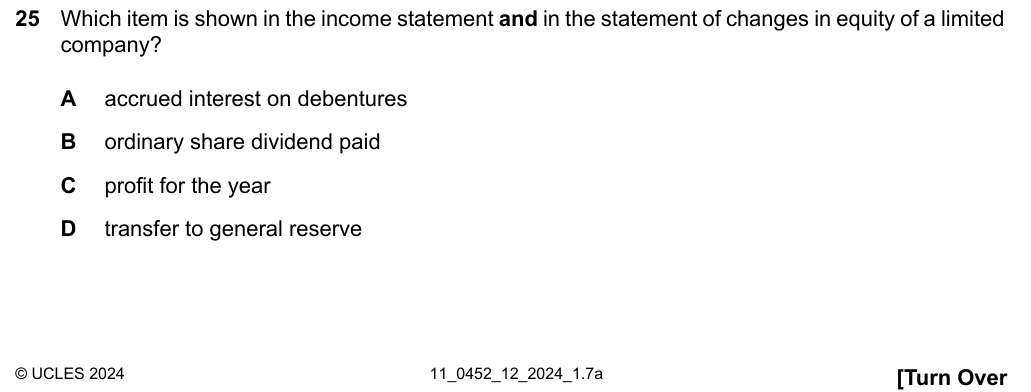
Answer: C.
Question 2
Use the complete source image for the question and answer choices. Source reference: S21 Paper 11, Q23.
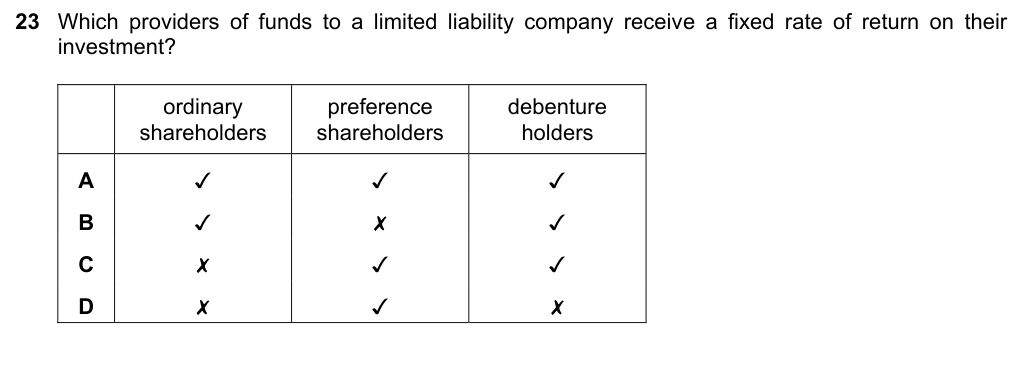
Answer: C.
Question 3
Use the complete source image for the question and answer choices. Source reference: W22 Paper 12, Q22.
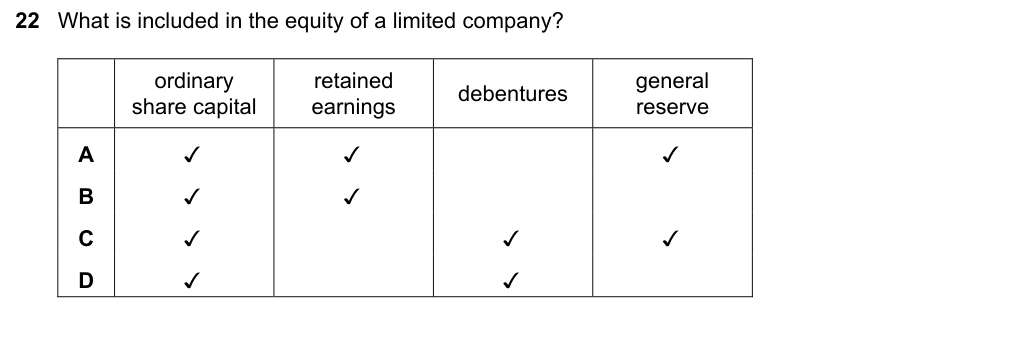
Answer: A.
What the syllabus asks for on this topicSyllabus points
Syllabus points
- Explain the advantages and disadvantages of operating as a limited company.
- Explain the meaning of limited liability and of ordinary and preference shares.
- Explain the meaning of debentures and of reserves.
- Prepare the financial statements of a limited company.
Related CIE 0452 Accounting topics
Not the topic you were looking for? Describe what you are stuck on in your own words and we will take you to the notes that answer it.