Irrecoverable debts and allowances
Contents: 8 sections
Irrecoverable debts
An irrecoverable debt is a specific customer who will not pay: they have gone out of business, disappeared, or refused. It is a certainty, not an estimate.
- Debit irrecoverable debts (an expense), credit trade receivables.
The customer's account is closed and the amount becomes an expense of the year in which it was decided the money would not come in.
Two reasons for doing this, and both earn marks:
- Prudence. Trade receivables would otherwise be overstated by an amount that will never be collected.
- Matching. The loss belongs to the period the sale was made in, or as soon as it is known.
Irrecoverable debts recovered
Sometimes a debt written off is later paid. Because the customer's account was closed, the receipt has nowhere obvious to go.
- Credit irrecoverable debts recovered, and debit bank with the amount received.
The recovery is other income in the income statement. It is not a sale, because no goods were supplied, and it is not deducted from this year's irrecoverable debts unless the question specifically says the two are netted off.
Allowance for irrecoverable debts
An allowance is different in kind from a write-off. It is an estimate covering the receivables that remain, made because past experience says some percentage of them will not pay, without knowing which ones.
It exists because of prudence: do not overstate receivables, and do not overstate profit.
The mechanic that carries the marks: only the change in the allowance goes to the income statement.
- An increase in the allowance is an expense.
- A decrease is income, shown as other income or as a reduction of the expense.
The order of the calculation
Write off the irrecoverable debts first, then calculate the allowance on what is left. Calculating the allowance on receivables that still include a debt about to be written off counts the same loss twice.
Trade receivables are $52 000 before writing off a debt of $2 000. An allowance of 5% is to be maintained. Last year's allowance was $1 800.
Write off the $2 000 first, leaving receivables of $50 000.
The required allowance is 5% of 50 000, which is $2 500. The existing allowance is $1 800, so the increase is 2 500 minus 1 800, which is $700, and $700 is charged to the income statement.
In the income statement this year: irrecoverable debts $2 000, plus the increase in the allowance $700.
In the statement of financial position:
| $ | $ | |
|---|---|---|
| Trade receivables | 50 000 | |
| Less allowance for irrecoverable debts | (2 500) | 47 500 |
Charging the whole $2 500 to the income statement instead of the $700 movement is the standard error, and it costs several marks each time.
A decrease in the allowance
If receivables fall, the required allowance falls with them.
Next year, receivables are $34 000 and the allowance is still 5%, so the required allowance is $1 700. The existing allowance is $2 500, so it must fall by $800.
That $800 is income. Debit the allowance account, credit the income statement. It is not an expense, and it increases profit.
The two are not the same thing
Questions often ask for the difference, and a precise answer is short:
| Irrecoverable debt | Allowance | |
|---|---|---|
| Certainty | A known, specific loss | An estimate |
| Applies to | One named customer | The receivables as a whole |
| Effect on receivables | Removes the balance | Does not remove any balance |
| In the income statement | The full amount | Only the change |
| In the statement of financial position | Nothing left to show | Deducted from receivables |
The row that matters most is the third. Creating an allowance does not cancel anybody's debt. The customers still owe the money and will still be chased for it; the business is simply presenting the receivables at a more realistic figure.
Common mistakes
- Charging the full allowance to the income statement instead of the movement.
- Calculating the allowance before writing off irrecoverable debts.
- Treating a decrease in the allowance as an expense.
- Showing trade receivables in the statement of financial position without deducting the allowance.
- Recording a recovered debt as a sale.
- Saying an allowance removes the debts from the customers' accounts.
- Confusing the allowance with the provision for depreciation. Both are credit balances deducted from an asset, but they cover different things.
Check you have it
Question 1
Use the complete source image for the question and answer choices. Source reference: W24 Paper 12, Q8.
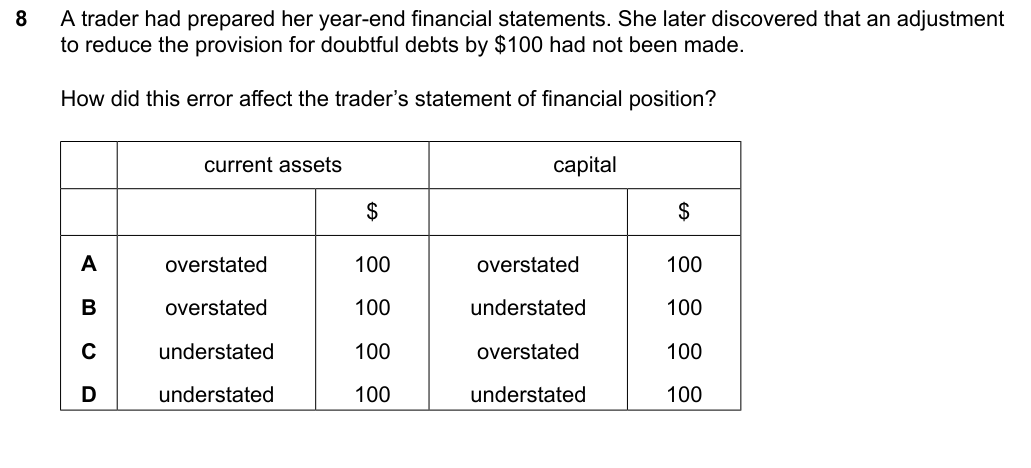
Answer: D.
Question 2
At the end of the financial year, Karim decided to increase his provision for doubtful debts. How will this affect his income statement and the statement of financial position? Use the complete source image for the question and answer choices. Source reference: S23 Paper 11, Q22.
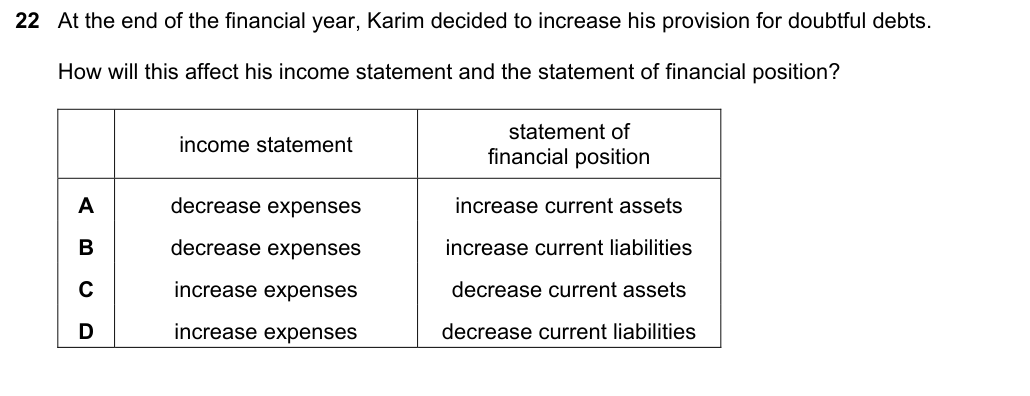
Answer: C.
Question 3
Sally wished to increase the balance on the provision for doubtful debts account at the end of the financial year. How should this increase be recorded? Use the complete source image for the question and answer choices. Source reference: W21 Paper 11, Q15.
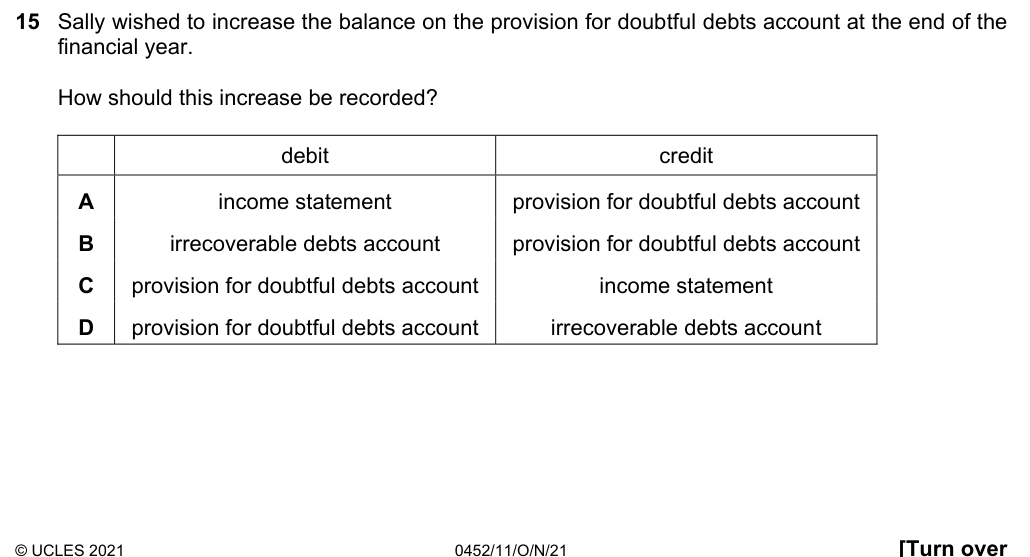
Answer: A.
What the syllabus asks for on this topicSyllabus points
Syllabus points
- Explain why irrecoverable debts are written off.
- Record irrecoverable debts and irrecoverable debts recovered.
- Explain the purpose of an allowance for irrecoverable debts.
- Create and adjust an allowance and show it in the financial statements.
Related CIE 0452 Accounting topics
Not the topic you were looking for? Describe what you are stuck on in your own words and we will take you to the notes that answer it.