37 past-paper questions on this unit. Five of them are below. Answer on the page: each one is marked the moment you pick, the correct option is shown whether or not you found it, and the full explanation opens either way.
CIE 0452 AccountingPaper 1 MCQsFree account
Irrecoverable debts and allowances: five questions to try now
Real past-paper questions, the answer key from the mark scheme, and the explanation that goes with it. No account needed to answer them.
Question 1
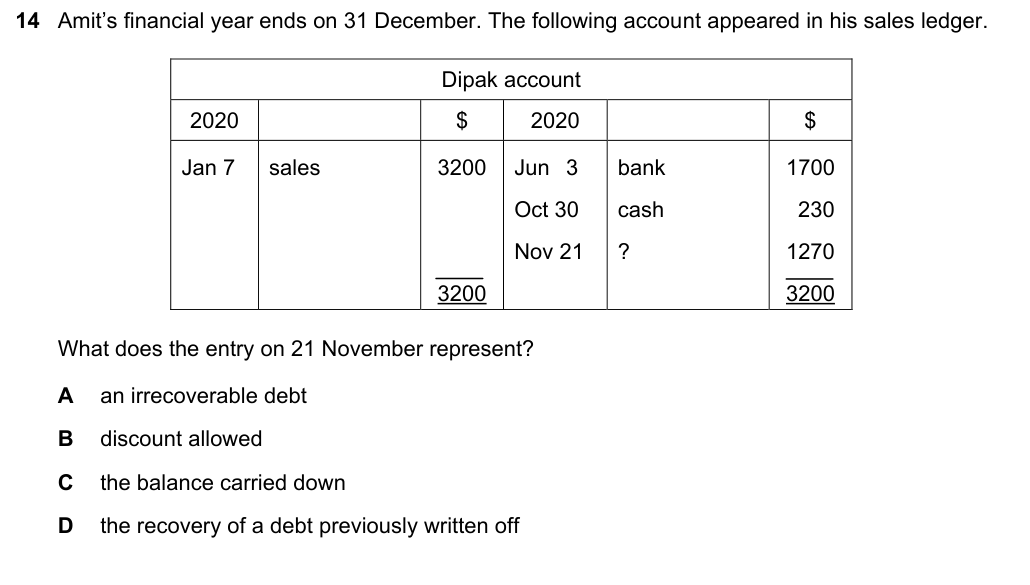
Use the complete source image for the question and answer choices. Source reference: W21 Paper 11, Q14.
Answer: A.
The account closes to nothing: sales of 3200 on the debit side are matched by 1700 by bank, 230 in cash and the unnamed 1270. Since the account is cleared with no balance carried forward, the 1270 cannot be C, and it is not a payment because both payments are already named. It is the write off of the rest of the debt as irrecoverable, so A is correct. B is the wrong scale, since discount allowed is a small percentage granted for prompt settlement, not 40 per cent of the invoice. D describes money coming back on a debt already written off, which would go through the bank rather than through this account.
Question 2
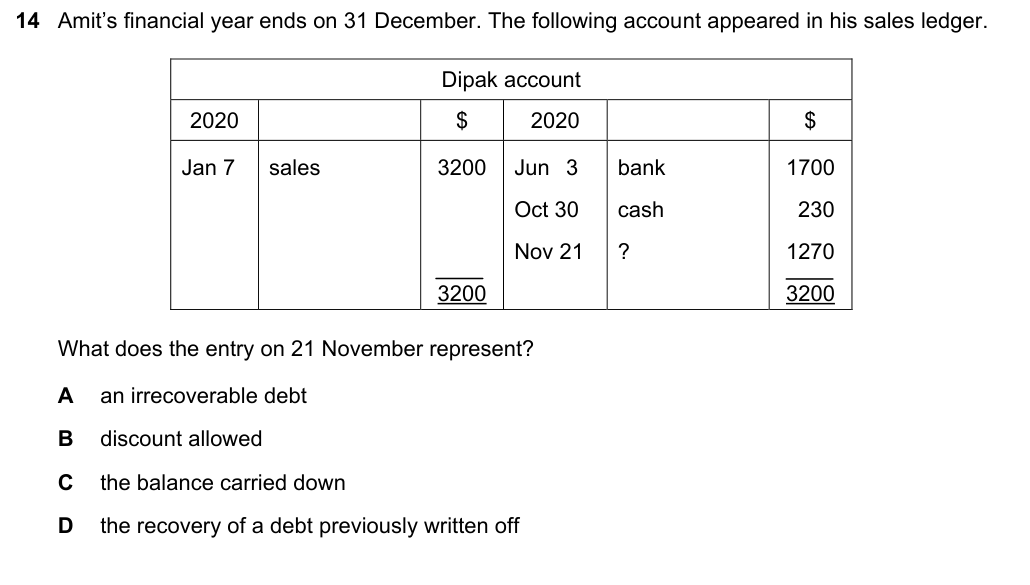
Use the complete source image for the question and answer choices. Source reference: W21 Paper 13, Q14.
Answer: A.
The account closes to nothing: sales of 3200 on the debit side are matched by 1700 by bank, 230 in cash and the unnamed 1270. Since the account is cleared with no balance carried forward, the 1270 cannot be C, and it is not a payment because both payments are already named. It is the write off of the rest of the debt as irrecoverable, so A is correct. B is the wrong scale, since discount allowed is a small percentage granted for prompt settlement, not 40 per cent of the invoice. D describes money coming back on a debt already written off, which would go through the bank rather than through this account.
Question 3
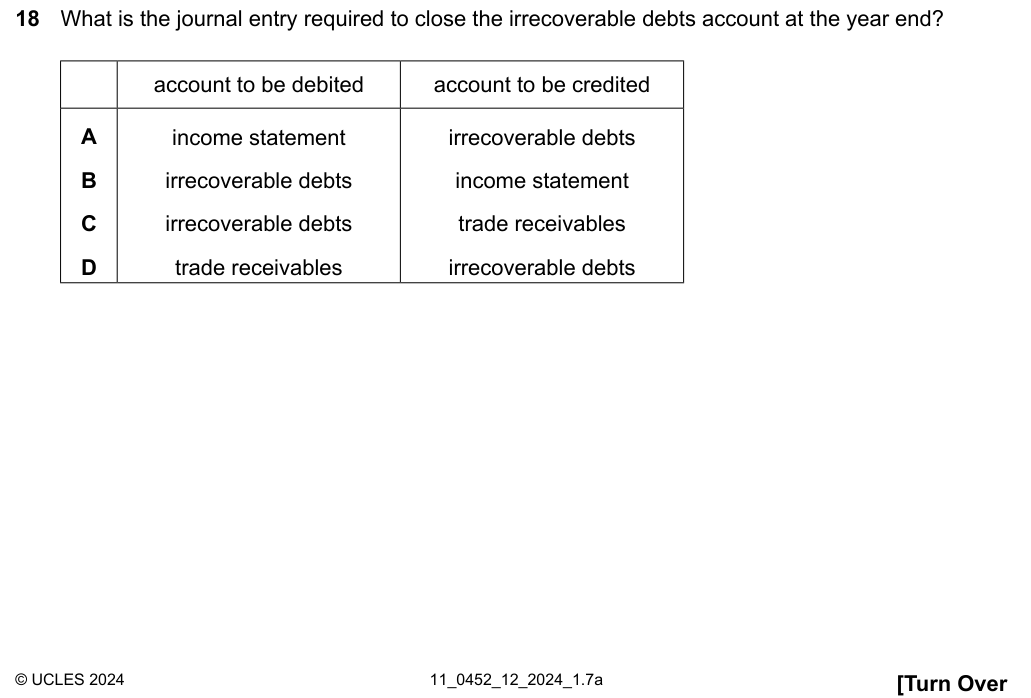
What is the journal entry required to close the irrecoverable debts account at the year end? Use the complete source image for the question and answer choices. Source reference: W24 Paper 12, Q18.
Answer: A.
The irrecoverable debts account is an expense account, and at the year end every expense account is closed by transferring its balance to the income statement. Since the expense sits as a debit balance, clearing it means CREDITING irrecoverable debts and debiting the income statement, so A is correct. B reverses those sides and would turn the loss into income. C is the entry that WROTE the debt off during the year, from the customer's account rather than from a general trade receivables one, and D reverses that.
Question 4
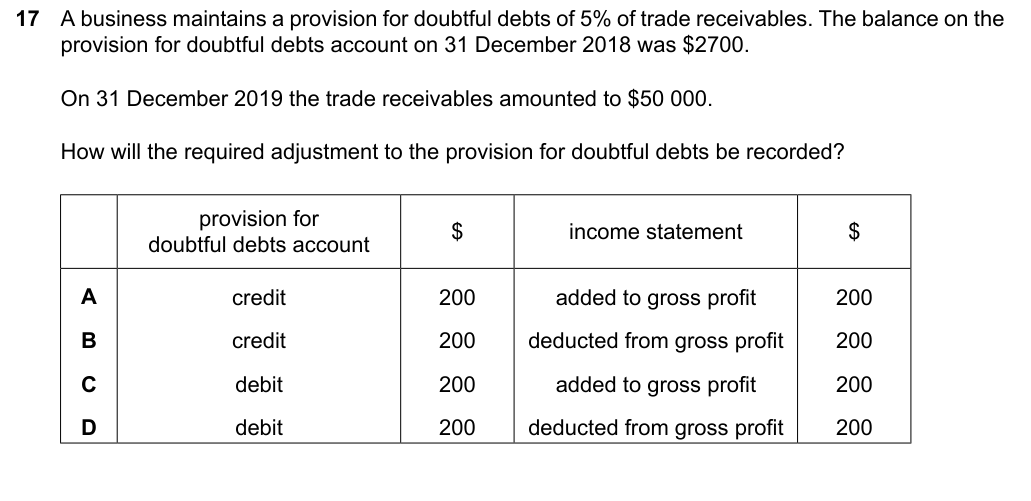
Use the complete source image for the question and answer choices. Source reference: M24 Paper 12, Q17.
Answer: C.
The provision must end the year at 5 per cent of 50 000, which is 2500, and it currently stands at 2700, so it has to FALL by 200. Reducing a provision means debiting the provision for doubtful debts account, and the other half of the entry is a credit in the income statement, which is added rather than deducted. C is correct, showing a debit of 200 in the account and 200 added to gross profit. D has the right entry in the account but treats the release as an expense. A and B credit the provision account, which would increase it when the required figure has gone down.
Question 5
Devendra prepared the following journal entry. debit credit $ $ irrecoverable debts 714 Tobias 714 Which statement is correct?
Answer: C.
Debiting irrecoverable debts records the loss as an expense, and crediting Tobias removes the balance from his account, which is the write off of a debt that will not be collected. C is correct. A describes a provision, and a provision never touches an individual customer's account, which is what makes it a general estimate rather than a write off. B would debit the bank, since receiving money increases it. D describes a recovery, where the bank is debited and the credit goes to a debts recovered account, because the customer's account was already closed.
These questions are drawn from past CIE 0452 Accounting papers and filtered to irrecoverable debts and allowances. You answer, you find out immediately whether you were right, and you get the reasoning for the correct option and for each distractor. Wrong answers go to a mistakes locker so you can come back to exactly those.
Practice is free. You need an account only so your progress and your mistakes are still there next time.
These are the errors that cost marks on irrecoverable debts and allowances, taken from our own topic notes. Read them before you practise and you will recognise the traps in the questions.
Charging the full allowance to the income statement instead of the movement.
Calculating the allowance before writing off irrecoverable debts.
Treating a decrease in the allowance as an expense.
Showing trade receivables in the statement of financial position without deducting the allowance.
Recording a recovered debt as a sale.
Saying an allowance removes the debts from the customers' accounts.
Confusing the allowance with the provision for depreciation. Both are credit balances deducted from an asset, but they cover different things.