Business documents
Contents: 7 sections
The documents in order
A credit sale generates a sequence of documents, and questions test whether you know which stage each one belongs to and which way it travels.
| Document | Sent by | Sent to | Purpose |
|---|---|---|---|
| Invoice | Seller | Buyer | States what was supplied and how much is owed |
| Credit note | Seller | Buyer | Reduces the amount owed, for returns or an overcharge |
| Debit note | Buyer | Seller | Asks for a reduction; a request, not an adjustment |
| Statement of account | Seller | Buyer | Monthly summary of invoices, credit notes and payments, showing the balance due |
| Cheque counterfoil | Kept by payer | Record of a payment made | |
| Receipt | Seller | Buyer | Proof that payment has been received |
| Paying-in slip counterfoil | Kept by depositor | Record of money paid into the bank | |
| Petty cash voucher | Claimant | Petty cashier | Authorises and records a small cash payment |
Two of these are regularly confused.
Debit note and credit note. The debit note goes from buyer to seller asking for money off. The credit note goes back from seller to buyer actually giving it. Only the credit note is recorded in the returns journals; the debit note is a request and is not entered in the books.
Invoice and statement. The invoice covers one transaction. The statement covers a period and lists all of them with a running balance. A statement is not entered in the books at all: it is used to check that the supplier's record agrees with yours.
What is on an invoice
- The names and addresses of the seller and the buyer.
- The invoice number and the date.
- A description of the goods, the quantity and the unit price.
- Trade discount, deducted from the list price.
- The total amount due.
- The terms, such as "net 30 days" or "2% cash discount if paid within 14 days".
E. & O.E. often appears at the foot, standing for errors and omissions excepted. It means the seller reserves the right to correct a mistake later.
Trade discount and cash discount
These behave completely differently, and the distinction is examined every year.
| Trade discount | Cash discount | |
|---|---|---|
| Given for | Buying in bulk, or being in the same trade | Paying within a set time |
| Deducted | Before the invoice total | After, when payment is made |
| Recorded in the books? | Never | Yes |
| Appears as | Nothing at all | Discount allowed (expense) or discount received (income) |
Goods with a list price of $2 000 carry 25% trade discount. The invoice is for $1 500, and $1 500 is the figure entered in the sales journal. The $500 appears nowhere.
If the customer then pays within 14 days and takes a 2% cash discount, they pay 2% less than $1 500, which is $30 off, so $1 470 is received. The seller records discount allowed of $30 as an expense; the buyer records discount received of $30 as income.
Why documents matter
- They are the source for the books of prime entry. Nothing is entered without one.
- They provide evidence if a dispute arises.
- They allow figures to be checked against an independent record.
- They help prevent fraud, since a payment without a supporting document stands out.
Which book each document feeds
| Document | Book of prime entry |
|---|---|
| Sales invoice (copy) | Sales journal |
| Purchase invoice | Purchases journal |
| Credit note issued | Sales returns journal |
| Credit note received | Purchases returns journal |
| Cheque counterfoil, paying-in counterfoil, receipt | Cash book |
| Petty cash voucher | Petty cash book |
| Anything else | The journal |
Common mistakes
- Saying the debit note reduces the amount owed. It only requests the reduction.
- Recording trade discount in the books.
- Entering the statement of account in the ledger.
- Calculating cash discount on the list price instead of on the invoice total after trade discount.
- Saying an invoice is a request for payment received. It is issued by the seller.
- Recording a credit note received in the sales returns journal.
Check you have it
Question 1
Which business documents provide information for writing up the sales journal and the sales returns journal? Use the complete source image for the question and answer choices. Source reference: W22 Paper 13, Q6.
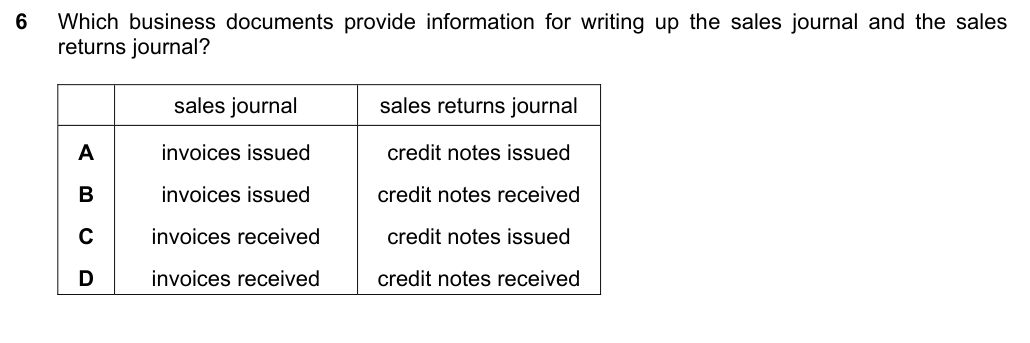
Answer: A.
Question 2
Alisha entered the credit notes she received in March in the correct returns journal.
How was the total of this journal recorded in the ledger at the end of the month?
Answer: A.
Question 3
A customer paid $15 600 to a supplier after receiving a 2 2 1 % cash discount and a trade discount of 20%.
What was the amount of the invoice entered in the purchases journal?
Answer: C.
What the syllabus asks for on this topicSyllabus points
Syllabus points
- Recognise and understand the main business documents.
- State the use of each document and who sends it to whom.
- Complete simple business documents.
- Distinguish trade discount from cash discount.
Related CIE 0452 Accounting topics
Not the topic you were looking for? Describe what you are stuck on in your own words and we will take you to the notes that answer it.