37 past-paper questions on this unit. Five of them are below. Answer on the page: each one is marked the moment you pick, the correct option is shown whether or not you found it, and the full explanation opens either way.
CIE 0452 AccountingPaper 1 MCQsFree account
Business documents: five questions to try now
Real past-paper questions, the answer key from the mark scheme, and the explanation that goes with it. No account needed to answer them.
Question 1
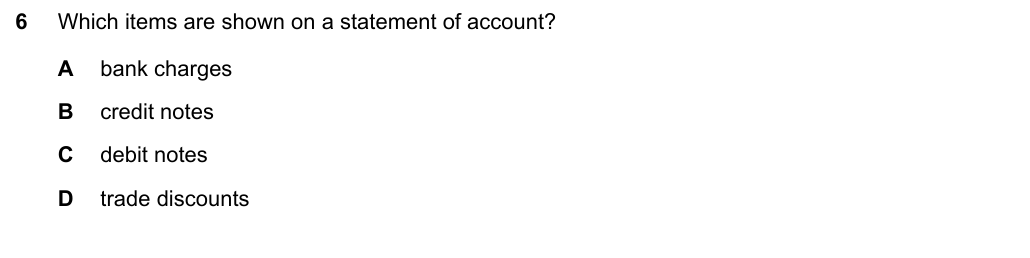
Which items are shown on a statement of account? Use the complete source image for the question and answer choices. Source reference: S23 Paper 11, Q6.
Answer: B.
A statement of account is a copy of the customer's account in the supplier's sales ledger, so it shows the entries that have actually been made on that account: the opening balance, invoices, credit notes, and payments received. Credit notes are among them, so B is correct. C, debit notes, are only the customer's REQUEST for an allowance, and no entry is made until the supplier agrees, so nothing appears on the account. D, trade discounts, are deducted before the invoice total is calculated, so the account carries only the net amount and never the discount itself. A, bank charges, belong to a bank statement, which is a different document prepared by the bank about the business's own account.
Question 2
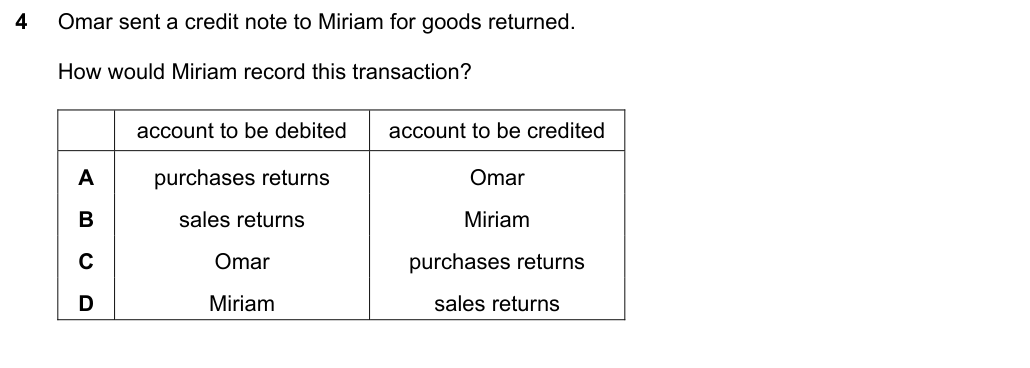
Omar sent a credit note to Miriam for goods returned. How would Miriam record this transaction? Use the complete source image for the question and answer choices. Source reference: S22 Paper 11, Q4.
Answer: C.
The question asks about MIRIAM's books, and Miriam is the customer who returned the goods. A credit note received reduces what she owes Omar, so his account in her purchases ledger is debited, and the other half of the entry is a credit to purchases returns, which reduces her net purchases. That is the pairing in C, debit Omar and credit purchases returns. A has the right two accounts but on opposite sides, which would increase her debt instead of reducing it. B and D both use sales returns, and that account belongs to the seller, so it is where OMAR records the same event in his own books.
Question 3
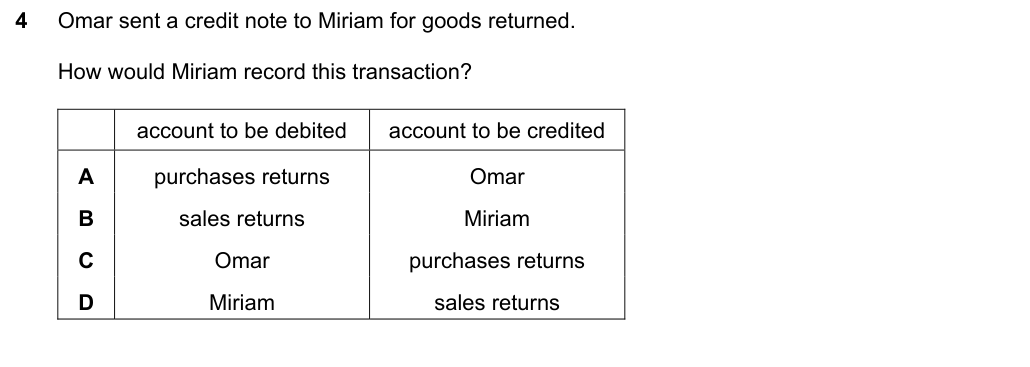
Omar sent a credit note to Miriam for goods returned. How would Miriam record this transaction? Use the complete source image for the question and answer choices. Source reference: S22 Paper 12, Q4.
Answer: C.
The question asks about MIRIAM's books, and Miriam is the customer who returned the goods. A credit note received reduces what she owes Omar, so his account in her purchases ledger is debited, and the other half of the entry is a credit to purchases returns, which reduces her net purchases. That is the pairing in C, debit Omar and credit purchases returns. A has the right two accounts but on opposite sides, which would increase her debt instead of reducing it. B and D both use sales returns, and that account belongs to the seller, so it is where OMAR records the same event in his own books.
Question 4
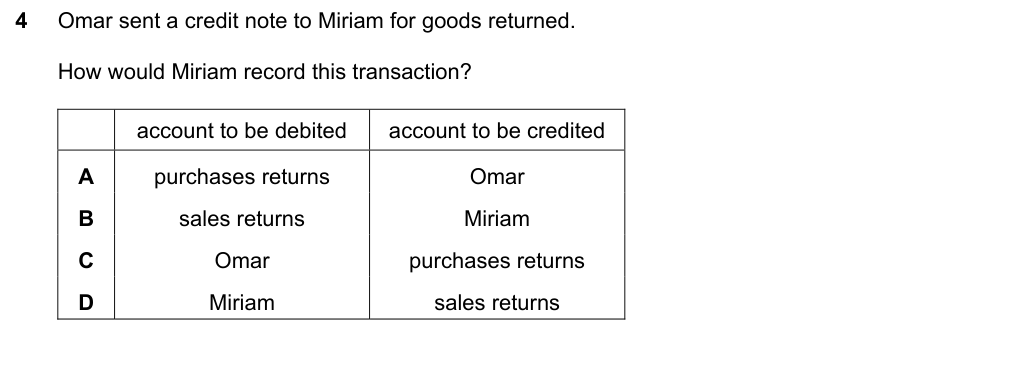
Omar sent a credit note to Miriam for goods returned. How would Miriam record this transaction? Use the complete source image for the question and answer choices. Source reference: S22 Paper 13, Q4.
Answer: C.
The question asks about MIRIAM's books, and Miriam is the customer who returned the goods. A credit note received reduces what she owes Omar, so his account in her purchases ledger is debited, and the other half of the entry is a credit to purchases returns, which reduces her net purchases. That is the pairing in C, debit Omar and credit purchases returns. A has the right two accounts but on opposite sides, which would increase her debt instead of reducing it. B and D both use sales returns, and that account belongs to the seller, so it is where OMAR records the same event in his own books.
Question 5
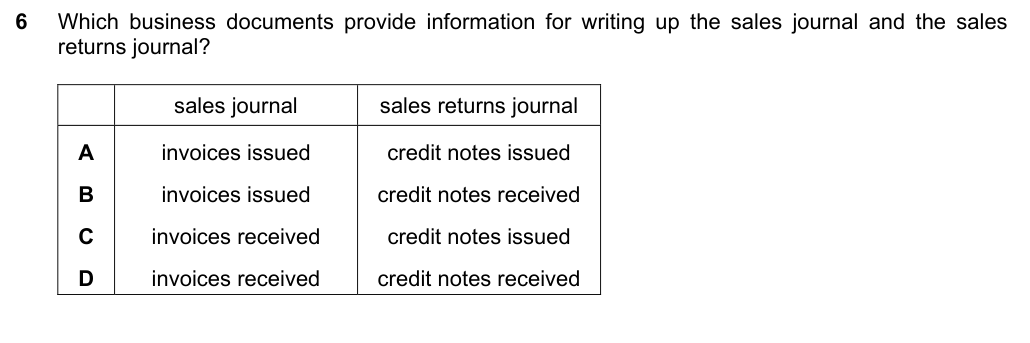
Which business documents provide information for writing up the sales journal and the sales returns journal? Use the complete source image for the question and answer choices. Source reference: W22 Paper 11, Q6.
Answer: A.
Both journals belong to the SELLER, so both are written up from documents the seller sends out, and A is correct. The sales journal lists the invoices issued for goods sold on credit, and the sales returns journal lists the credit notes issued when those customers send goods back. B keeps the right source for the sales journal but takes credit notes received, and a credit note received comes from a supplier and belongs in the purchases returns journal. C and D both use invoices received, which are the documents a buyer gets and which are entered in the purchases journal, so they describe the other side of the trade entirely.
These questions are drawn from past CIE 0452 Accounting papers and filtered to business documents. You answer, you find out immediately whether you were right, and you get the reasoning for the correct option and for each distractor. Wrong answers go to a mistakes locker so you can come back to exactly those.
Practice is free. You need an account only so your progress and your mistakes are still there next time.
These are the errors that cost marks on business documents, taken from our own topic notes. Read them before you practise and you will recognise the traps in the questions.
Saying the debit note reduces the amount owed. It only requests the reduction.
Recording trade discount in the books.
Entering the statement of account in the ledger.
Calculating cash discount on the list price instead of on the invoice total after trade discount.
Saying an invoice is a request for payment received. It is issued by the seller.
Recording a credit note received in the sales returns journal.