Sole traders
Contents: 7 sections
The sole trader
One owner, who takes all the profit and bears all the risk.
Advantages: quick and cheap to set up, complete control, all decisions are the owner's, the accounts are private, and profit does not have to be shared.
Disadvantages: unlimited liability, so the owner's personal assets are at risk; limited capital; long hours with no one to share the work; and the business ends if the owner does.
Unlimited liability is the point most worth understanding rather than reciting. The business and the owner are the same person in law, so a debt of the business is a debt of the owner.
The income statement
It runs in two parts.
Trading section, giving gross profit
Revenue, less sales returns, gives net sales. Then cost of sales:
opening inventory + purchases − purchases returns + carriage inwards − goods taken by the owner − closing inventory
Gross profit is net sales less cost of sales.
Profit and loss section, giving profit for the year
Gross profit, plus other income (rent received, discount received, irrecoverable debts recovered, a decrease in the allowance), less expenses (wages, rent, insurance, carriage outwards, depreciation, irrecoverable debts, an increase in the allowance).
Three items decide a lot of marks:
- Carriage inwards is part of cost of sales, because it is a cost of getting goods in.
- Carriage outwards is an expense in the second section, because it is a cost of getting goods out to customers.
- Goods taken by the owner are deducted from purchases and added to drawings, at cost. They are never a sale.
A service business has no goods, so it has no trading section at all: it has revenue or fees, less expenses, giving profit for the year. Producing a gross profit for a business that sells services is a common error.
A worked income statement
| $ | $ | |
|---|---|---|
| Revenue | 96 000 | |
| Less sales returns | (1 500) | |
| 94 500 | ||
| Opening inventory | 8 200 | |
| Purchases | 52 000 | |
| Carriage inwards | 1 300 | |
| Less goods taken by owner | (700) | |
| Less closing inventory | (9 400) | |
| Cost of sales | (51 400) | |
| Gross profit | 43 100 | |
| Add rent received | 2 400 | |
| 45 500 | ||
| Less expenses | ||
| Wages | 21 000 | |
| Insurance | 1 800 | |
| Carriage outwards | 1 100 | |
| Depreciation | 3 000 | (26 900) |
| Profit for the year | 18 600 |
Check the cost of sales: 8 200 plus 52 000 plus 1 300, less 700, less 9 400, is $51 400. And 94 500 minus 51 400 is $43 100.
The statement of financial position
The layout runs from least liquid to most liquid.
Assets: non-current assets at cost less provision for depreciation, giving carrying amount; then current assets in order of liquidity, which is inventory, trade receivables (less the allowance), other receivables, bank, cash.
Capital and liabilities: capital at the start, plus capital introduced, plus profit for the year, less drawings, giving closing capital; then non-current liabilities; then current liabilities.
Note the order of the current assets. Inventory first, cash last, because the list runs from hardest to turn into money to easiest. Reversing it is a presentation error that examiners do penalise.
The adjustments
Every adjustment appears twice, once in each statement. An answer that adjusts one and not the other will not balance.
| Adjustment | Income statement | Statement of financial position |
|---|---|---|
| Accrued expense | Add to the expense | Current liability |
| Prepaid expense | Deduct from the expense | Current asset |
| Depreciation | Expense for the year | Added to the provision, reducing the carrying amount |
| Irrecoverable debt | Expense | Deducted from trade receivables |
| Increase in the allowance | Expense | Allowance deducted from receivables |
| Closing inventory | Deducted in cost of sales | Current asset |
| Goods taken by the owner | Deducted from purchases | Added to drawings |
Common mistakes
- Preparing a trading section for a service business.
- Putting carriage inwards among the expenses.
- Treating goods taken by the owner as a sale.
- Listing current assets with cash first.
- Treating drawings as an expense in the income statement.
- Adjusting the income statement and forgetting the matching entry in the statement of financial position.
- Showing trade receivables without deducting the allowance.
Check you have it
Question 1
What is shown in the capital and liabilities section of a statement of financial position of a business? Use the complete source image for the question and answer choices. Source reference: W21 Paper 12, Q18.
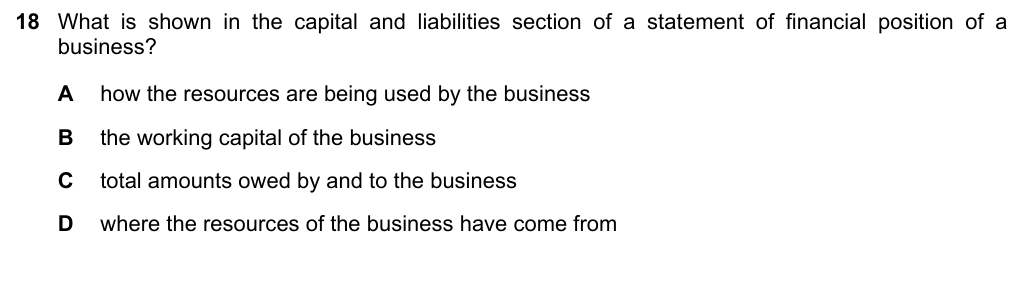
Answer: D.
Question 2
Sabeena runs a retail business. She plans to close her business in a few weeks’ time.
How should her fixtures and fittings be valued in the statement of financial position?
Answer: B.
Question 3
When valuing his closing inventory, Asim omitted goods costing $990. What is the effect of this error? Use the complete source image for the question and answer choices. Source reference: M23 Paper 12, Q20.
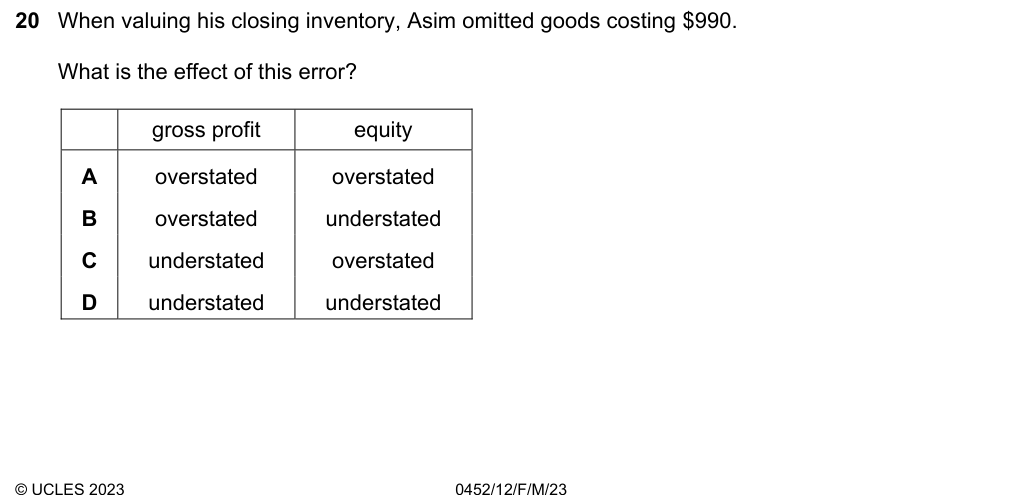
Answer: D.
What the syllabus asks for on this topicSyllabus points
Syllabus points
- Explain the advantages and disadvantages of trading as a sole trader.
- Prepare an income statement for a trading business and for a service business.
- Prepare a statement of financial position.
- Make the year-end adjustments within the financial statements.
Related CIE 0452 Accounting topics
Not the topic you were looking for? Describe what you are stuck on in your own words and we will take you to the notes that answer it.