76 past-paper questions on this unit. Five of them are below. Answer on the page: each one is marked the moment you pick, the correct option is shown whether or not you found it, and the full explanation opens either way.
CIE 0452 AccountingPaper 1 MCQsFree account
Sole traders: five questions to try now
Real past-paper questions, the answer key from the mark scheme, and the explanation that goes with it. No account needed to answer them.
Question 1
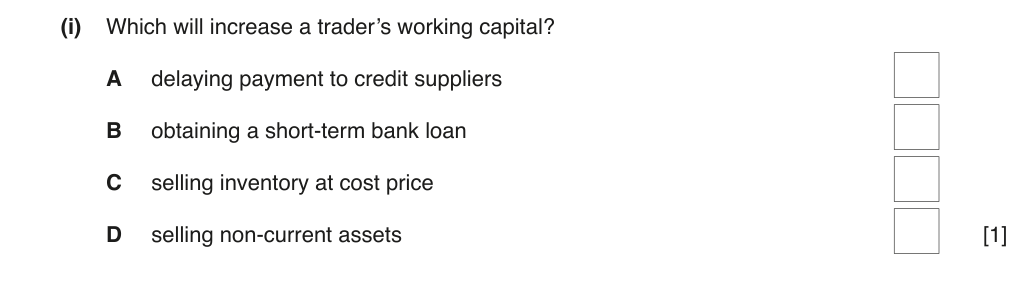
Which will increase a trader’s working capital? Use the complete source image for the question and answer choices. Source reference: M19 Paper 12, Q1(i).
Answer: D.
Working capital is current assets less current liabilities, so it only moves when something crosses the boundary between current and non-current. Selling a non-current asset does exactly that, turning an asset that was outside working capital into cash that is inside it, so D is correct. A changes nothing, since delaying payment leaves both the cash and the payable where they are. B raises a current asset and a current liability equally. C swaps inventory for cash at the same value, so the total is unchanged.
Question 2
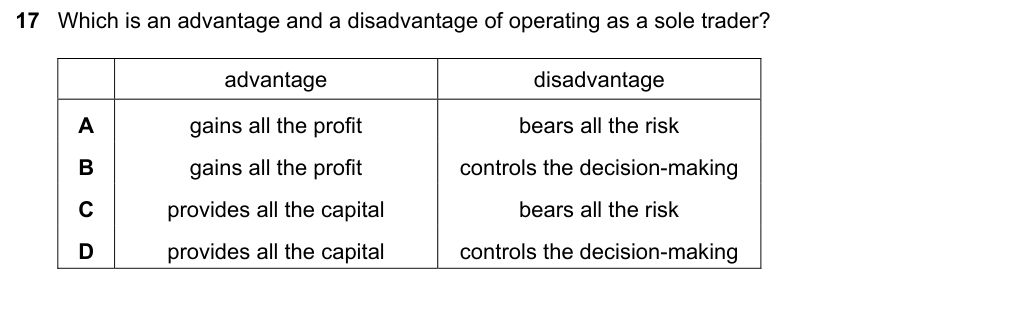
Which is an advantage and a disadvantage of operating as a sole trader? Use the complete source image for the question and answer choices. Source reference: W21 Paper 12, Q17.
Answer: A.
A sole trader owns the business outright, so all the profit is his, which is the advantage, and there is nobody to share the losses or the liability with, so he bears all the risk, which is the disadvantage. A is correct. B and D call controlling the decision-making a DISADVANTAGE, when answering to nobody is one of the main attractions of the form. C calls providing all the capital an advantage, when having no partners to contribute is exactly what limits a sole trader's finance.
Question 3
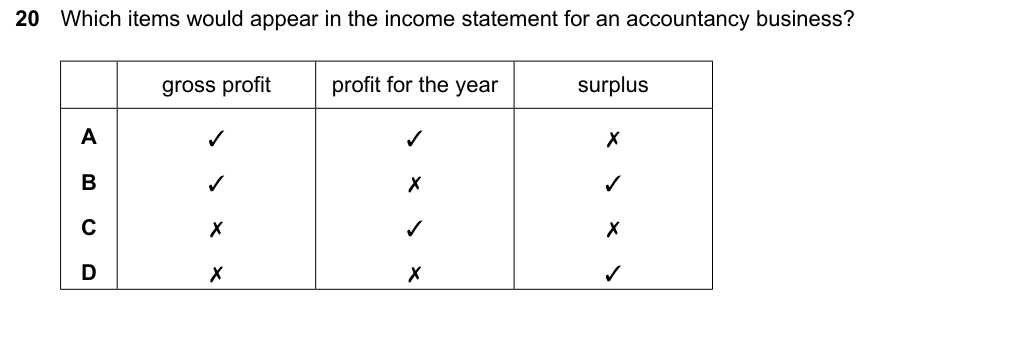
Which items would appear in the income statement for an accountancy business? Use the complete source image for the question and answer choices. Source reference: W24 Paper 12, Q20.
Answer: C.
An accountancy business sells professional time rather than goods, so it buys nothing to resell, has no cost of sales, and therefore has no gross profit. It does still work out a profit for the year, being its fees less its expenses. C ticks only that one and is correct. A and B tick gross profit, which cannot exist without a trading section. B and D tick surplus, which is the word a CLUB uses for the excess of income over expenditure, because a club has no owner to earn a profit for.
Question 4
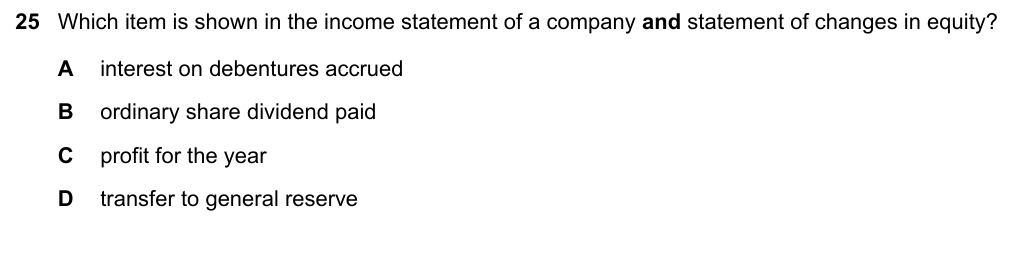
Which item is shown in the income statement of a company and statement of changes in equity? Use the complete source image for the question and answer choices. Source reference: S20 Paper 11, Q25.
Answer: C.
Profit for the year is the one figure that appears in both. It is the result the income statement works towards, and it is the opening addition in the statement of changes in equity, which shows how the shareholders' stake moved. C is correct. A, interest on debentures, is a finance cost and belongs to the income statement alone. B, a dividend paid, and D, a transfer to general reserve, are both movements within equity, so each appears in the statement of changes in equity and nowhere else.
Question 5
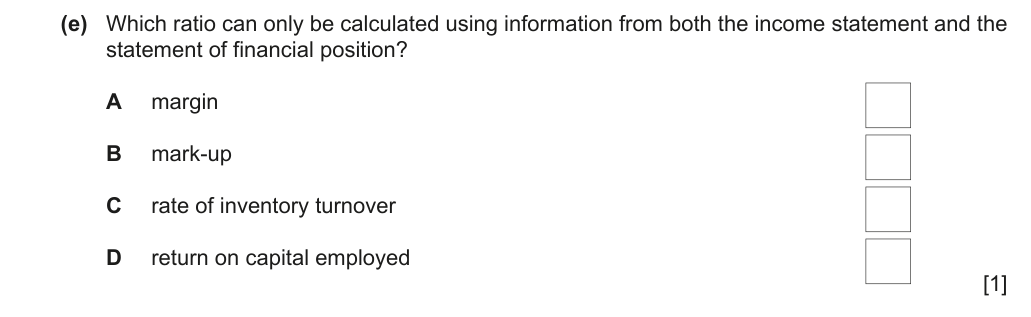
Which ratio can only be calculated using information from both the income statement and the statement of financial position? Use the complete source image for the question and answer choices. Source reference: W19 Paper 12, Q1(e).
Answer: D.
Return on capital employed divides the profit, which comes from the income statement, by capital employed, which appears only in the statement of financial position, so both statements are needed and D is correct. A and B, margin and mark-up, use revenue, cost of sales and gross profit, all of which sit in the income statement. C is the one worth pausing on: the rate of inventory turnover needs the cost of sales and the average inventory, and BOTH inventory figures already appear in the trading section, so the income statement alone is enough.
These questions are drawn from past CIE 0452 Accounting papers and filtered to sole traders. You answer, you find out immediately whether you were right, and you get the reasoning for the correct option and for each distractor. Wrong answers go to a mistakes locker so you can come back to exactly those.
Practice is free. You need an account only so your progress and your mistakes are still there next time.
These are the errors that cost marks on sole traders, taken from our own topic notes. Read them before you practise and you will recognise the traps in the questions.
Preparing a trading section for a service business.
Putting carriage inwards among the expenses.
Treating goods taken by the owner as a sale.
Listing current assets with cash first.
Treating drawings as an expense in the income statement.
Adjusting the income statement and forgetting the matching entry in the statement of financial position.
Showing trade receivables without deducting the allowance.