The double entry system
Contents: 7 sections
The rule
Every transaction has two effects of equal value, one debit and one credit. Debit is the left side of an account and credit the right. Those words mean nothing more than that: a debit is not "good" and a credit is not "money coming in".
Which side increases an account:
| Increased by a | Decreased by a | |
|---|---|---|
| Asset | Debit | Credit |
| Expense | Debit | Credit |
| Drawings | Debit | Credit |
| Liability | Credit | Debit |
| Income | Credit | Debit |
| Capital | Credit | Debit |
DEAD CLIC is the usual memory aid: Debits are Expenses, Assets and Drawings; Credits are Liabilities, Income and Capital.
A credit entry in the bank account means the bank balance has gone down. Bank statements use the words the other way round, because the bank is describing its own books, and that is where the confusion usually starts.
Working out an entry
Ask two questions in order: which two accounts are affected, and is each one going up or down? The rule table then gives the sides.
| Transaction | Debit | Credit |
|---|---|---|
| Owner pays $15 000 into the bank | Bank | Capital |
| Buys goods for resale on credit from L Roy | Purchases | L Roy |
| Sells goods on credit to M Osei | M Osei | Sales |
| Pays L Roy by cheque | L Roy | Bank |
| M Osei pays by cheque | Bank | M Osei |
| Returns goods to L Roy | L Roy | Purchases returns |
| M Osei returns goods | Sales returns | M Osei |
| Pays rent in cash | Rent | Cash |
| Owner takes $300 for personal use | Drawings | Bank |
| Buys a delivery van by cheque | Motor vehicles | Bank |
Two rows repay attention. Purchases is an expense account for goods bought for resale; buying a van is not a purchase, it is a non-current asset. And drawings has its own account: it is not an expense and it does not go in the income statement.
Balancing an account
At the end of a period each account is balanced:
- Add up both sides and find which is larger.
- Enter the difference on the smaller side as "Balance c/d", so the two sides now total the same.
- Rule off the account with both totals equal.
- Enter the same figure on the opposite side, below the totals, as "Balance b/d".
The balance brought down is the account's balance going into the next period, and it is the figure that appears in the trial balance.
A trade payable account has purchases of $900 and $600 on the credit side, and a payment of $900 on the debit side. Credits total $1 500 and debits $900, so the balance c/d on the debit side is $600, both sides then total $1 500, and the balance b/d of $600 appears on the credit side. It is a credit balance because the supplier is still owed $600.
Reading a balance
The balance tells you what the account is and what it means:
| Account | Normal balance | What it means |
|---|---|---|
| Bank | Debit | Money in the bank |
| Bank | Credit | An overdraft |
| Trade receivables | Debit | Customers owe the business |
| Trade payables | Credit | The business owes suppliers |
| Capital | Credit | The owner's claim |
| Sales | Credit | Income earned |
| Purchases | Debit | An expense |
An account with the opposite of its usual balance is a signal worth explaining rather than an automatic error. A credit balance on a customer's account usually means they have overpaid or have been given a credit note after paying.
Where the accounts live
- Sales ledger: a personal account for each credit customer.
- Purchases ledger: a personal account for each credit supplier.
- General ledger: everything else, including sales, purchases, expenses, assets and capital.
- The cash book holds the bank and cash accounts.
Common mistakes
- Reading a credit in the cash book as money received.
- Debiting the supplier when buying goods on credit. The supplier is credited.
- Entering a van purchase in the purchases account.
- Treating drawings as an expense.
- Putting the balance c/d on the larger side.
- Forgetting to bring the balance down, so the account is left with no opening figure.
- Recording only one side of a transaction.
Check you have it
Question 1
Use the complete source image for the question and answer choices. Source reference: M19 Paper 12, Q1(a).
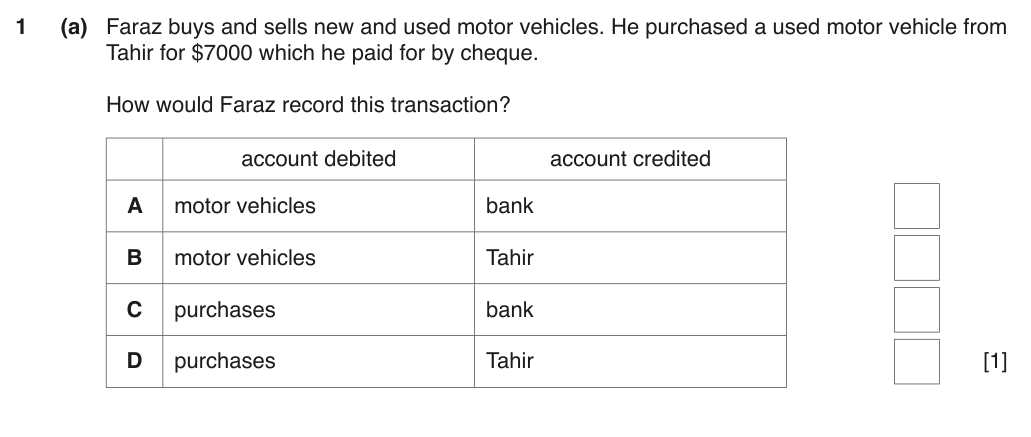
Answer: C.
Question 2
Use the complete source image for the question and answer choices. Source reference: S19 Paper 12, Q1(e).
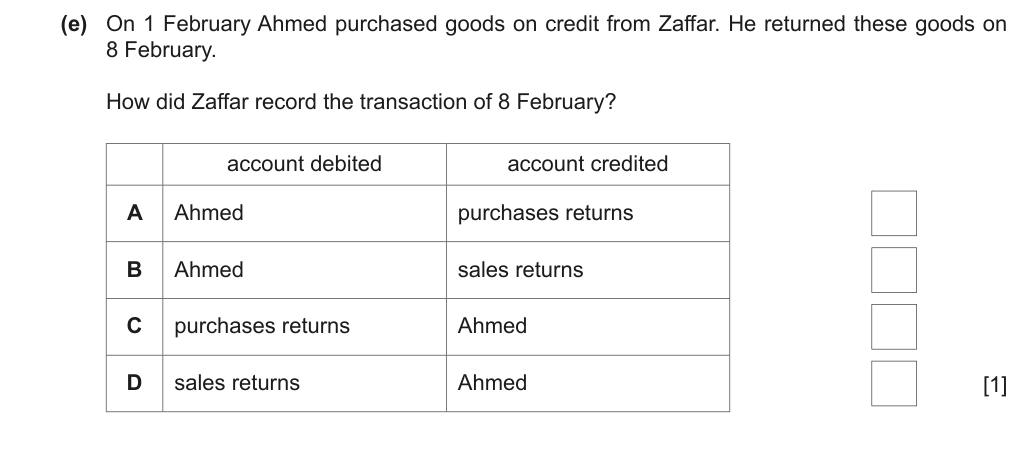
Answer: D.
Question 3
Use the complete source image for the question and answer choices. Source reference: S19 Paper 13, Q1(e).
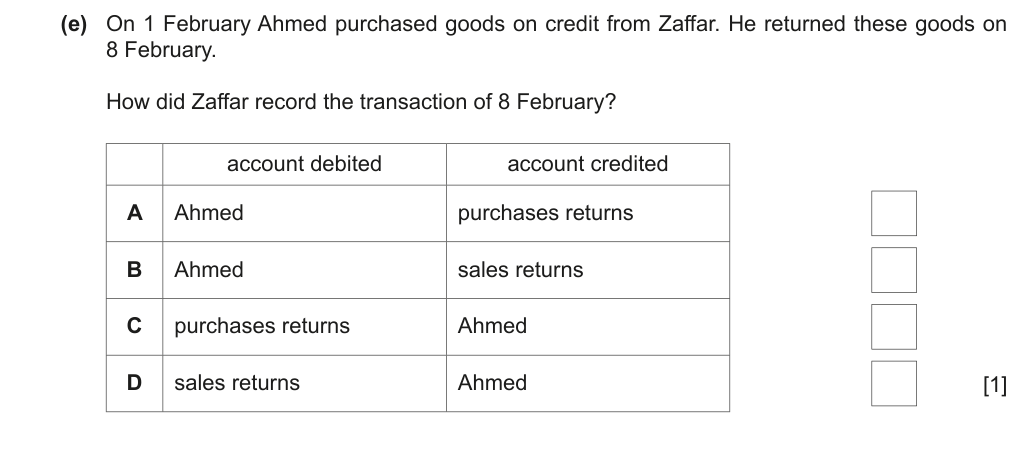
Answer: D.
What the syllabus asks for on this topicSyllabus points
Syllabus points
- Explain the dual aspect of every transaction.
- Process accounting data using the double entry system.
- Balance ledger accounts and bring down the balances.
- Interpret ledger accounts and their balances.
Related CIE 0452 Accounting topics
Not the topic you were looking for? Describe what you are stuck on in your own words and we will take you to the notes that answer it.