37 past-paper questions on this unit. Five of them are below. Answer on the page: each one is marked the moment you pick, the correct option is shown whether or not you found it, and the full explanation opens either way.
CIE 0452 AccountingPaper 1 MCQsFree account
The double entry system: five questions to try now
Real past-paper questions, the answer key from the mark scheme, and the explanation that goes with it. No account needed to answer them.
Question 1
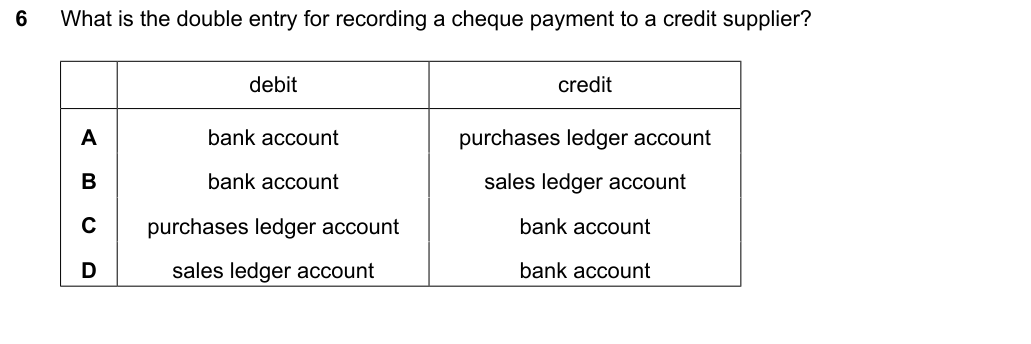
What is the double entry for recording a cheque payment to a credit supplier? Use the complete source image for the question and answer choices. Source reference: S24 Paper 12, Q6.
Answer: C.
Paying a credit supplier does two things: it reduces the money owed and it reduces the money in the bank. The supplier's account is in the purchases ledger and carries a credit balance for what is owed, so reducing it means a debit, while the bank is credited because money has gone out. C is correct and A is that entry reversed, which would show the bank growing as a result of a payment. B and D use the sales ledger, which holds credit CUSTOMERS, and a supplier's account is never kept there. The direction of the money and the identity of the ledger have to be settled separately.
Question 2
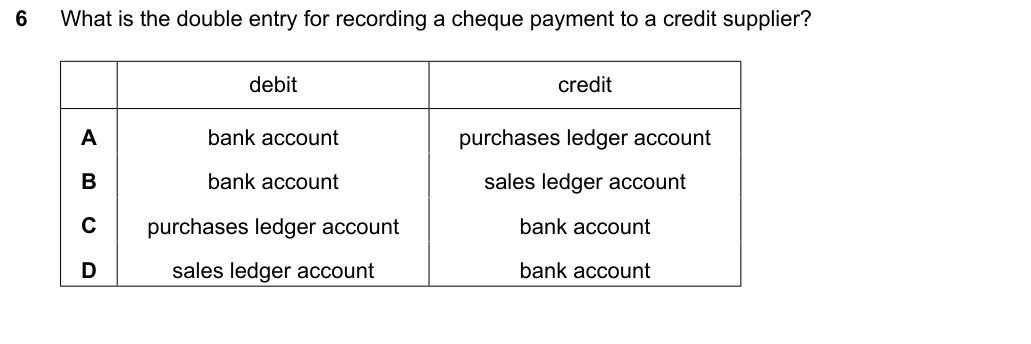
What is the double entry for recording a cheque payment to a credit supplier? Use the complete source image for the question and answer choices. Source reference: S24 Paper 13, Q6.
Answer: C.
Paying a credit supplier does two things: it reduces the money owed and it reduces the money in the bank. The supplier's account is in the purchases ledger and carries a credit balance for what is owed, so reducing it means a debit, while the bank is credited because money has gone out. C is correct and A is that entry reversed, which would show the bank growing as a result of a payment. B and D use the sales ledger, which holds credit CUSTOMERS, and a supplier's account is never kept there. The direction of the money and the identity of the ledger have to be settled separately.
Question 3
Goods bought on credit by Tumelo from Tebogo are returned before they are paid for. Tumelo keeps a full double entry system. Where will Tumelo record the return of goods?
Answer: C.
Tumelo is the buyer, so goods going back to Tebogo are PURCHASES returns. The entry has two halves in two different ledgers: debit Tebogo's personal account, which is in the purchases ledger, and credit the purchases returns account, which is a nominal account in the general ledger. C names both. B gives only the nominal half and leaves the supplier still showing the full debt. D gives only the personal half and leaves the returns unrecorded. A is wrong twice over: no money has moved, so the cash book is not involved, and Tebogo is a supplier whose account is never kept in the sales ledger.
Question 4
On 15 February, Kalou made the following entries in his accounts. debit $ credit $ bank 228 Droghba 240 discount allowed 12 Which transaction was being recorded?
Answer: A.
Read the entries as a settlement. Droghba's account is CREDITED with 240, so a debt of 240 owed to Kalou has been cleared, which makes Droghba the customer and Kalou the seller. The two debits show how it was cleared: 228 into the bank and 12 to discount allowed. That is a cash discount granted for prompt payment, so A is correct. B is impossible, because trade discount is deducted before the invoice is written and never reaches an account, so no entry for it could appear. C and D reverse the parties: had Kalou paid Droghba, the bank would be credited rather than debited, and the discount would be discount received.
Question 5
In which sections of Zamir’s ledger would the following accounts be maintained? 1 the sales account 2 the account of Harjit, a trade receivable sales account Harjit account
Answer: B.
The sales account records income and is a nominal account, so it belongs in the nominal or general ledger. Harjit is a trade receivable, which means he is a credit customer, and customers' personal accounts are kept in the sales ledger. That pairing is B. A puts Harjit in the purchases ledger, which is for credit suppliers. C moves the sales account into the purchases ledger, but a nominal account is never kept in a personal ledger. D swaps them completely, putting the sales account in the sales ledger, which is the trap the two similar names are designed to set.
These questions are drawn from past CIE 0452 Accounting papers and filtered to the double entry system. You answer, you find out immediately whether you were right, and you get the reasoning for the correct option and for each distractor. Wrong answers go to a mistakes locker so you can come back to exactly those.
Practice is free. You need an account only so your progress and your mistakes are still there next time.
These are the errors that cost marks on the double entry system, taken from our own topic notes. Read them before you practise and you will recognise the traps in the questions.
Reading a credit in the cash book as money received.
Debiting the supplier when buying goods on credit. The supplier is credited.
Entering a van purchase in the purchases account.
Treating drawings as an expense.
Putting the balance c/d on the larger side.
Forgetting to bring the balance down, so the account is left with no opening figure.