Trial balances
Contents: 7 sections
What it is
A trial balance is a list of all the ledger balances at a date, with the debit balances in one column and the credit balances in the other. It is prepared before the financial statements and is not itself a financial statement.
If the two columns are equal, the arithmetic of the double entry is probably right. If they are not, something is definitely wrong.
Which column
| Debit column | Credit column |
|---|---|
| Non-current assets, at cost | Capital |
| Inventory (opening) | Sales |
| Trade receivables | Purchases returns |
| Bank and cash | Discount received |
| Purchases | Trade payables |
| Sales returns | Bank overdraft |
| Carriage inwards and carriage outwards | Loan |
| Expenses (rent, wages, insurance) | Rent received and other income |
| Discount allowed | Provision for depreciation |
| Drawings | Allowance for irrecoverable debts |
| Irrecoverable debts |
The last two entries in the credit column are the ones most often placed wrongly. Provision for depreciation and the allowance for irrecoverable debts are credit balances, even though they relate to assets. They are deducted from the asset in the statement of financial position rather than listed with it.
Two more that catch people: drawings is a debit even though capital is a credit, and both carriage inwards and carriage outwards are debits, because both are expenses.
Only opening inventory appears in the trial balance. Closing inventory is not a ledger balance at that stage; it comes from the year-end count and is brought in as an adjustment.
What a trial balance is for
- It checks the arithmetic of the double entry.
- It collects all the balances in one place, ready for the financial statements.
- It reveals that an error exists when the columns disagree.
What it does not prove
A balanced trial balance does not prove the books are correct. Six kinds of error leave both columns equal:
| Error | What happened |
|---|---|
| Omission | The transaction was left out completely |
| Commission | The right amount in the wrong account of the right type, such as a sale posted to the wrong customer |
| Principle | The right amount in the wrong type of account, such as a new machine posted to repairs |
| Original entry | The wrong amount used, but the same wrong amount on both sides |
| Reversal of entries | The right accounts, but debit and credit the wrong way round |
| Compensating | Two separate errors of equal size on opposite sides that cancel out |
The difference between commission and principle is worth a sentence, because the two names are easily swapped. Commission stays within the right class of account; principle crosses into the wrong class. A sale posted to the wrong customer is commission, because both are customers. A machine posted to repairs is principle, because an asset has become an expense.
When the columns disagree
The errors that cause a difference are the one-sided ones: only one entry made, both entries on the same side, a balance added up wrongly, a balance written into the wrong column, or a figure transposed on one side only.
A transposition error has a signature: the difference is divisible by 9. Writing $86 as $68 gives a difference of $18, and 18 divided by 9 is 2. If the difference divides exactly by 9, look for two digits swapped before checking anything else.
If the difference cannot be found quickly, it is entered in a suspense account so that draft financial statements can be prepared. The suspense account is temporary and must be cleared before the final statements are published.
Common mistakes
- Saying a balanced trial balance proves the accounts are correct.
- Putting provision for depreciation or the allowance for irrecoverable debts in the debit column.
- Putting drawings on the credit side.
- Including closing inventory.
- Putting carriage outwards on the credit side because it relates to sales.
- Calling the trial balance a financial statement.
- Confusing errors of commission with errors of principle.
Check you have it
Question 1
Which items appear on the debit side of a trial balance? Use the complete source image for the question and answer choices. Source reference: W24 Paper 12, Q7.
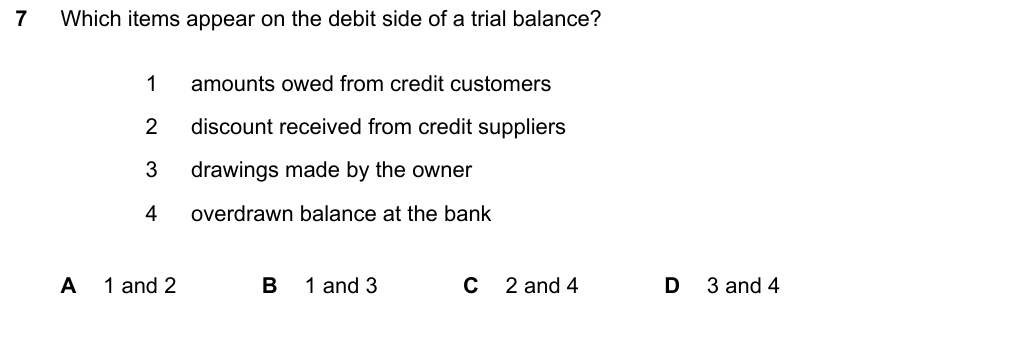
Answer: B.
Question 2
The totals of a trial balance agreed but it was found that the purchase of office equipment had been debited to office expenses account.
Which type of error has been made?
Answer: D.
Question 3
After completing the trial balance, it was found that an amount of $4000 for motor vehicle repairs had been entered in the motor vehicle account.
Which type of error is this?
Answer: D.
What the syllabus asks for on this topicSyllabus points
Syllabus points
- Prepare a trial balance from a list of balances.
- Explain the uses and the limitations of a trial balance.
- Identify the errors that a trial balance does not reveal.
Related CIE 0452 Accounting topics
Not the topic you were looking for? Describe what you are stuck on in your own words and we will take you to the notes that answer it.