23 past-paper questions on this unit. Five of them are below. Answer on the page: each one is marked the moment you pick, the correct option is shown whether or not you found it, and the full explanation opens either way.
CIE 0452 AccountingPaper 1 MCQsFree account
Trial balances: five questions to try now
Real past-paper questions, the answer key from the mark scheme, and the explanation that goes with it. No account needed to answer them.
Question 1
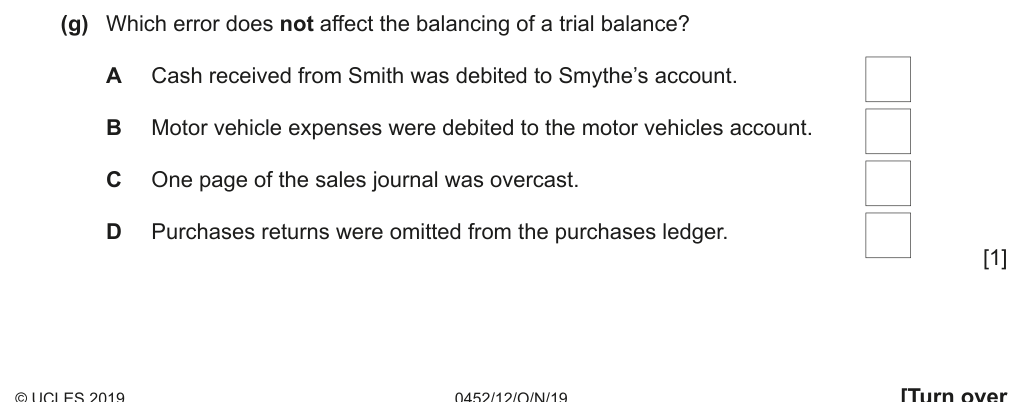
Which error does not affect the balancing of a trial balance? Use the complete source image for the question and answer choices. Source reference: W19 Paper 12, Q1(g).
Answer: B.
The question asks which error leaves the totals still agreeing, so look for the one that keeps debits equal to credits. In B the payment was debited, just to the motor vehicles account rather than to motor vehicle expenses. It is a debit either way, so the totals are untouched, and B is correct. This is an error of principle: an expense of running the vehicle has been treated as the cost of the vehicle itself. A misses the credit to Smith and debits Smythe instead, so two debits face no credit. C overcasts one side of the sales journal only, so the sales account is credited more than the customers are debited. D leaves out one half of an entry entirely.
Question 2
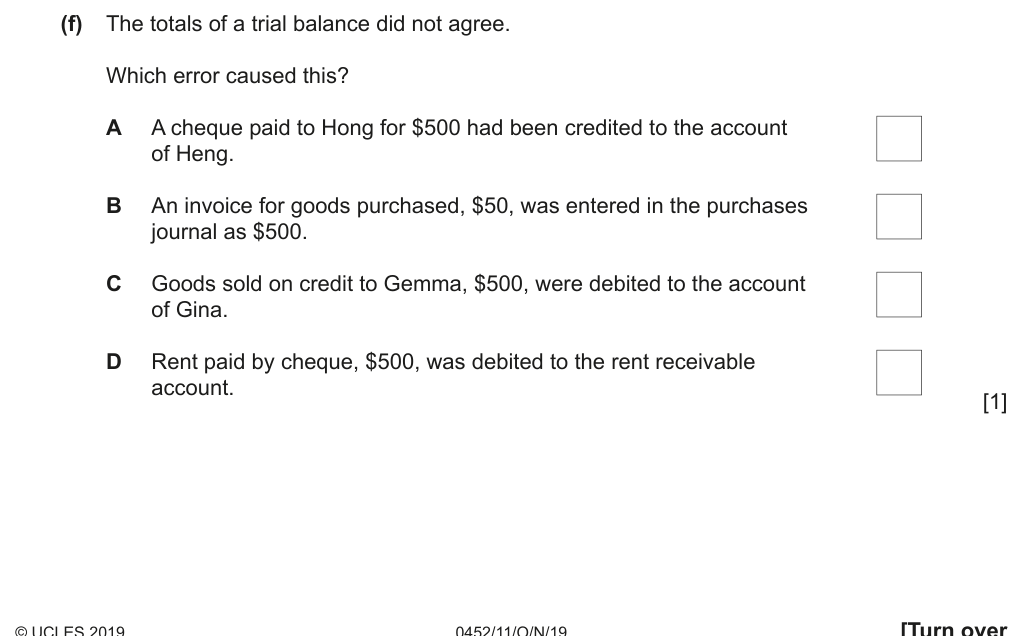
The totals of a trial balance did not agree. Which error caused this? Use the complete source image for the question and answer choices. Source reference: W19 Paper 11, Q1(f).
Answer: A.
A trial balance only fails when the debits and the credits are unequal, so look for the error that is one sided. In A the payment to Hong should have been debited to his account, but instead Heng was credited, so a debit of 500 is missing and a credit of 500 has been added, leaving the totals 1000 apart. A is correct. B is an error of original entry: the wrong figure went into both sides, so the totals still agree. C is an error of commission, the right amount in the wrong personal account, and both sides are still equal. D is an error of principle, a debit in the wrong class of account, but it is still a debit, so the totals agree there too.
Question 3
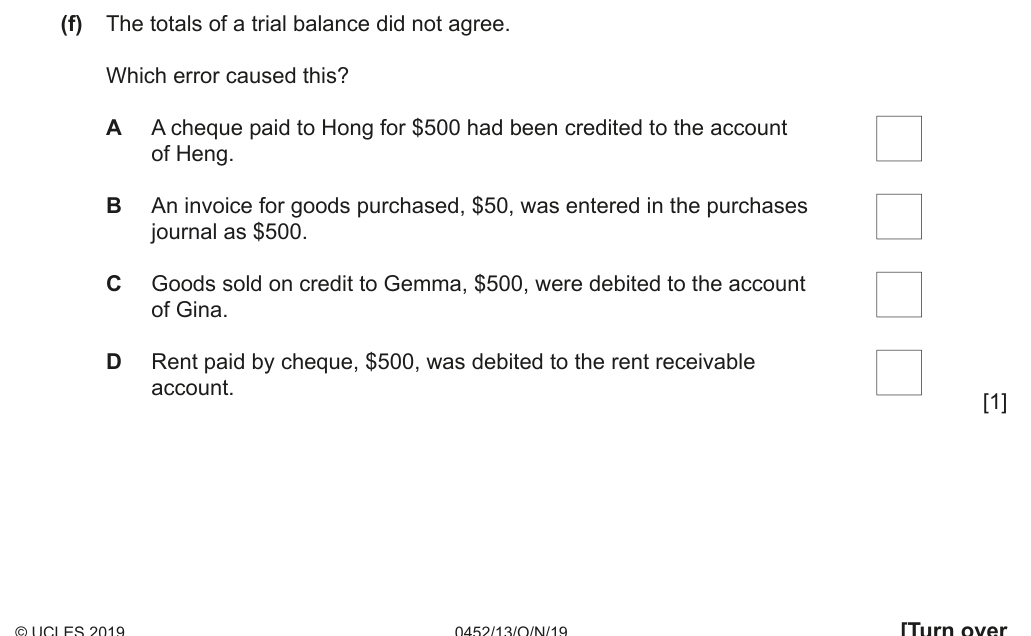
The totals of a trial balance did not agree. Which error caused this? Use the complete source image for the question and answer choices. Source reference: W19 Paper 13, Q1(f).
Answer: A.
A trial balance only fails when the debits and the credits are unequal, so look for the error that is one sided. In A the payment to Hong should have been debited to his account, but instead Heng was credited, so a debit of 500 is missing and a credit of 500 has been added, leaving the totals 1000 apart. A is correct. B is an error of original entry: the wrong figure went into both sides, so the totals still agree. C is an error of commission, the right amount in the wrong personal account, and both sides are still equal. D is an error of principle, a debit in the wrong class of account, but it is still a debit, so the totals agree there too.
Question 4
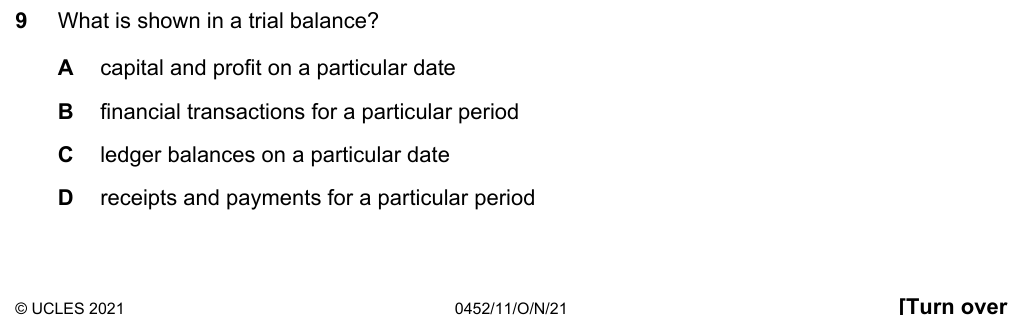
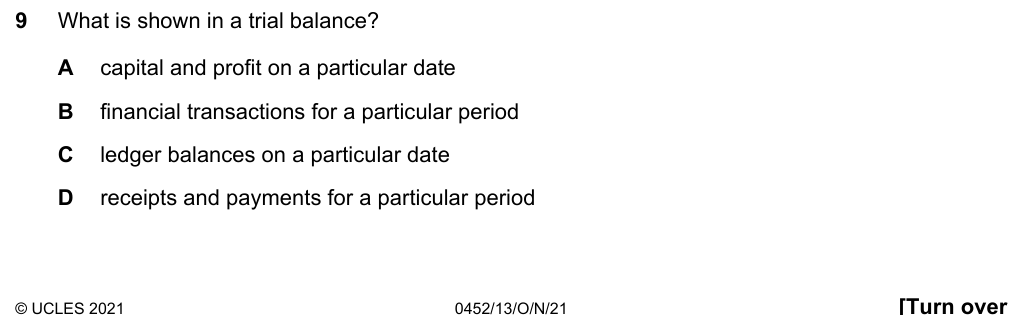
What is shown in a trial balance? Use the complete source image for the question and answer choices. Source reference: W21 Paper 11, Q9.
Answer: C.
A trial balance is a list of the balances on the ledger accounts, taken at one moment to check that total debits equal total credits, so C is correct. B is wrong because a trial balance shows balances, not the transactions that produced them; those are in the journals and ledger accounts. D describes a summary of the cash book, since receipts and payments cover money only, while the trial balance covers every account. A names two figures that come later: capital appears in the trial balance but profit does not, because it is calculated from the balances afterwards, in the income statement.
Question 5
What is shown in a trial balance? Use the complete source image for the question and answer choices. Source reference: W21 Paper 13, Q9.
Answer: C.
A trial balance is a list of the balances on the ledger accounts, taken at one moment to check that total debits equal total credits, so C is correct. B is wrong because a trial balance shows balances, not the transactions that produced them; those are in the journals and ledger accounts. D describes a summary of the cash book, since receipts and payments cover money only, while the trial balance covers every account. A names two figures that come later: capital appears in the trial balance but profit does not, because it is calculated from the balances afterwards, in the income statement.
These questions are drawn from past CIE 0452 Accounting papers and filtered to trial balances. You answer, you find out immediately whether you were right, and you get the reasoning for the correct option and for each distractor. Wrong answers go to a mistakes locker so you can come back to exactly those.
Practice is free. You need an account only so your progress and your mistakes are still there next time.
These are the errors that cost marks on trial balances, taken from our own topic notes. Read them before you practise and you will recognise the traps in the questions.
Saying a balanced trial balance proves the accounts are correct.
Putting provision for depreciation or the allowance for irrecoverable debts in the debit column.
Putting drawings on the credit side.
Including closing inventory.
Putting carriage outwards on the credit side because it relates to sales.
Calling the trial balance a financial statement.
Confusing errors of commission with errors of principle.