52 past-paper questions on this unit. Five of them are below. Answer on the page: each one is marked the moment you pick, the correct option is shown whether or not you found it, and the full explanation opens either way.
CIE 0452 AccountingPaper 1 MCQsFree account
Limited companies: five questions to try now
Real past-paper questions, the answer key from the mark scheme, and the explanation that goes with it. No account needed to answer them.
Question 1
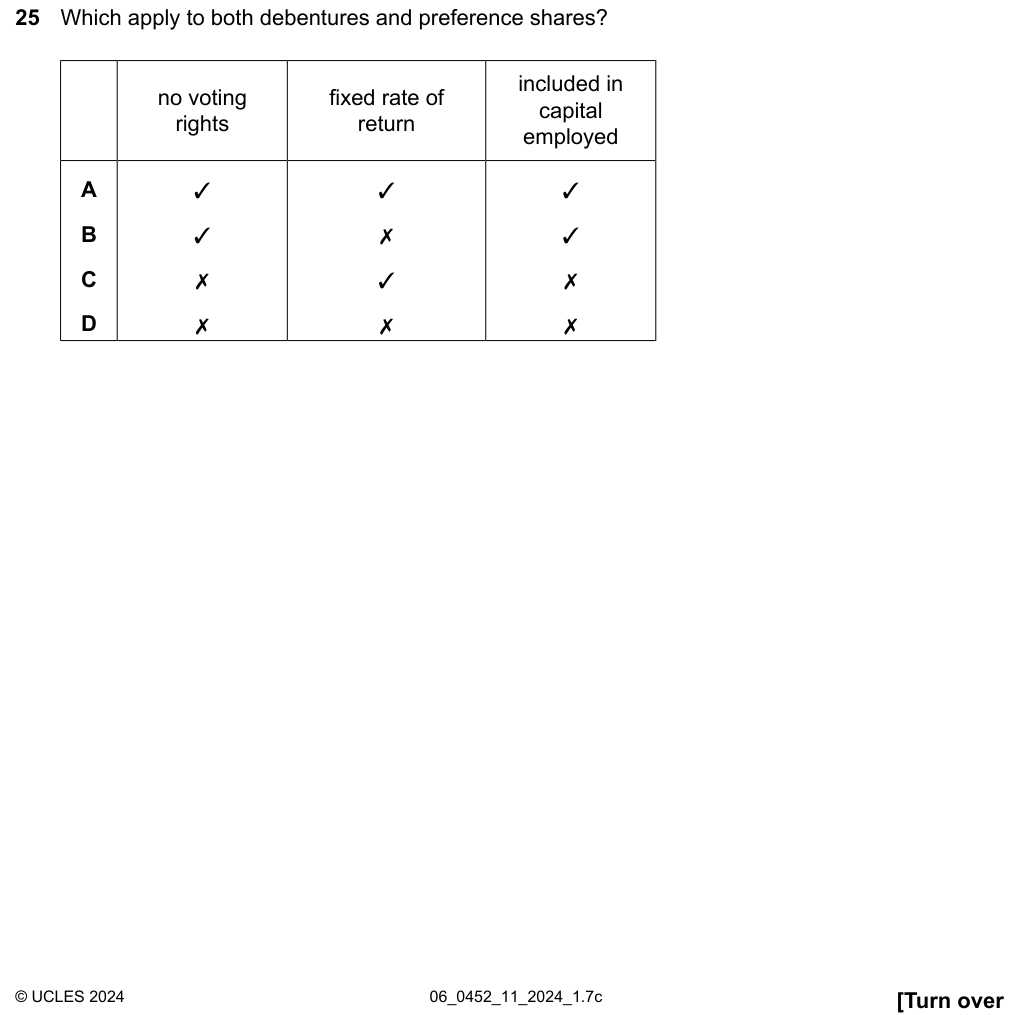
Which apply to both debentures and preference shares? Use the complete source image for the question and answer choices. Source reference: S24 Paper 11, Q25.
Answer: A.
All three apply to both. Neither a debenture holder nor a preference shareholder normally votes at the annual general meeting, both receive a return fixed in advance rather than one that varies with profit, and both are part of capital employed, since that figure is equity plus non-current liabilities and takes in long-term funding of either kind. A is correct. The other three options each deny one of the shared features, most often the inclusion in capital employed, which is easy to miss because a debenture is a liability rather than equity.
Question 2
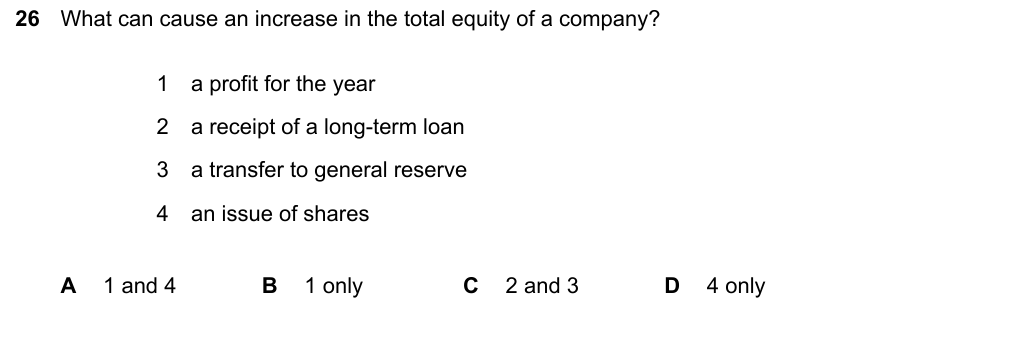
What can cause an increase in the total equity of a company? Use the complete source image for the question and answer choices. Source reference: M24 Paper 12, Q26.
Answer: A.
Equity rises when the owners put money in or when the business earns it, so a profit for the year and an issue of shares both increase it, and A is correct. Item 2, a long-term loan, brings cash in but creates an equal liability, so the shareholders' stake is unchanged. Item 3, a transfer to general reserve, moves an amount from retained earnings to another reserve and leaves the total exactly where it was, which is why it is offered so often as a distractor.
Question 3
A limited company applied the accounting objective of comparability in preparing its financial statements. What is the effect of this on the interested parties?
Answer: B.
Comparability is the objective that lets a reader set one set of financial statements beside another, whether that is the same company in a different year or two different companies, and see where they are alike and where they differ. B is correct. C describes understandability, the objective that the statements be clear to a reader with reasonable knowledge. A and D both point at relevance, which is about information being useful and timely for a decision, and a set of statements can be perfectly relevant while still being impossible to compare.
Question 4
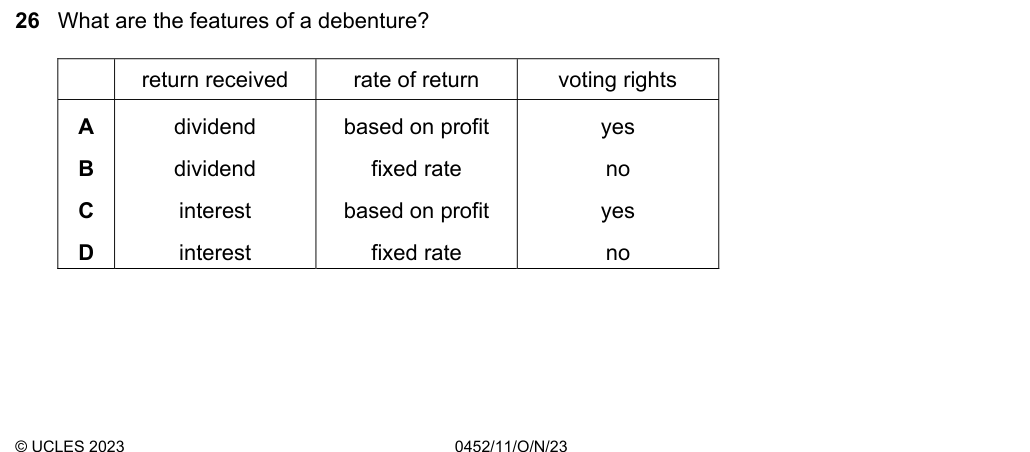
What are the features of a debenture? Use the complete source image for the question and answer choices. Source reference: W23 Paper 11, Q26.
Answer: D.
A debenture is a loan to the company, so the holder receives INTEREST rather than a dividend, at a rate fixed when the debenture was issued rather than one that depends on profit, and because a lender is not an owner there are no voting rights. D is correct. A and B call the return a dividend, which is what a shareholder receives out of profit. A and C make the rate depend on profit, but interest must be paid in a loss-making year too, and that is exactly what separates the two.
Question 5
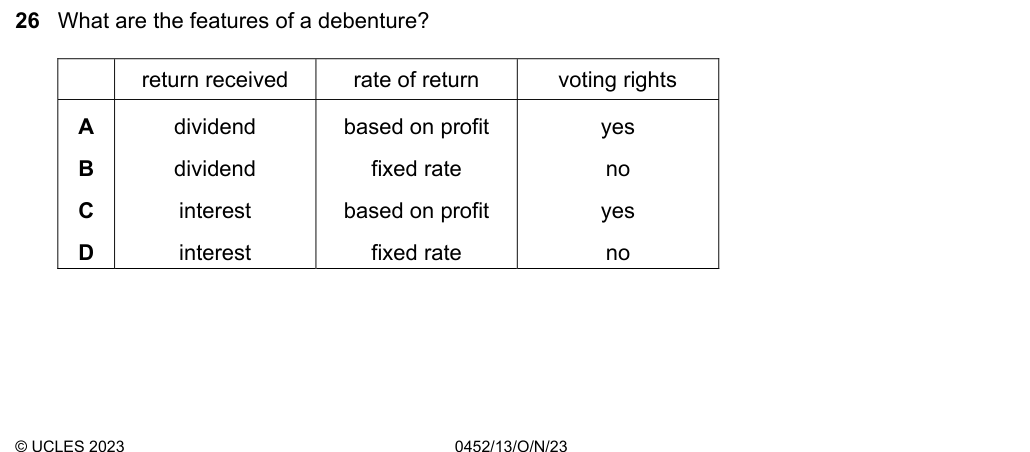
What are the features of a debenture? Use the complete source image for the question and answer choices. Source reference: W23 Paper 13, Q26.
Answer: D.
A debenture is a loan to the company, so the holder receives INTEREST rather than a dividend, at a rate fixed when the debenture was issued rather than one that depends on profit, and because a lender is not an owner there are no voting rights. D is correct. A and B call the return a dividend, which is what a shareholder receives out of profit. A and C make the rate depend on profit, but interest must be paid in a loss-making year too, and that is exactly what separates the two.
These questions are drawn from past CIE 0452 Accounting papers and filtered to limited companies. You answer, you find out immediately whether you were right, and you get the reasoning for the correct option and for each distractor. Wrong answers go to a mistakes locker so you can come back to exactly those.
Practice is free. You need an account only so your progress and your mistakes are still there next time.
These are the errors that cost marks on limited companies, taken from our own topic notes. Read them before you practise and you will recognise the traps in the questions.
Saying limited liability means the company is not liable for its debts.
Treating dividends as an expense.
Treating debenture interest as an appropriation.
Showing share capital at issue price rather than nominal value.
Putting debentures in the equity section.
Paying a dividend out of share premium or the revaluation reserve.
Saying a transfer to general reserve reduces the profit for the year.
Saying a public limited company is owned by the government.