37 past-paper questions on this unit. Five of them are below. Answer on the page: each one is marked the moment you pick, the correct option is shown whether or not you found it, and the full explanation opens either way.
CIE 0452 AccountingPaper 1 MCQsFree account
Books of prime entry: five questions to try now
Real past-paper questions, the answer key from the mark scheme, and the explanation that goes with it. No account needed to answer them.
Question 1
Jabari maintains a petty cash book using the imprest system. The imprest is restored at the end of each month. Which amount restores the imprest at the end of a month?
Answer: D.
Under the imprest system the petty cashier begins each period with a fixed float, spends part of it, and is given back exactly what was spent so that the float returns to its original level. What was spent is evidenced by the petty cash vouchers, so the restoring amount is their total and D is correct. C describes the cash left in the tin after the spending, not the top-up. B is the imprest amount itself, since cash remaining plus vouchers always equals the float, which is the arithmetic check the system is built on. A subtracts the vouchers from the cash remaining, which corresponds to nothing.
Question 2
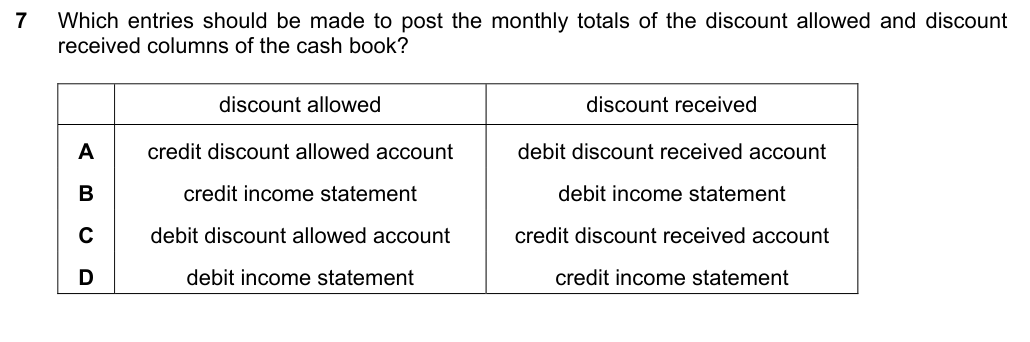
Which entries should be made to post the monthly totals of the discount allowed and discount received columns of the cash book? Use the complete source image for the question and answer choices. Source reference: W22 Paper 12, Q7.
Answer: C.
The discount columns are memorandum only, so their totals have to be posted to real ledger accounts at the month end. Discount allowed is an expense of granting customers early settlement, and expenses are debited. Discount received is income earned by settling early with suppliers, and income is credited. That is C. A has both accounts on the wrong side, turning an expense into income and income into an expense. B and D post straight to the income statement, but the income statement is a financial statement prepared from the ledger at the year end, not an account that receives monthly postings, and the discount accounts are what carry the figures until then.
Question 3
The discount column on the debit side of a trader’s cash book totalled $1300 and the discount column on the credit side totalled $700. How much discount did the trader receive?
Answer: B.
Discount follows the side of the cash book it sits beside. The debit side records money coming in, so the discount column there is discount ALLOWED to customers. The credit side records money going out, so the discount column there is discount RECEIVED from suppliers. The trader received the 700 on the credit side, so B is correct. C of 1300 is the discount allowed, the other column. A of 600 nets the two off, but allowed and received are separate expenses and income and are never combined. D of 2000 adds them together, which does the same thing in the other direction.
Question 4
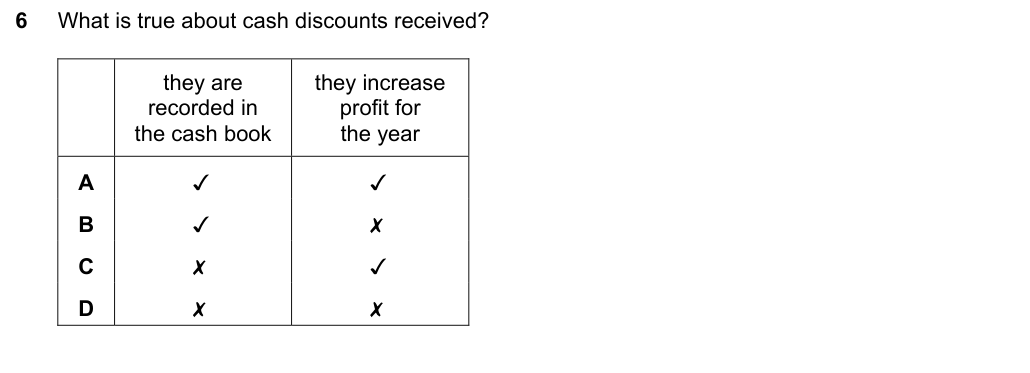
Use the complete source image for the question and answer choices. Source reference: S23 Paper 12, Q6.
Answer: A.
Both statements are true, so A is correct. Cash discount received is only known when the supplier is paid, so it is recorded in the memorandum discount column on the credit side of the cash book, and the monthly total is posted from there to the discount received account. It also increases profit, because discount received is income added in the income statement, reducing the effective cost of trading. B accepts the cash book but denies the effect on profit, which would leave an item of income out of the accounts altogether. C denies the cash book and would leave the discount with no book of prime entry. D denies both.
Question 5
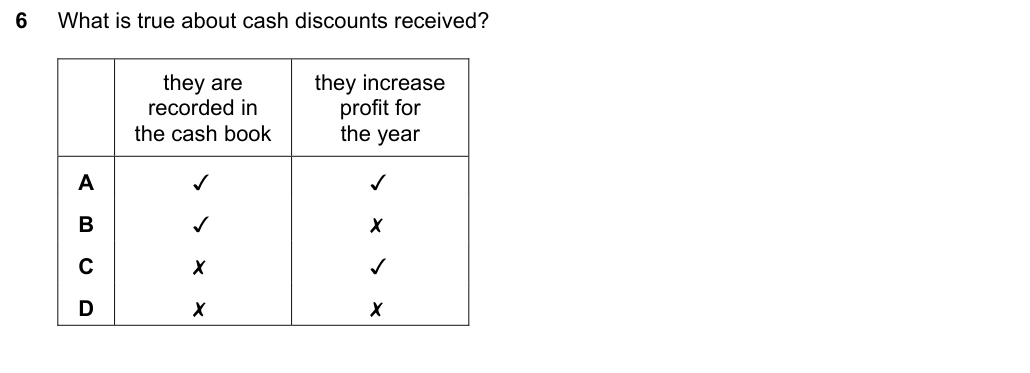
Use the complete source image for the question and answer choices. Source reference: S23 Paper 13, Q6.
Answer: A.
Both statements are true, so A is correct. Cash discount received is only known when the supplier is paid, so it is recorded in the memorandum discount column on the credit side of the cash book, and the monthly total is posted from there to the discount received account. It also increases profit, because discount received is income added in the income statement, reducing the effective cost of trading. B accepts the cash book but denies the effect on profit, which would leave an item of income out of the accounts altogether. C denies the cash book and would leave the discount with no book of prime entry. D denies both.
These questions are drawn from past CIE 0452 Accounting papers and filtered to books of prime entry. You answer, you find out immediately whether you were right, and you get the reasoning for the correct option and for each distractor. Wrong answers go to a mistakes locker so you can come back to exactly those.
Practice is free. You need an account only so your progress and your mistakes are still there next time.
These are the errors that cost marks on books of prime entry, taken from our own topic notes. Read them before you practise and you will recognise the traps in the questions.
Putting cash sales in the sales journal.
Calling a book of prime entry a ledger.
Balancing the discount columns of the cash book as though they were part of double entry.
Reimbursing petty cash with the full imprest instead of with the amount spent.
Posting the journal total to each personal account as well as to the nominal account.
Writing a journal entry with no narrative.
Recording a contra entry twice by posting it to another ledger account.