Depreciation and disposal of non-current assets Exam Questions
64 past-paper questions on this unit. Five of them are below. Answer on the page: each one is marked the moment you pick, the correct option is shown whether or not you found it, and the full explanation opens either way.
CIE 0452 AccountingPaper 1 MCQsFree account
Depreciation and disposal of non-current assets: five questions to try now
Real past-paper questions, the answer key from the mark scheme, and the explanation that goes with it. No account needed to answer them.
Question 1
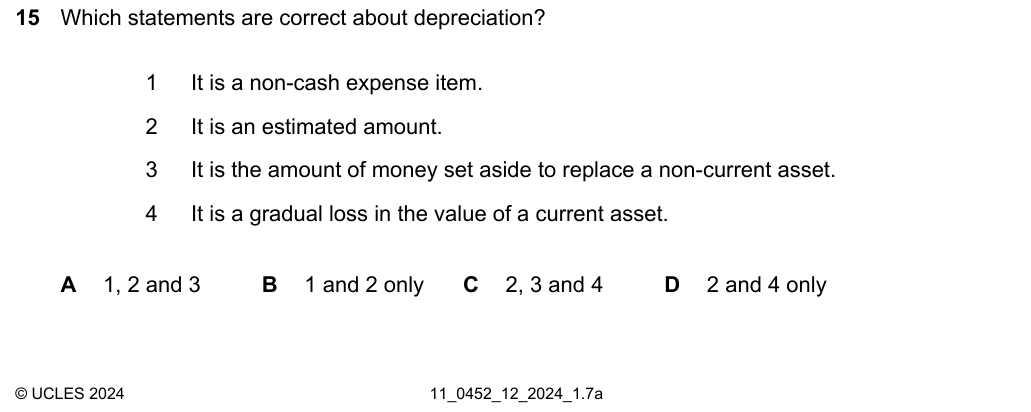
Which statements are correct about depreciation? Use the complete source image for the question and answer choices. Source reference: W24 Paper 12, Q15.
Answer: B.
Statements 1 and 2 are both true, so B is correct: depreciation is charged as an expense without any money leaving the business, and the amount rests on estimates of useful life and residual value rather than on a known figure. Statement 3 is the persistent misconception that a sum of money is set aside, when nothing is. Statement 4 names the wrong class of asset, since depreciation applies to NON-current assets held for use, not to current assets such as inventory. A and C include statement 3, and C and D include statement 4.
Question 2
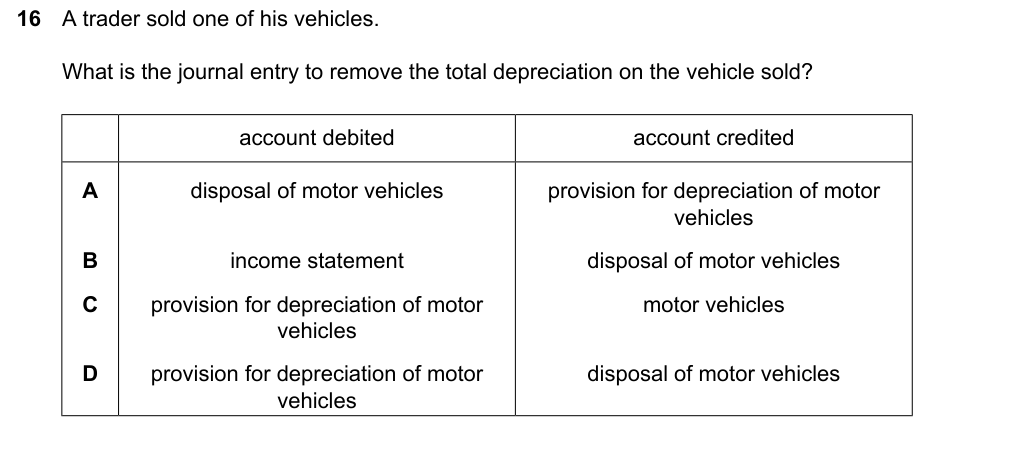
A trader sold one of his vehicles. What is the journal entry to remove the total depreciation on the vehicle sold? Use the complete source image for the question and answer choices. Source reference: S24 Paper 12, Q16.
Answer: D.
The provision for depreciation has built up over the years and must be cleared out when the asset leaves. Since the provision carries a credit balance, removing it means DEBITING the provision for depreciation account, and the matching credit goes to the disposal account, where it sits against the cost so that the book value emerges. D is correct. C credits motor vehicles, but the cost is transferred separately and this entry concerns only the accumulated depreciation. A reverses the sides. B is the entry that transfers the eventual profit or loss, which comes later.
Question 3
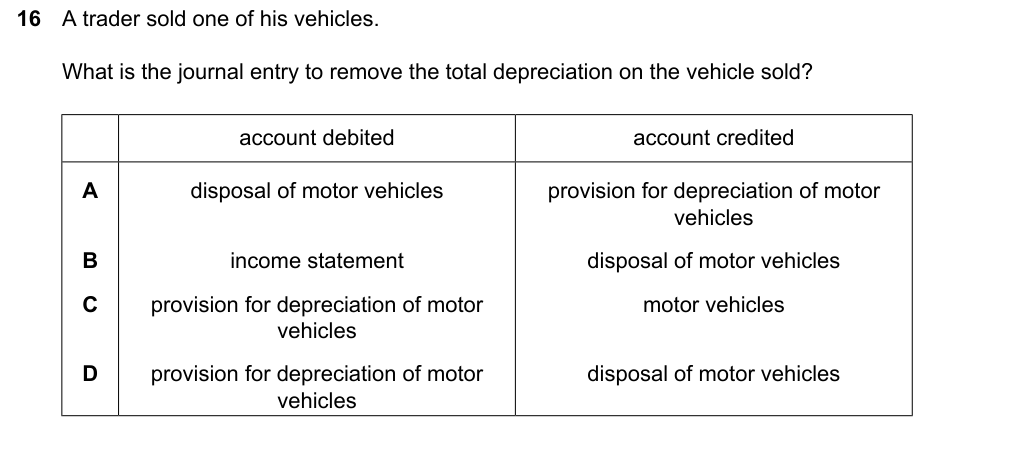
A trader sold one of his vehicles. What is the journal entry to remove the total depreciation on the vehicle sold? Use the complete source image for the question and answer choices. Source reference: S24 Paper 13, Q16.
Answer: D.
The provision for depreciation has built up over the years and must be cleared out when the asset leaves. Since the provision carries a credit balance, removing it means DEBITING the provision for depreciation account, and the matching credit goes to the disposal account, where it sits against the cost so that the book value emerges. D is correct. C credits motor vehicles, but the cost is transferred separately and this entry concerns only the accumulated depreciation. A reverses the sides. B is the entry that transfers the eventual profit or loss, which comes later.
Question 4
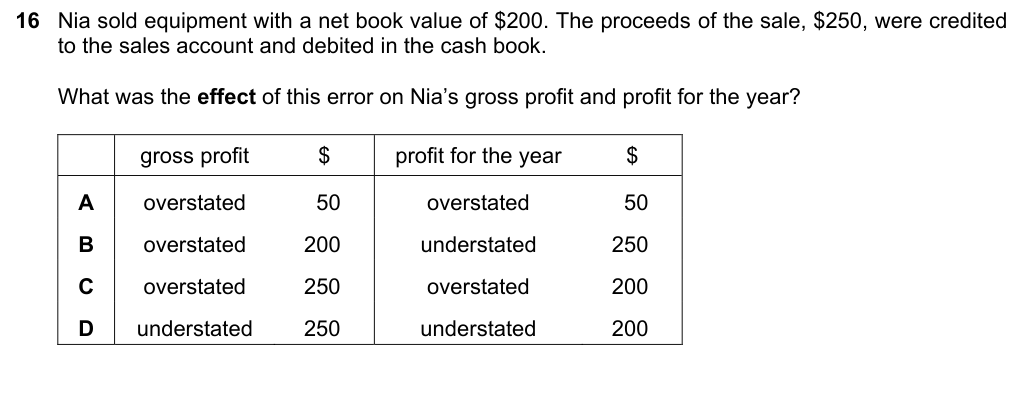
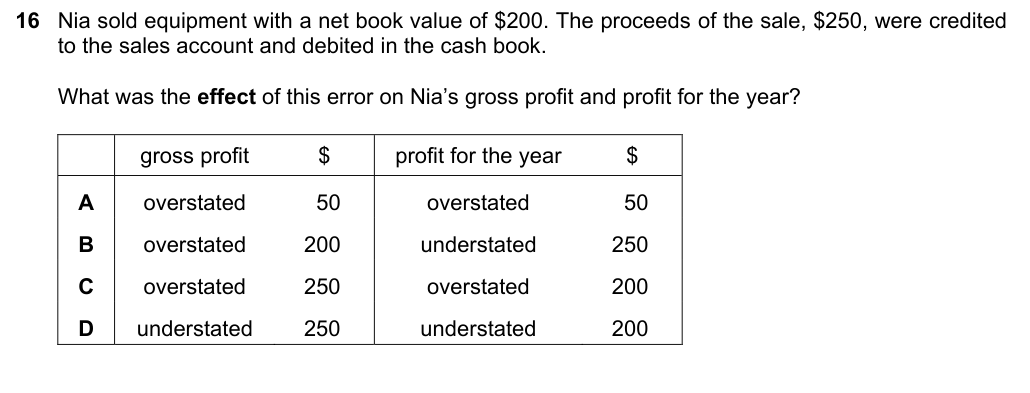
Use the complete source image for the question and answer choices. Source reference: S21 Paper 12, Q16.
Answer: C.
The equipment was not trading stock, so its proceeds should never have touched the sales account. Sales are 250 too high, and sales feed gross profit directly, so gross profit is overstated by 250. The profit for the year is different: the correct treatment would still have credited a profit on disposal of 50, being 250 less the book value of 200, so only 200 of the 250 was extra, and the profit for the year is overstated by 200. C is correct. A uses the 50 gain for both. B and D reverse a direction that can only be an overstatement.
Question 5
Use the complete source image for the question and answer choices. Source reference: S21 Paper 13, Q16.
Answer: C.
The equipment was not trading stock, so its proceeds should never have touched the sales account. Sales are 250 too high, and sales feed gross profit directly, so gross profit is overstated by 250. The profit for the year is different: the correct treatment would still have credited a profit on disposal of 50, being 250 less the book value of 200, so only 200 of the 250 was extra, and the profit for the year is overstated by 200. C is correct. A uses the 50 gain for both. B and D reverse a direction that can only be an overstatement.
These questions are drawn from past CIE 0452 Accounting papers and filtered to depreciation and disposal of non-current assets. You answer, you find out immediately whether you were right, and you get the reasoning for the correct option and for each distractor. Wrong answers go to a mistakes locker so you can come back to exactly those.
Practice is free. You need an account only so your progress and your mistakes are still there next time.
These are the errors that cost marks on depreciation and disposal of non-current assets, taken from our own topic notes. Read them before you practise and you will recognise the traps in the questions.
Applying the reducing-balance rate to cost every year.
Deducting residual value in a reducing-balance calculation. Residual value belongs to the straight-line formula only.
Saying depreciation saves money to replace the asset.
Crediting the asset account instead of the provision account.
Forgetting to transfer accumulated depreciation to the disposal account.
Comparing proceeds with cost instead of with carrying amount.
Ignoring the business's stated policy on part years.