42 past-paper questions on this unit. Five of them are below. Answer on the page: each one is marked the moment you pick, the correct option is shown whether or not you found it, and the full explanation opens either way.
CIE 0452 AccountingPaper 1 MCQsFree account
Manufacturing accounts: five questions to try now
Real past-paper questions, the answer key from the mark scheme, and the explanation that goes with it. No account needed to answer them.
Question 1
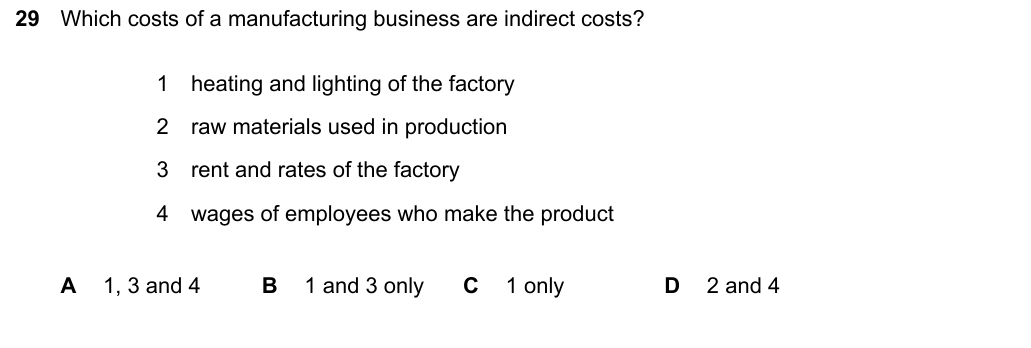
Which costs of a manufacturing business are indirect costs? Use the complete source image for the question and answer choices. Source reference: M24 Paper 12, Q29.
Answer: B.
An indirect cost cannot be traced to any particular unit made. Heating and lighting the factory and the factory's rent and rates are both incurred to keep the building running whatever comes out of it, so items 1 and 3 are indirect and B is correct. Item 2, raw materials used in production, goes into the product itself, and item 4, the wages of the employees who make it, is paid for working on it, so both are direct costs and belong in prime cost.
Question 2
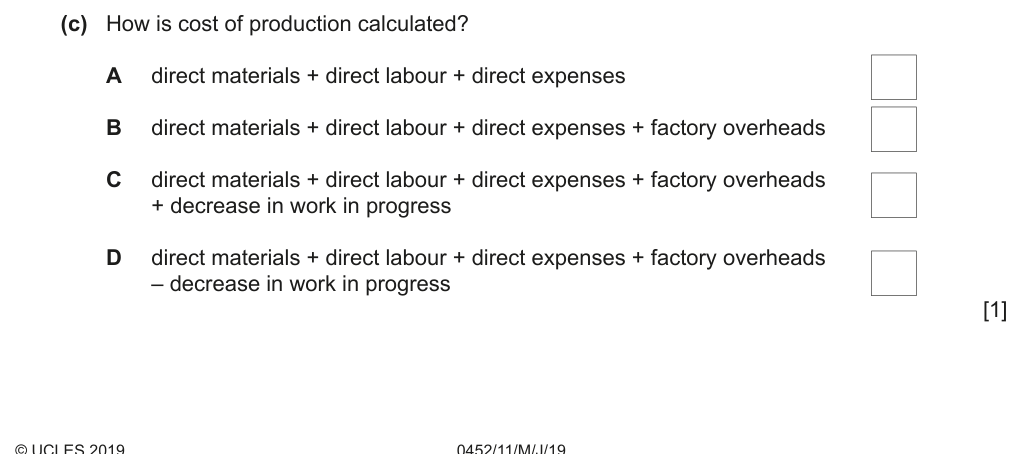
How is cost of production calculated? Use the complete source image for the question and answer choices. Source reference: S19 Paper 11, Q1(c).
Answer: C.
Cost of production is prime cost plus factory overheads, then adjusted for work in progress. The adjustment is to add the opening figure and deduct the closing one, and where the question expresses that as a single movement, a DECREASE in work in progress is added, because more was finished during the year than was started. C is correct. B stops before the adjustment. A stops at prime cost, leaving the overheads out altogether, and D has the movement the wrong way round.
Question 3
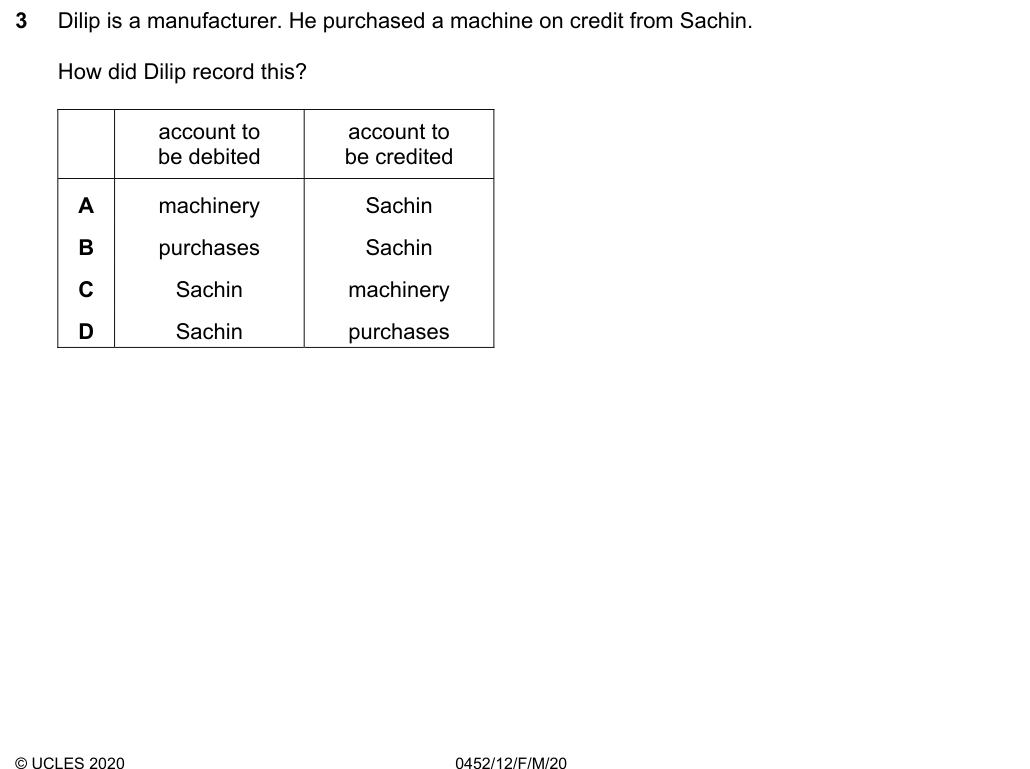
Dilip is a manufacturer. He purchased a machine on credit from Sachin. How did Dilip record this? Use the complete source image for the question and answer choices. Source reference: M20 Paper 12, Q3.
Answer: A.
Dilip is a MANUFACTURER, so a machine is a non-current asset he will use to make goods, not stock he intends to resell. The machinery account is therefore debited, and Sachin is credited because the machine was bought on credit. A is correct. B would be right only for a business that deals in machines, where the machine would be inventory and go to purchases. C and D reverse the entry, which would record Dilip as having sold the machine to Sachin rather than bought it.
Question 4
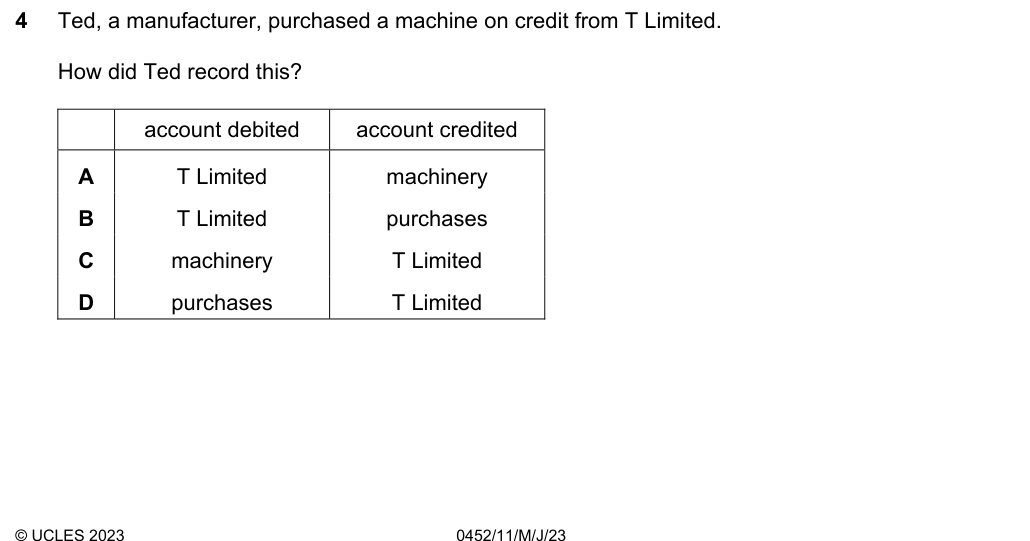
Ted, a manufacturer, purchased a machine on credit from T Limited. How did Ted record this? Use the complete source image for the question and answer choices. Source reference: S23 Paper 11, Q4.
Answer: C.
Ted is a MANUFACTURER, so a machine is a non-current asset he will use to make goods rather than stock he intends to resell. The machinery account is debited and T Limited is credited, since the machine was bought on credit. C is correct. D would be right only for a business that deals in machines, where the machine would be inventory. A and B reverse the entry, which would record Ted as having sold the machine to T Limited rather than bought it from them.
Question 5
A factory makes uniforms for school children. What is not included in the calculation of prime cost in the factory’s manufacturing account?
Answer: C.
Prime cost holds the costs traceable to the uniforms themselves. The cloth is the raw material, the delivery of that cloth to the factory is carriage inwards and forms part of what the material costs, and the machinists sew the garments, so A, B and D all belong. The drivers who take the finished uniforms out to shops are delivering a completed product, which is a distribution cost charged in the income statement, so C is correct. The two carriage costs travel in opposite directions and only the inward one reaches prime cost.
These questions are drawn from past CIE 0452 Accounting papers and filtered to manufacturing accounts. You answer, you find out immediately whether you were right, and you get the reasoning for the correct option and for each distractor. Wrong answers go to a mistakes locker so you can come back to exactly those.
Practice is free. You need an account only so your progress and your mistakes are still there next time.
These are the errors that cost marks on manufacturing accounts, taken from our own topic notes. Read them before you practise and you will recognise the traps in the questions.
Including factory overheads in prime cost.
Putting office or selling costs in the manufacturing account.
Adjusting work in progress at the top rather than at the bottom.
Adding closing inventory and deducting opening inventory.
Using raw materials inventory in the trading section, or finished goods in the manufacturing account.
Forgetting to split a cost that covers both the factory and the office.
Forgetting that cost of production, not purchases, goes into cost of sales.