14 past-paper questions on this unit. Five of them are below. Answer on the page: each one is marked the moment you pick, the correct option is shown whether or not you found it, and the full explanation opens either way.
CIE 0452 AccountingPaper 1 MCQsFree account
Accounting policies: five questions to try now
Real past-paper questions, the answer key from the mark scheme, and the explanation that goes with it. No account needed to answer them.
Question 1
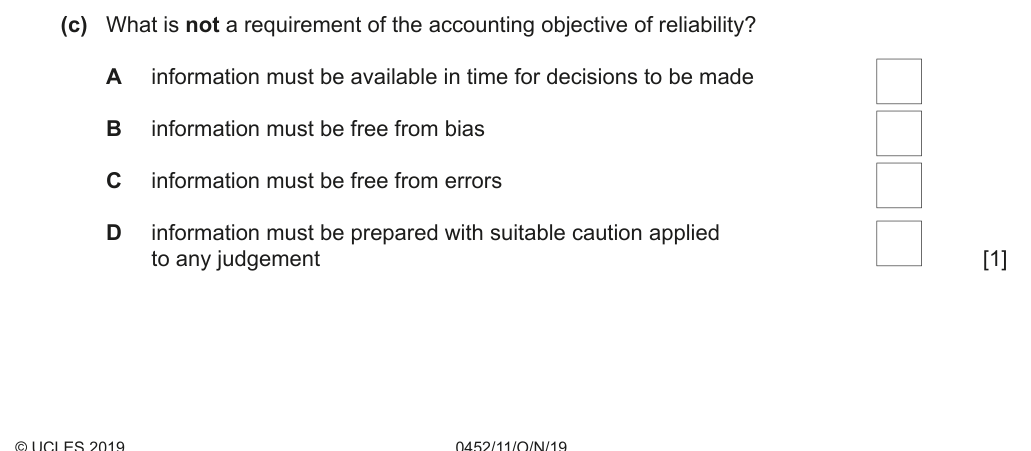
What is not a requirement of the accounting objective of reliability? Use the complete source image for the question and answer choices. Source reference: W19 Paper 11, Q1(c).
Answer: A.
The question asks which is NOT a requirement of reliability. Being available in time for a decision is TIMELINESS, which belongs to relevance: information that arrives too late cannot influence a choice, however accurate it is. A is the answer. B, C and D are all genuine parts of reliability, since dependable information must be free from bias, free from error, and prepared with suitable caution wherever a judgement has to be made.
Question 2
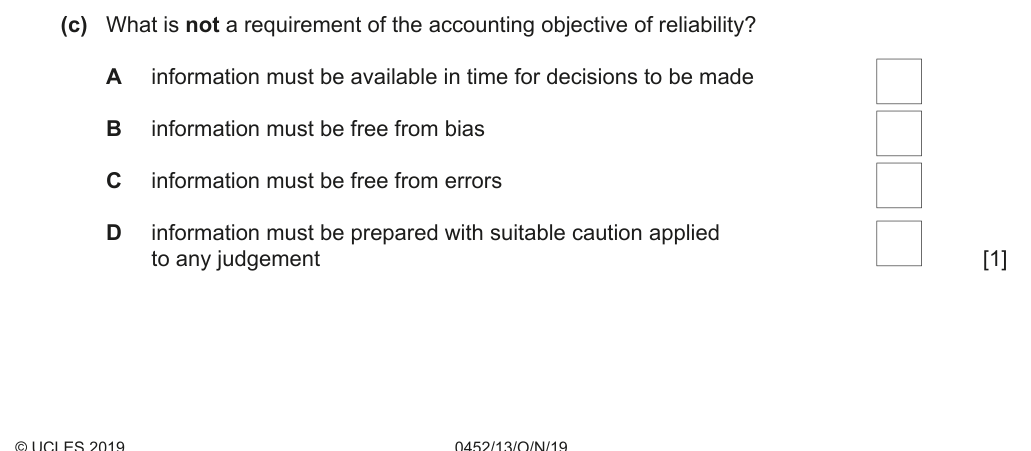
What is not a requirement of the accounting objective of reliability? Use the complete source image for the question and answer choices. Source reference: W19 Paper 13, Q1(c).
Answer: A.
The question asks which is NOT a requirement of reliability. Being available in time for a decision is TIMELINESS, which belongs to relevance: information that arrives too late cannot influence a choice, however accurate it is. A is the answer. B, C and D are all genuine parts of reliability, since dependable information must be free from bias, free from error, and prepared with suitable caution wherever a judgement has to be made.
Question 3
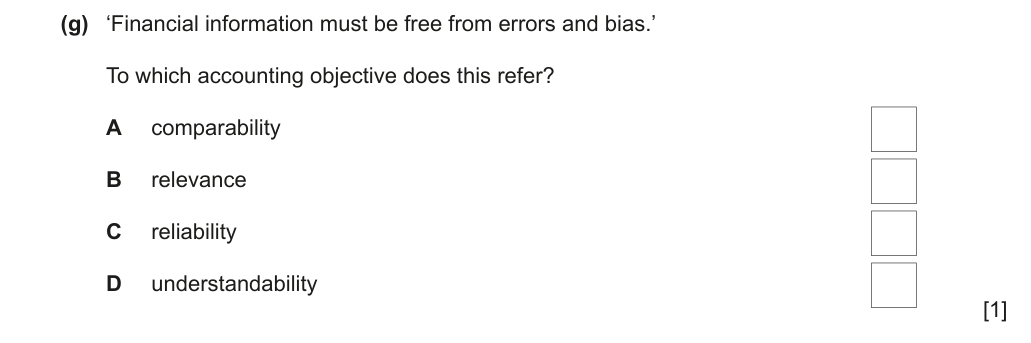
‘Financial information must be free from errors and bias.’ To which accounting objective does this refer? Use the complete source image for the question and answer choices. Source reference: S19 Paper 11, Q1(g).
Answer: C.
Freedom from errors and bias is the definition of reliability: a reader must be able to depend on the figures, and they must not be slanted towards any particular conclusion. C is correct. A, comparability, lets a reader set one set of statements against another. B, relevance, is about the information bearing on a decision and arriving in time to affect it. D, understandability, is about clear presentation, and a figure can be perfectly clear and still be wrong or partial.
Question 4
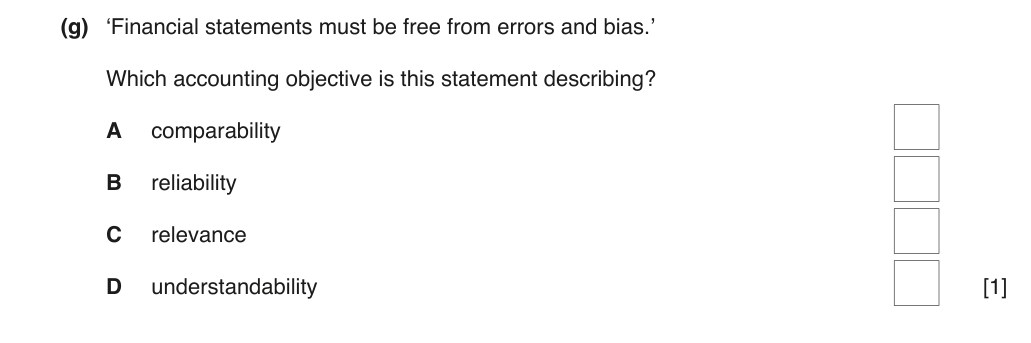
‘Financial statements must be free from errors and bias.’ Which accounting objective is this statement describing? Use the complete source image for the question and answer choices. Source reference: M19 Paper 12, Q1(g).
Answer: B.
Freedom from errors and bias is the definition of reliability: a reader must be able to depend on the figures, and they must not be slanted towards any particular conclusion. B is correct. A, comparability, lets a reader set one set of statements against another. C, relevance, is about the information bearing on a decision and arriving in time to affect it. D, understandability, is about clear presentation, and a statement can be perfectly clear and still be biased.
Question 5
‘The information provided in financial statements should be capable of being independently verified.’ To which accounting policy does this statement refer?
Answer: C.
Independent verification is the test of RELIABILITY: another person working from the same records and the same evidence should reach the same figures. C is correct. B, relevance, is about the information making a difference to a decision and arriving in time. A, comparability, is about setting one set of statements against another. D, understandability, is about clear presentation, and a figure can be perfectly clear yet impossible for anyone else to check.
These questions are drawn from past CIE 0452 Accounting papers and filtered to accounting policies. You answer, you find out immediately whether you were right, and you get the reasoning for the correct option and for each distractor. Wrong answers go to a mistakes locker so you can come back to exactly those.
Practice is free. You need an account only so your progress and your mistakes are still there next time.
These are the errors that cost marks on accounting policies, taken from our own topic notes. Read them before you practise and you will recognise the traps in the questions.
Confusing an accounting policy, which is a choice of treatment, with an accounting principle, which is a rule the treatment must respect.
Saying comparability means every business must use the same policy. It means each business must be consistent and must disclose changes.
Saying a policy can never be changed.
Naming the four objectives without applying them to the situation in the question.
Using the older terminology in an answer.
Saying international standards remove all judgement from accounting.