107 past-paper questions on this unit. Five of them are below. Answer on the page: each one is marked the moment you pick, the correct option is shown whether or not you found it, and the full explanation opens either way.
CIE 0620 ChemistryPaper 1 and Paper 2 MCQsFree account
Electrolysis: five questions to try now
Real past-paper questions, the answer key from the mark scheme, and the explanation that goes with it. No account needed to answer them.
Question 1
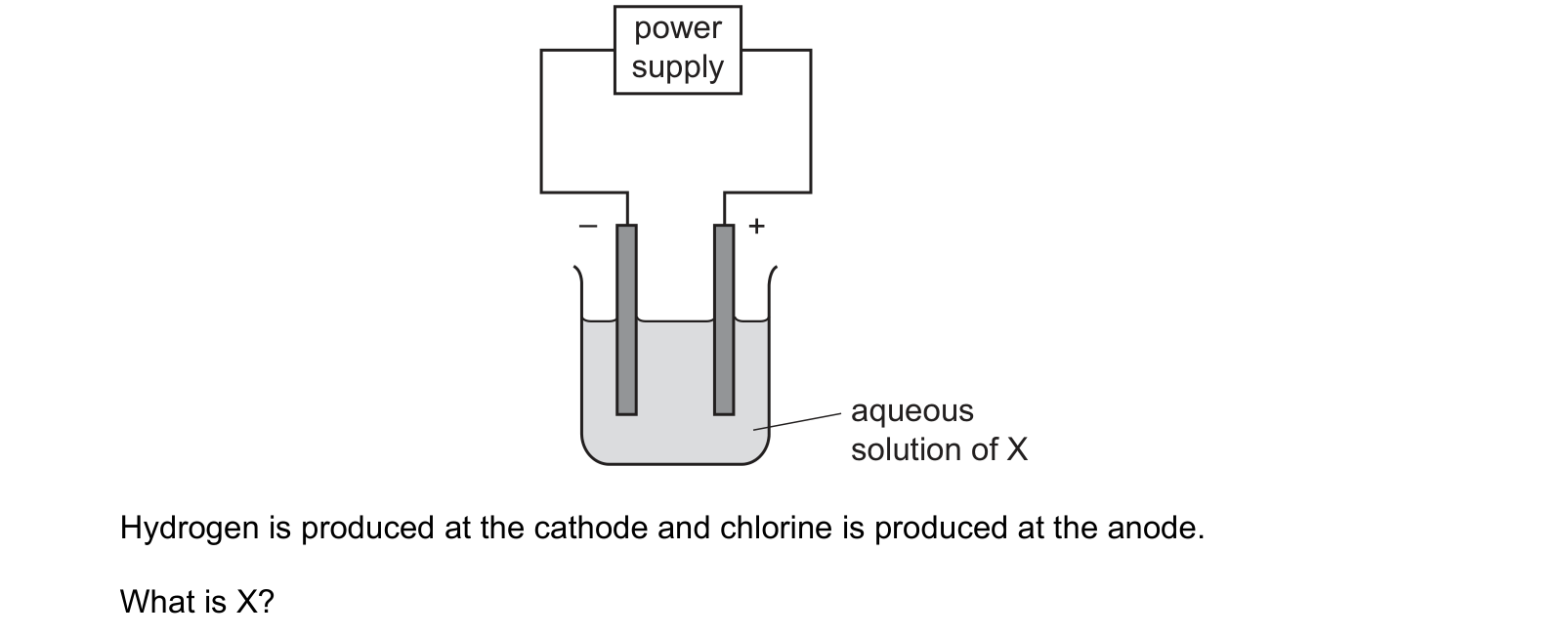
The diagram shows the electrolysis of an aqueous solution of X using inert electrodes. Hydrogen is produced at the cathode and chlorine is produced at the anode. What is X?
Answer: B.
Chlorine at the anode requires two conditions: chloride ions must be present and they must be concentrated enough to be discharged ahead of hydroxide ions. Dilute hydrochloric acid and dilute sodium chloride solution both fail the second condition and would give oxygen instead. Concentrated copper(II) chloride solution would indeed give chlorine at the anode, but at the cathode copper ions are discharged in preference to hydrogen, so copper would plate out and no hydrogen would appear. Concentrated hydrochloric acid meets both observations at once, giving hydrogen at the cathode from H+ and chlorine at the anode from the abundant chloride ions.
Question 2
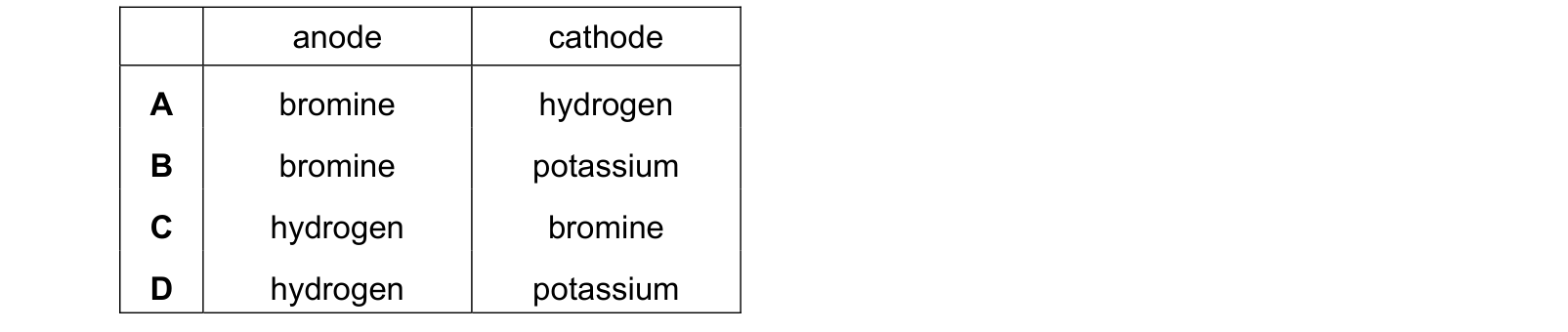
Electrolysis is carried out on dilute aqueous potassium bromide. Which products are formed at the anode and the cathode? Each answer gives, in order: anode; cathode.
Answer: A.
At the cathode the choice lies between K+ and H+, and potassium is one of the most reactive metals, so hydrogen is released while the potassium ions stay in solution. At the anode the bromide ions are discharged in preference to the hydroxide ions, because a bromide ion gives up its electron considerably more readily than a chloride ion does, so bromine is the product. That gives bromine at the anode with hydrogen at the cathode. The row placing potassium at the cathode ignores how reactive potassium is, and the rows offering hydrogen at the anode move a product formed by gaining electrons to the electrode where electrons are lost.
Question 3
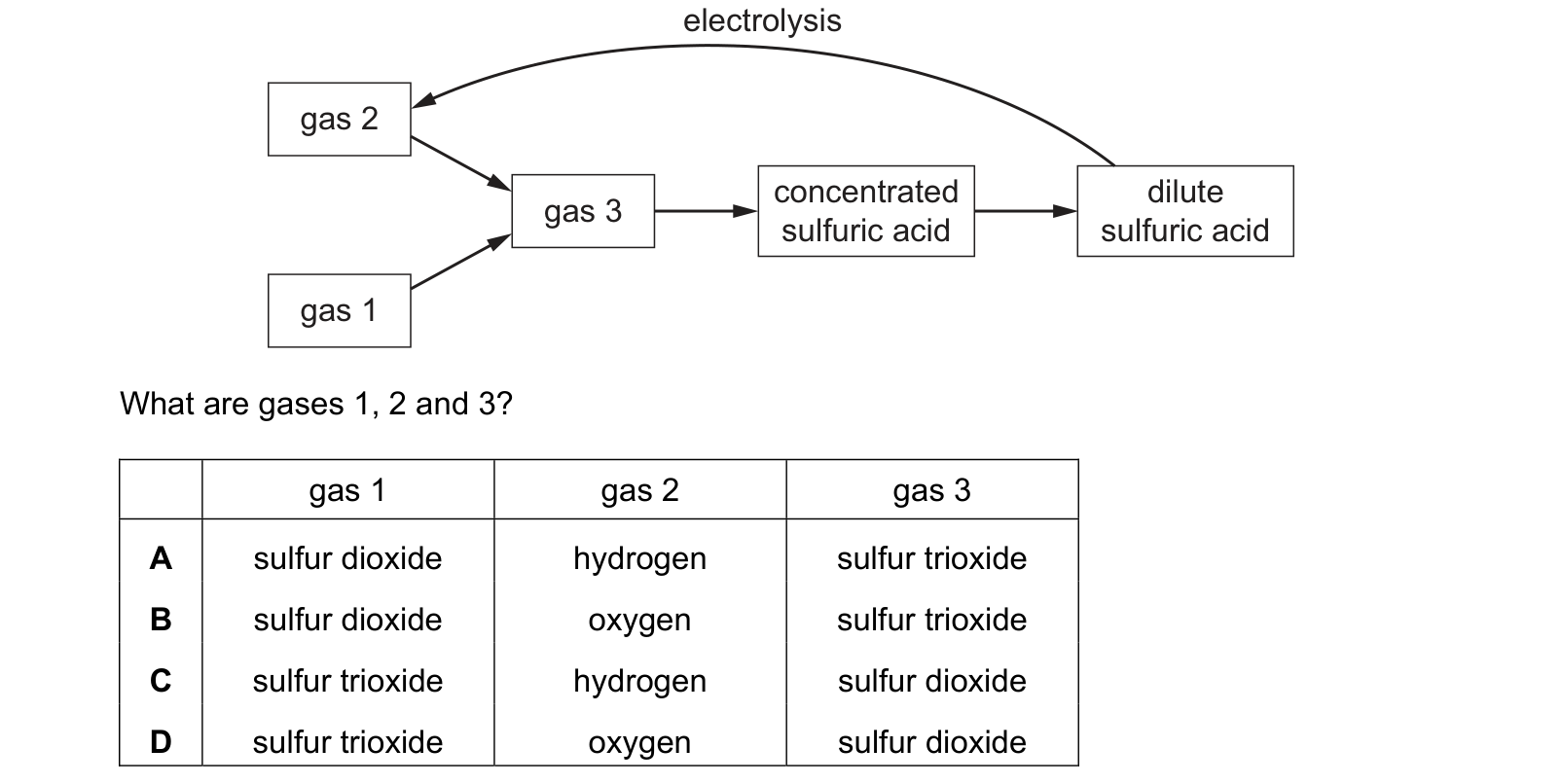
The flow chart shows part of the process for the manufacture of sulfuric acid and its electrolysis. What are gases 1, 2 and 3? Each answer gives, in order: gas 1; gas 2; gas 3.
Answer: B.
The flow chart makes gas 2 a product of the electrolysis of dilute sulfuric acid that is then fed back to react with gas 1. Electrolysing dilute sulfuric acid gives hydrogen at the cathode and oxygen at the anode, and it is oxygen, not hydrogen, that reacts with a sulfur oxide. In the Contact process sulfur dioxide combines with oxygen to form sulfur trioxide, which is then absorbed to make concentrated sulfuric acid, so gas 1 is sulfur dioxide, gas 2 is oxygen and gas 3 is sulfur trioxide. The rows naming hydrogen as gas 2 pick the wrong electrode product, and the rows starting from sulfur trioxide run the Contact process backwards, since the trioxide is what is made rather than what is fed in.
Question 4
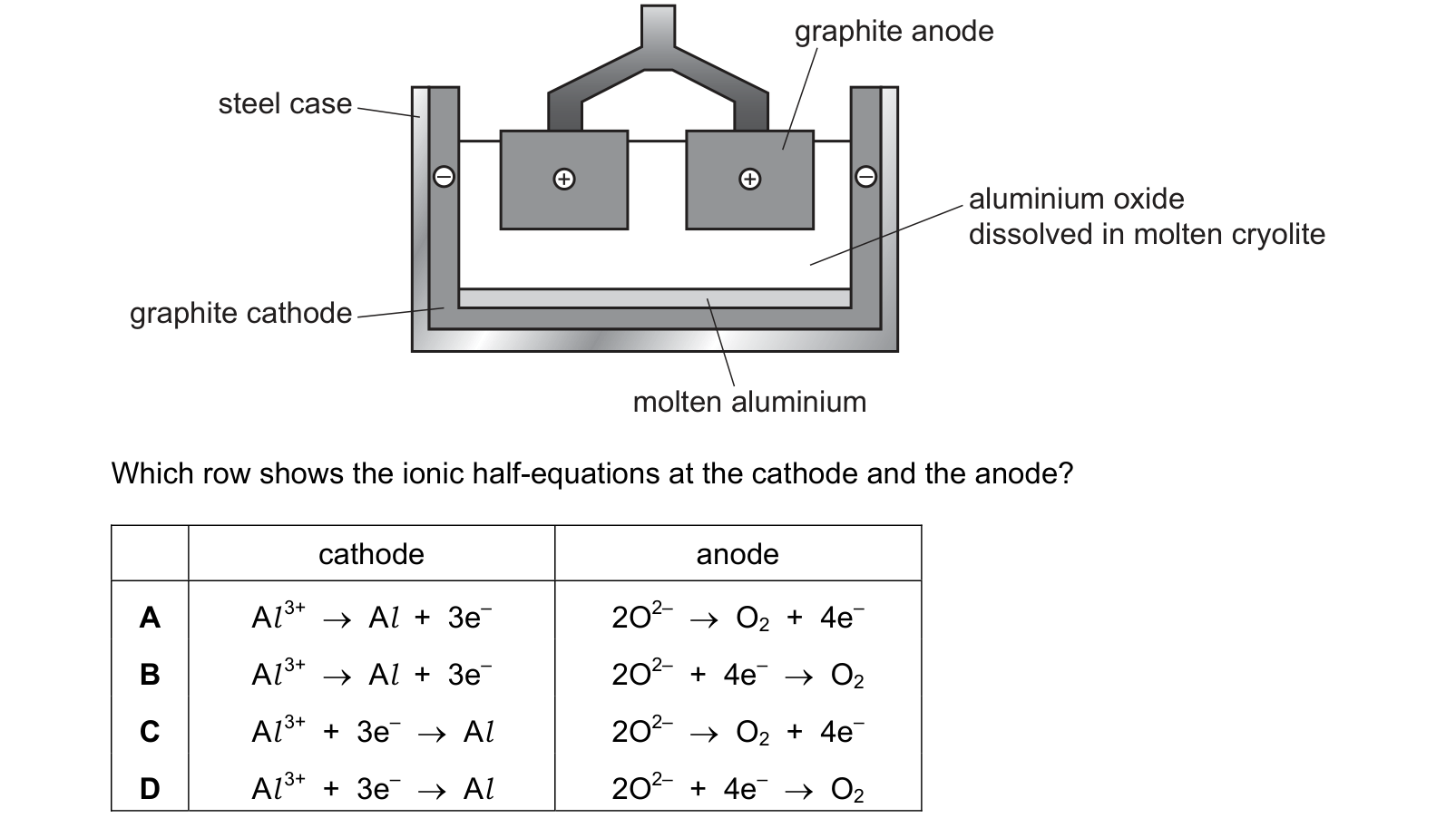
Aluminium is extracted by electrolysis as shown. graphite cathode Which row shows the ionic half-equations at the cathode and the anode? Each answer gives, in order: cathode; anode.
Answer: C.
Two rules settle the row. At the cathode reduction occurs, so the electrons belong on the left of the arrow, Al3+ + 3e- → Al, which eliminates both rows writing the aluminium equation with electrons on the right. At the anode oxidation occurs, so electrons belong on the right, 2O2- → O2 + 4e-, which eliminates the rows that add electrons to the oxide ions. Charge has to balance too, and two oxide ions carry four negative charges, so four electrons is the only possible number. The molten aluminium shown collecting at the graphite cathode in the diagram confirms which electrode makes the metal.
Question 5
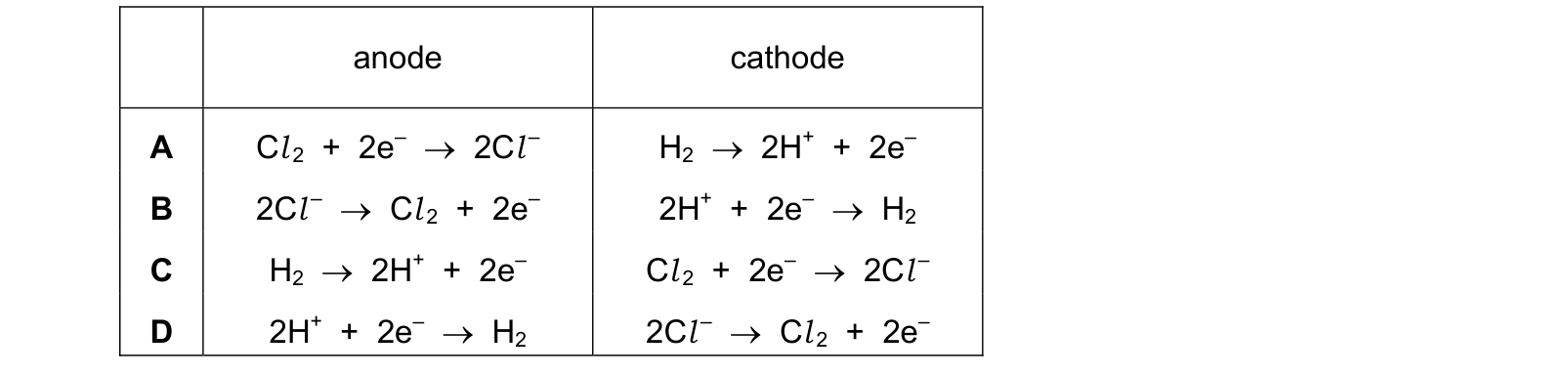
What are the ionic half-equations for the electrode reactions during the electrolysis of concentrated aqueous sodium chloride? Each answer gives, in order: anode; cathode.
Answer: B.
At the anode negative ions lose electrons, so the electrons appear on the right: 2Cl- → Cl2 + 2e-, chloride being discharged in preference to hydroxide because the solution is concentrated. At the cathode positive ions gain electrons, so the electrons appear on the left: 2H+ + 2e- → H2, since sodium is far too reactive to be discharged. The row that swaps those two equations puts a reduction at the anode. The two rows written with Cl2 and H2 as reactants describe chlorine being reduced and hydrogen being oxidised, which is this electrolysis running backwards.
These questions are drawn from past CIE 0620 Chemistry papers and filtered to electrolysis. You answer, you find out immediately whether you were right, and you get the reasoning for the correct option and for each distractor. Wrong answers go to a mistakes locker so you can come back to exactly those.
Practice is free. You need an account only so your progress and your mistakes are still there next time.
These are the errors that cost marks on electrolysis, taken from our own topic notes. Read them before you practise and you will recognise the traps in the questions.
Saying the anode is negative. The anode is positive, and anions go to it.
Trying to electrolyse a solid ionic compound. It must be molten or aqueous.
Predicting sodium at the cathode from aqueous sodium chloride.
Saying electrons move through the electrolyte.
Writing a half-equation with the electrons on the wrong side. Cathode reactions take electrons in, anode reactions give them out.
Confusing the two gas tests: hydrogen pops with a lighted splint and oxygen relights a glowing splint.
Saying the blue colour fades when copper electrodes are used. It fades only with inert electrodes.