Electrolysis
Contents: 10 sections
The cell and its vocabulary
Electrolysis is the decomposition of an ionic compound, when molten or in aqueous solution, by the passage of an electric current.
The compound must be molten or dissolved because its ions have to be free to move. A solid ionic compound holds its ions in fixed positions in the lattice, so it does not conduct and cannot be electrolysed.
- The anode is the positive electrode. Negative ions, anions, move to it.
- The cathode is the negative electrode. Positive ions, cations, move to it.
- The electrolyte is the molten or aqueous ionic substance being broken down.
- Inert electrodes are made of platinum or of carbon in the form of graphite, and take no part in the reaction.
Two rules cover every Core prediction:
- Metals or hydrogen are formed at the cathode.
- Non-metals other than hydrogen are formed at the anode.
Molten lead(II) bromide
Lead(II) bromide is heated until it melts, and inert graphite electrodes are dipped in.
- Cathode: a silvery grey bead of molten lead forms.
- Anode: red-brown fumes of bromine are given off.
This is the model for any molten binary compound, one that contains just two elements: the metal appears at the cathode and the non-metal at the anode. Molten zinc chloride gives zinc and chlorine; molten aluminium oxide gives aluminium and oxygen. No prediction is needed beyond reading the two elements out of the formula.
The lamp in the circuit only lights once the solid has melted, which is the observation that proves ions must be mobile.
Concentrated aqueous sodium chloride
- Cathode: hydrogen, seen as bubbles of a colourless gas that pops with a lighted splint.
- Anode: chlorine, a pale yellow-green gas that bleaches damp litmus paper.
- Left in solution: sodium hydroxide, so the solution becomes alkaline.
Sodium is not produced, even though it is the metal in the compound. In a solution there is also hydrogen present from the water, and hydrogen is less reactive than sodium, so hydrogen is discharged instead.
Dilute sulfuric acid
- Cathode: hydrogen, which pops with a lighted splint.
- Anode: oxygen, which relights a glowing splint.
The overall effect is that water is being split, so the gases come off in a fixed ratio of 2 to 1:
2H₂O → 2H₂ + O₂
If 24 cm³ of hydrogen is collected, the volume of oxygen is 24 / 2 = 12 cm³. A question showing two collecting tubes is usually asking you to identify which gas is which from that ratio: the fuller tube is always the hydrogen.
Predicting the products in solution (Extended)
For aqueous solutions there are two things present at each electrode competing to be discharged, and the rules are:
At the cathode, the less reactive of the metal and hydrogen is produced.
- The metal is above hydrogen in the reactivity series, as sodium, potassium, calcium, magnesium, aluminium and zinc are: hydrogen is produced.
- The metal is below hydrogen, as copper and silver are: the metal is produced.
At the anode, it depends on the ion and on the concentration.
- A concentrated halide solution gives the halogen: chlorine, bromine or iodine.
- A dilute halide solution, or any sulfate or nitrate solution, gives oxygen.
| Electrolyte | At the cathode | At the anode |
|---|---|---|
| Concentrated sodium chloride | Hydrogen | Chlorine |
| Dilute sodium chloride | Hydrogen | Oxygen |
| Copper(II) sulfate | Copper | Oxygen |
| Dilute sulfuric acid | Hydrogen | Oxygen |
| Molten lead(II) bromide | Lead | Bromine |
The middle two rows carry the whole idea. Changing the concentration of sodium chloride changes the anode product without touching the cathode product, and swapping sodium for copper changes the cathode product without touching the anode product.
How charge is carried (Extended)
Three separate movements happen at once, and a full-mark answer names all three.
- In the external circuit: electrons flow from the negative terminal of the power supply to the cathode, and from the anode back to the positive terminal.
- In the electrolyte: ions move. Cations travel to the cathode and anions to the anode.
- At the electrodes: cations gain electrons at the cathode and anions lose electrons at the anode, so the circuit is completed.
Electrons never travel through the electrolyte, and ions never travel through the wires. Saying that electrons flow through the solution is a standard error and loses the mark.
Half-equations (Extended)
At the cathode, reduction, meaning gain of electrons:
- Pb²⁺ + 2e⁻ → Pb
- 2H⁺ + 2e⁻ → H₂
- Cu²⁺ + 2e⁻ → Cu
At the anode, oxidation, meaning loss of electrons:
- 2Br⁻ → Br₂ + 2e⁻
- 2Cl⁻ → Cl₂ + 2e⁻
- 4OH⁻ → O₂ + 2H₂O + 4e⁻
Check the last one both ways. Atoms: 4 oxygen and 4 hydrogen on the left, and on the right 2 in O₂ plus 2 in the water gives 4 oxygen, with 4 hydrogen. Charge: 4 × (−1) = −4 on the left, and 0 + 4 × (−1) = −4 on the right.
The number of electrons is always the charge on the ion times the number of ions, so a 2+ ion needs 2 electrons and two 1− ions release 2.
Aqueous copper(II) sulfate (Extended)
With inert carbon electrodes:
- Cathode: a pink-brown layer of copper is deposited, and the cathode gains mass.
- Anode: bubbles of oxygen, which relight a glowing splint.
- The blue colour of the solution fades, because Cu²⁺ ions are being removed and not replaced, and the solution becomes acidic as sulfuric acid is left behind.
With copper electrodes:
- Cathode: copper is deposited and the cathode gains mass.
- Anode: the copper anode dissolves and loses mass, by Cu → Cu²⁺ + 2e⁻.
- The blue colour does not change, because every Cu²⁺ removed at the cathode is replaced by one entering the solution from the anode.
The mass gained at the cathode equals the mass lost at the anode. If the cathode gains 0.64 g then the anode has lost 0.64 g, and this is the basis of purifying copper and of electroplating.
Common mistakes
- Saying the anode is negative. The anode is positive, and anions go to it.
- Trying to electrolyse a solid ionic compound. It must be molten or aqueous.
- Predicting sodium at the cathode from aqueous sodium chloride.
- Saying electrons move through the electrolyte.
- Writing a half-equation with the electrons on the wrong side. Cathode reactions take electrons in, anode reactions give them out.
- Confusing the two gas tests: hydrogen pops with a lighted splint and oxygen relights a glowing splint.
- Saying the blue colour fades when copper electrodes are used. It fades only with inert electrodes.
Check you have it
Question 1
What is produced at each electrode during the electrolysis of aqueous solutions using inert electrodes? Each answer gives, in order: positive electrode (anode); negative electrode (cathode).

Answer: C.
Question 2
Four substances are electrolysed using inert electrodes. Which row describes the electrode products? substance anode product cathode product Use the source image for S19 Paper 11, question 10.
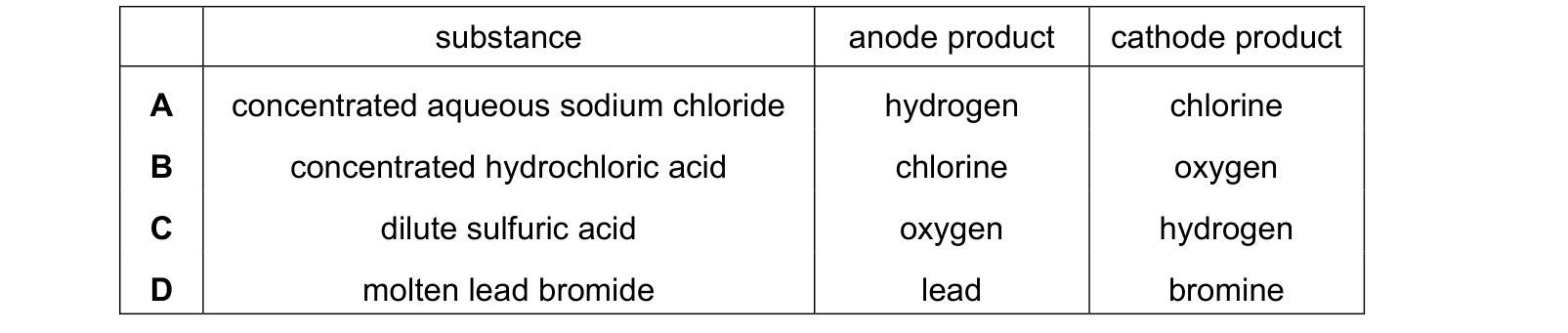
Answer: C.
Question 3
Concentrated aqueous sodium chloride is electrolysed using inert electrodes. Gases X and Y are produced at the electrodes shown. What are X and Y? Each answer gives, in order: X; Y.
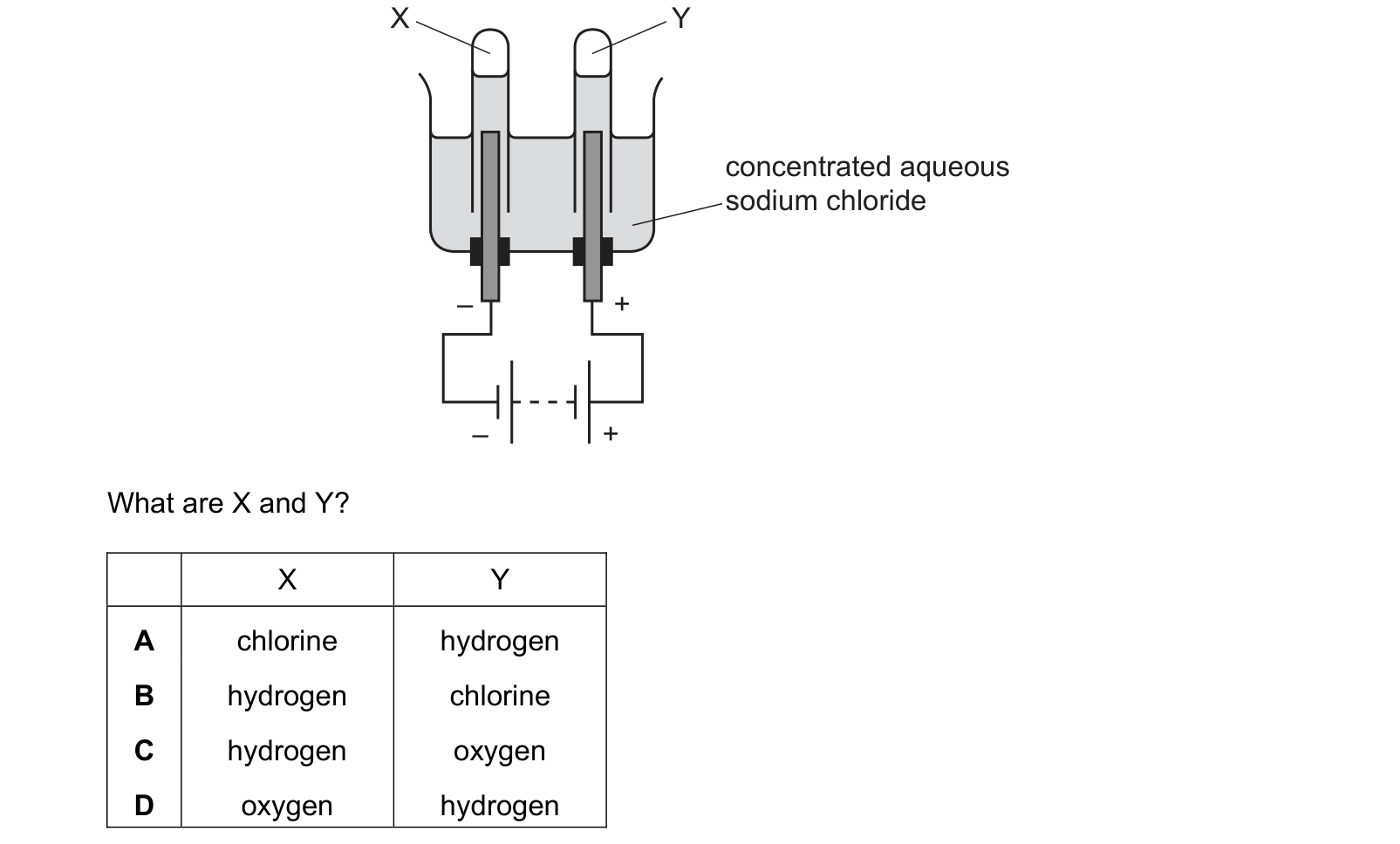
Answer: B.
What the syllabus asks for on this topicSyllabus points
Syllabus points
- Define electrolysis as the decomposition of an ionic compound, when molten or in aqueous solution, by the passage of an electric current.
- Identify the anode as the positive electrode, the cathode as the negative electrode, and the electrolyte as the substance being decomposed.
- Identify the products and describe the observations for the electrolysis of molten lead(II) bromide, concentrated aqueous sodium chloride and dilute sulfuric acid, using inert electrodes.
- State that metals or hydrogen form at the cathode and that non-metals other than hydrogen form at the anode, and predict the products for a molten binary compound.
- Extended only: describe the transfer of charge during electrolysis, in the external circuit, at the electrodes and in the electrolyte, and predict the products for a halide solution that is dilute or concentrated.
- Extended only: construct ionic half-equations for oxidation at the anode and reduction at the cathode, including the electrolysis of aqueous copper(II) sulfate with carbon and with copper electrodes.
Related CIE 0620 Chemistry topics
Not the topic you were looking for? Describe what you are stuck on in your own words and we will take you to the notes that answer it.