Ions and ionic bonds
Contents: 8 sections
Cations and anions
An ion is an atom, or a group of atoms, that has lost or gained electrons and so carries a charge. Atoms do this to reach the electronic configuration of a noble gas, which means a full outer shell.
Metals lose electrons and form positive ions, called cations. A sodium atom is 2,8,1; losing its single outer electron leaves 2,8, which is neon's configuration:
Na → Na⁺ + e⁻
Non-metals gain electrons and form negative ions, called anions. A chlorine atom is 2,8,7; gaining one electron gives 2,8,8, which is argon's configuration:
Cl + e⁻ → Cl⁻
The charge follows from the group, and the pattern is worth learning as a block:
| Group | Electrons moved | Ion formed | Example |
|---|---|---|---|
| I | Loses 1 | 1+ | Na⁺, K⁺ |
| II | Loses 2 | 2+ | Mg²⁺, Ca²⁺ |
| III | Loses 3 | 3+ | Al³⁺ |
| V | Gains 3 | 3− | N³⁻ |
| VI | Gains 2 | 2− | O²⁻, S²⁻ |
| VII | Gains 1 | 1− | Cl⁻, Br⁻ |
Notice that the number of protons never changes. A sodium ion still has 11 protons; it has 10 electrons, and 11 − 10 = 1, which is why the charge is 1+.
What an ionic bond is
An ionic bond is a strong electrostatic attraction between oppositely charged ions.
All three parts of that phrase are marked. It is electrostatic, meaning the attraction of opposite charges. It acts between ions, not atoms. And it is strong, which is what everything below follows from.
Ionic bonding happens between a metal and a non-metal, because one side needs to lose electrons and the other needs to gain them.
Sodium chloride, the Core example
Group I with Group VII is the case every Core candidate must be able to draw.
A sodium atom transfers its one outer electron to a chlorine atom. Sodium becomes Na⁺ with the configuration 2,8; chlorine becomes Cl⁻ with 2,8,8. The two ions then attract each other.
In a dot-and-cross diagram:
- Draw the outer shell only of each ion.
- Show sodium's outer shell empty, because the electron it once had has gone.
- Show chlorine's outer shell with eight electrons: seven crosses of its own and the one dot transferred from sodium, so the transfer is visible.
- Put square brackets round each ion with the charge written outside the top right corner: [Na]⁺ and [Cl]⁻.
Losing the brackets or the charges is the commonest way this diagram loses marks, and an arrow showing the transfer is worth adding.
Metals with non-metals generally (Extended)
Extended candidates must handle any metal with any non-metal, which means the numbers of ions no longer have to be equal. The rule is that the total positive charge must equal the total negative charge.
Magnesium chloride. Magnesium is 2,8,2 and loses 2 electrons to give Mg²⁺. Each chlorine gains only 1, so it takes two chlorine atoms to accept them: MgCl₂. The dot-and-cross diagram shows one magnesium and two separate chloride ions, each with its own brackets and charge.
Sodium oxide. Oxygen needs 2 electrons and each sodium supplies 1, so two sodium atoms are needed: Na₂O.
Aluminium oxide. Al³⁺ and O²⁻ do not balance one for one. The smallest number that 3 and 2 both divide into is 6, so take two aluminium ions and three oxide ions:
- 2 × (+3) = +6
- 3 × (−2) = −6
The formula is Al₂O₃, and this charge-balancing arithmetic is how any ionic formula is deduced.
The giant ionic lattice (Extended)
An ionic compound is not made of molecules. The ions pack into a giant lattice: a regular three-dimensional arrangement of alternating positive and negative ions extending in every direction.
In sodium chloride, each Na⁺ is surrounded by six Cl⁻ ions and each Cl⁻ by six Na⁺ ions, in a cubic arrangement. There is no such thing as one molecule of NaCl. The formula gives the ratio of the ions, which is why the correct name for its mass is relative formula mass rather than relative molecular mass.
Properties, and why (Extended explanations)
High melting and boiling points. There are very many strong electrostatic attractions throughout the lattice, and a great deal of energy is needed to overcome them.
| Compound | Melting point in °C | Ions present |
|---|---|---|
| Sodium chloride | 801 | Na⁺ and Cl⁻ |
| Magnesium oxide | 2852 | Mg²⁺ and O²⁻ |
Magnesium oxide melts more than 2000 °C higher than sodium chloride because its ions carry double charges, so each attraction is far stronger. That comparison is a favourite question, and the answer is always about the size of the charges.
Electrical conductivity. An ionic compound conducts only when its ions are free to move.
- Solid: does not conduct, because the ions are held in fixed positions in the lattice.
- Molten: conducts, because melting frees the ions to move to the electrodes.
- Aqueous: conducts, because dissolving separates the ions and lets them move.
Note carefully that it is the ions that carry the charge, not electrons. Answers that say ionic solids have no free electrons are describing why they do not conduct as metals do, but the mark is for the ions being fixed.
Solubility. Most ionic compounds dissolve in water and are insoluble in organic solvents such as petrol.
Brittleness. A blow that shifts one layer of the lattice brings like charges next to each other; they repel and the crystal splits cleanly.
Common mistakes
- Saying an ionic bond is the sharing of electrons. That is covalent bonding.
- Drawing a dot-and-cross diagram without brackets or without charges.
- Showing the sodium ion still holding its outer electron.
- Saying ionic compounds conduct because of delocalised electrons. They conduct because ions move.
- Saying solid sodium chloride conducts. It does not; the ions cannot move.
- Writing MgCl or AlO instead of balancing the charges to MgCl₂ and Al₂O₃.
- Calling an ionic compound a molecule, or using relative molecular mass for it.
Check you have it
Question 1
Which row describes the properties of potassium bromide? Each answer gives, in order: soluble in water; melting point; electrical conductivity when solid.
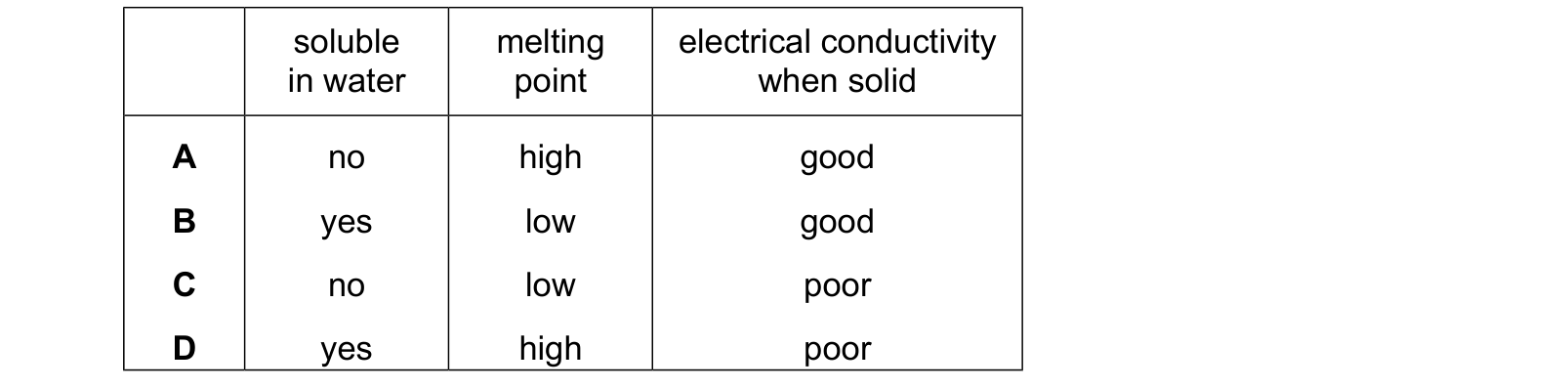
Answer: D.
Question 2
The arrangements of the electrons in two ions formed from elements X and Y are shown.
X Y Which equation represents the reaction between elements X and Y?
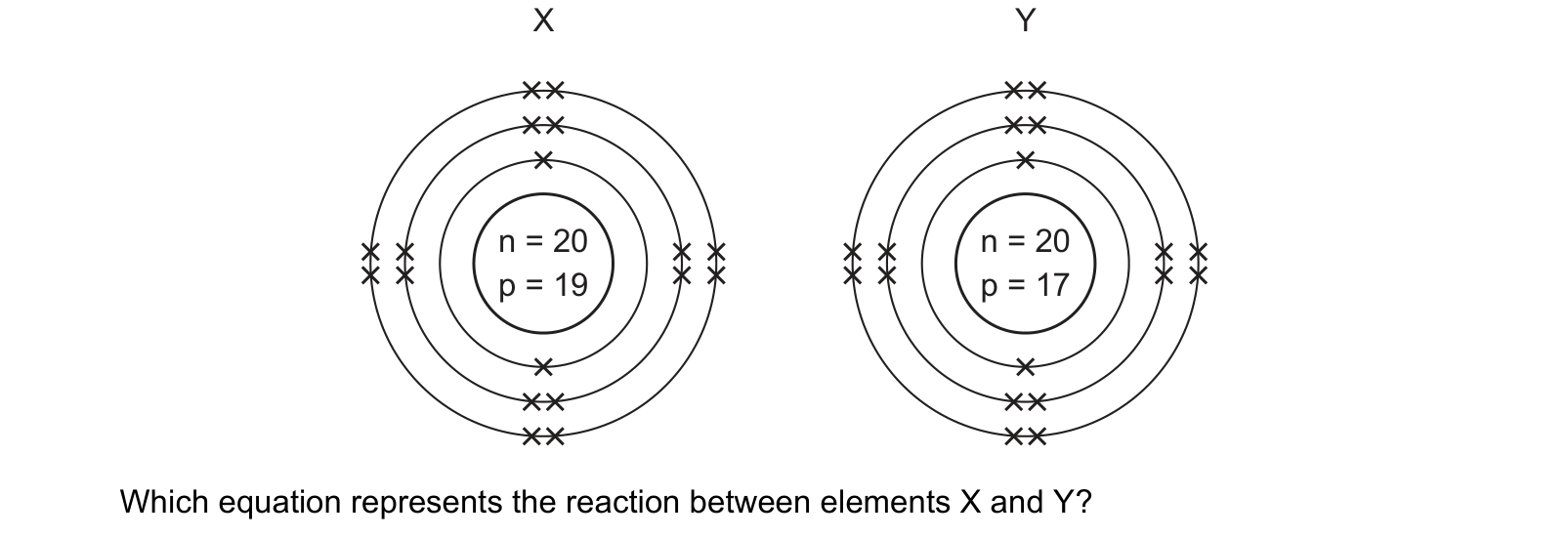
Answer: C.
Question 3
Which row describes the properties of potassium iodide, KI? Each answer gives, in order: type of bonding; boiling point; solid conducts electricity; aqueous solution conducts electricity.
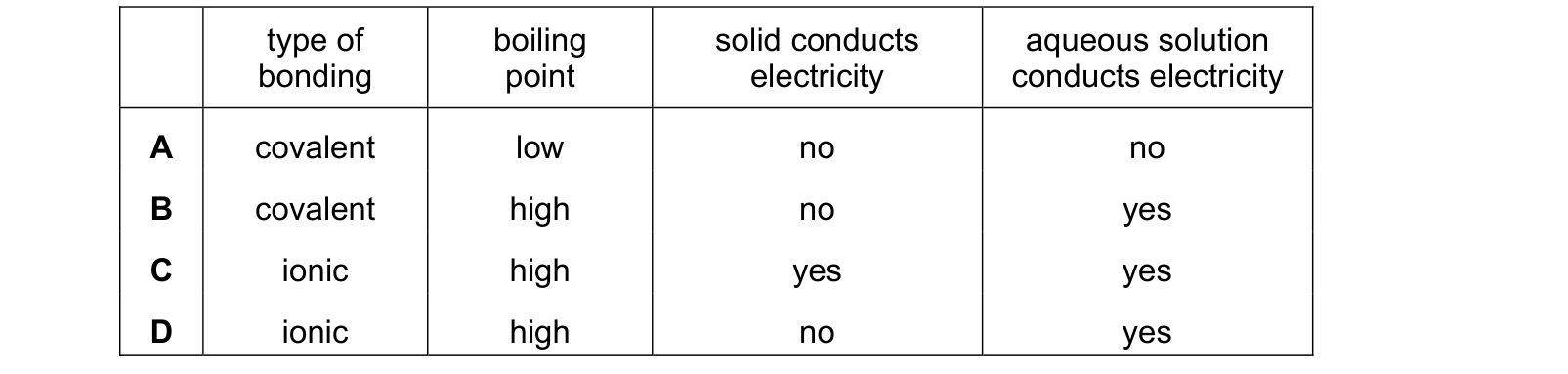
Answer: D.
What the syllabus asks for on this topicSyllabus points
Syllabus points
- Describe the formation of positive ions, known as cations, and negative ions, known as anions.
- State that an ionic bond is a strong electrostatic attraction between oppositely charged ions.
- Describe the formation of ionic bonds between elements from Group I and Group VII, using dot-and-cross diagrams.
- Describe the properties of ionic compounds: high melting points and boiling points, and good electrical conductivity when molten or aqueous but poor when solid.
- Extended only: describe the formation of ionic bonds between ions of metallic and non-metallic elements generally, using dot-and-cross diagrams.
- Extended only: describe the giant lattice structure of ionic compounds, and explain their properties in terms of structure and bonding.
Related CIE 0620 Chemistry topics
Not the topic you were looking for? Describe what you are stuck on in your own words and we will take you to the notes that answer it.