Alcohols
Contents: 9 sections
The alcohols
General formula CₙH₂ₙ₊₁OH. The functional group is the hydroxyl group, drawn in full as C-O-H, with a bond from the carbon to the oxygen and a second bond from the oxygen to a hydrogen. Writing it as an undivided "OH" in a displayed formula loses the mark.
| Alcohol | Structural formula | Molecular formula |
|---|---|---|
| Methanol | CH₃OH | CH₄O |
| Ethanol | CH₃CH₂OH | C₂H₆O |
| Propan-1-ol | CH₃CH₂CH₂OH | C₃H₈O |
| Propan-2-ol | CH₃CH(OH)CH₃ | C₃H₈O |
| Butan-1-ol | CH₃CH₂CH₂CH₂OH | C₄H₁₀O |
Ethanol is often written C₂H₅OH, which is the same thing. Note that it is not a hydrocarbon, because it contains oxygen as well as carbon and hydrogen.
Combustion
Alcohols burn in a plentiful supply of oxygen to carbon dioxide and water, releasing heat:
C₂H₅OH + 3O₂ → 2CO₂ + 3H₂O
2CH₃OH + 3O₂ → 2CO₂ + 4H₂O
When balancing, remember that the alcohol brings one oxygen atom of its own. In the ethanol equation, one oxygen from the ethanol plus six from 3O₂ makes seven on the left, matching four in 2CO₂ and three in 3H₂O on the right. Forgetting that extra oxygen is why so many answers give 3.5O₂ or 4O₂.
Uses of ethanol
- As a solvent. Ethanol dissolves many substances that water will not, and it evaporates quickly at room temperature, so it is used in perfumes, aftershaves, cosmetics, printing inks and medicines. Methylated spirit is ethanol with methanol added to make it undrinkable.
- As a fuel. It burns with a clean, almost smokeless flame. It is used in spirit burners and, in countries such as Brazil, blended with petrol as a motor fuel.
Manufacture 1: fermentation
C₆H₁₂O₆ → 2C₂H₅OH + 2CO₂
Conditions: aqueous glucose, yeast, a temperature of 25 to 35 °C, and the absence of oxygen.
Each condition is there for a reason worth knowing:
- Yeast supplies the enzymes that catalyse the reaction.
- 25 to 35 °C is a compromise. Below 25 °C the enzymes work too slowly; above about 40 °C they are denatured and the reaction stops altogether.
- No oxygen, because with air present the bacteria described below oxidise the ethanol to ethanoic acid and the product turns to vinegar.
Fermentation stops on its own at around 15 per cent ethanol, because the yeast is killed by its own product. To get a stronger solution, the mixture is then fractionally distilled: ethanol boils at 78 °C and water at 100 °C, so the ethanol distils off first.
Manufacture 2: hydration of ethene
C₂H₄ + H₂O → C₂H₅OH
Conditions: 300 °C, 60 atmospheres pressure, and a phosphoric acid catalyst.
The steam adds across the C=C double bond, an H going to one carbon and an OH to the other. This is the addition reaction from 11.5 seen from the alcohol's side.
Quote the numbers. "High temperature and pressure with a catalyst" is not worth the marks that 300 °C, 60 atmospheres and phosphoric acid are.
Comparing the two routes (Extended)
| Fermentation | Hydration of ethene | |
|---|---|---|
| Raw material | Glucose from sugar cane or sugar beet, which is renewable | Ethene from cracking petroleum, which is finite |
| Rate | Slow, taking days | Fast |
| Purity of product | Impure aqueous solution, needing fractional distillation | Pure ethanol, no separation needed |
| Type of process | Batch: fill, wait, empty, clean, refill | Continuous: runs without stopping |
| Energy needed | Low, since it runs near room temperature and atmospheric pressure | High, because of the temperature and the pressure |
| Labour | High | Low, once the plant is built |
Neither route wins on every line, which is exactly why an exam question asks for advantages and disadvantages. Fermentation wins on raw material and on running cost; hydration wins on speed, purity and labour.
Oxidation of ethanol (Extended)
Ethanol is oxidised to ethanoic acid, CH₃COOH, by two routes.
1. Acidified aqueous potassium manganate(VII). Warm ethanol with potassium manganate(VII) solution acidified with dilute sulfuric acid. The manganate(VII) is the oxidising agent, and the purple colour turns colourless as it is used up.
C₂H₅OH + 2[O] → CH₃COOH + H₂O
The [O] stands for oxygen supplied by the oxidising agent, and writing the equation in that form is accepted.
2. Bacterial oxidation. Leave a dilute solution of ethanol open to the air and bacteria oxidise it using oxygen from the atmosphere:
C₂H₅OH + O₂ → CH₃COOH + H₂O
This is why an opened bottle of wine turns sour after a few days, and it is how vinegar is made deliberately. It also explains why fermentation must be carried out in the absence of oxygen: the two processes are competing for the same ethanol.
Both routes make the same product. The laboratory route is fast and needs a reagent; the bacterial route is slow and needs only air.
Common mistakes
- Calling ethanol a hydrocarbon.
- Forgetting the oxygen atom in the alcohol when balancing a combustion equation.
- Giving the fermentation temperature as 60 °C or "warm". Above about 40 °C the yeast enzymes are denatured.
- Saying fermentation needs oxygen. It needs the absence of oxygen.
- Writing the fermentation equation without the carbon dioxide.
- Answering "suitable conditions" for the hydration of ethene instead of 300 °C, 60 atmospheres and phosphoric acid.
- Saying acidified potassium manganate(VII) goes from purple to clear. The change is purple to colourless.
- Claiming fermentation gives pure ethanol. It gives a dilute aqueous solution that must be distilled.
Check you have it
Question 1
Which row describes the production of ethanol and its properties? can be made can be made is used as a is used as a from glucose from ethene fuel solvent Use the source image for M20 Paper 12, question 38.
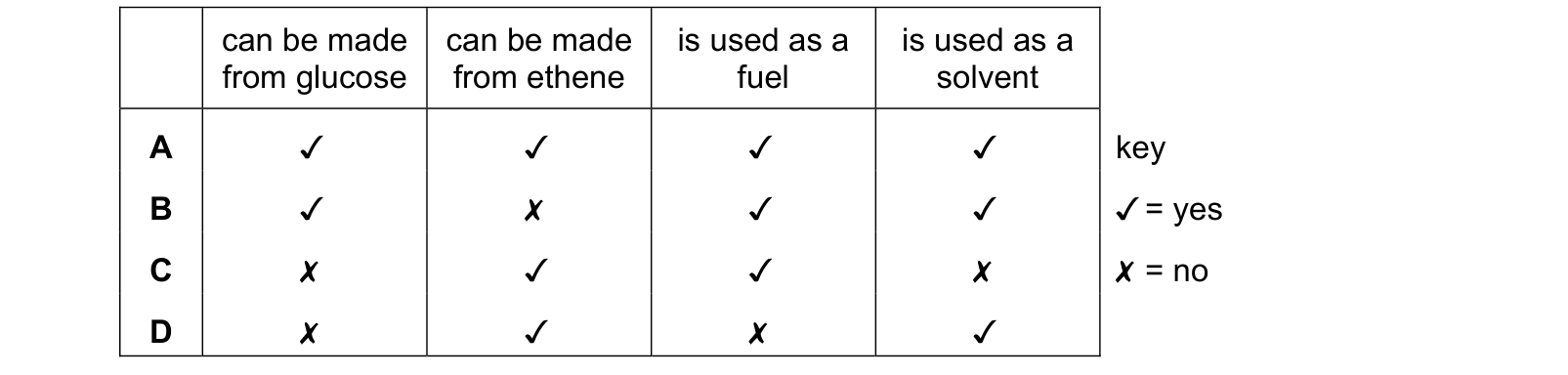
Answer: A.
Question 2
Which row describes the production of ethanol and its properties? can be made can be made is used as a is used as a from glucose from ethene fuel solvent Use the source image for M20 Paper 22, question 37.
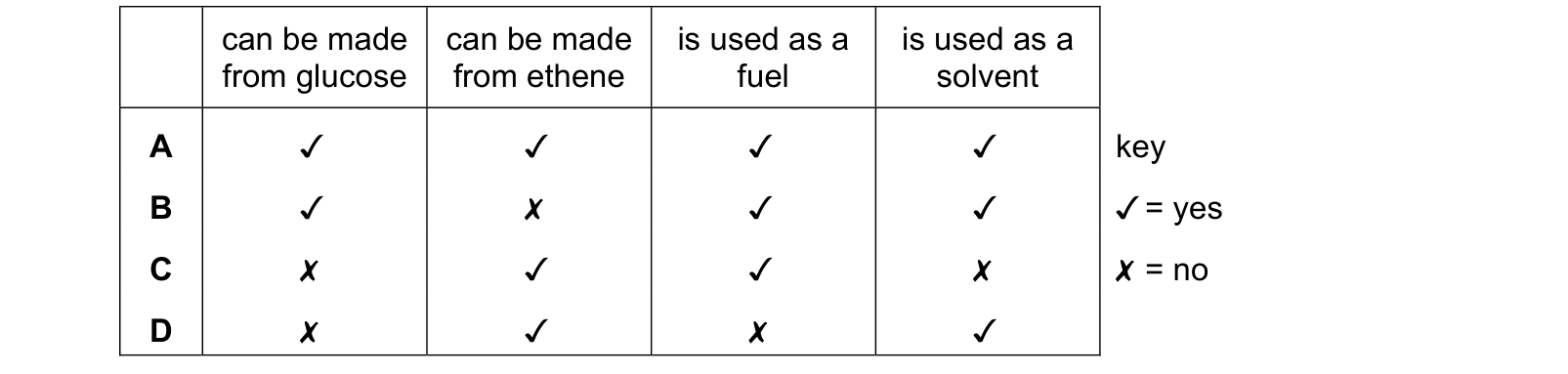
Answer: A.
Question 3
The reaction of ethanol with acidified potassium manganate(VII) is shown.
KMnO4 CH3CH2OH CH3COOH H+
Which type of reaction is taking place?

Answer: D.
What the syllabus asks for on this topicSyllabus points
Syllabus points
- Draw the structures of alcohols containing up to four carbon atoms, and state the general formula CₙH₂ₙ₊₁OH.
- Describe the manufacture of ethanol by fermentation of aqueous glucose and by the catalytic addition of steam to ethene, giving the conditions for each.
- Describe the complete combustion of ethanol.
- State the uses of ethanol as a solvent and as a fuel.
- Extended: describe the advantages and disadvantages of the two methods of manufacture.
- Extended: describe the oxidation of ethanol to ethanoic acid by acidified aqueous potassium manganate(VII) and by bacterial oxidation.
Related CIE 0620 Chemistry topics
Not the topic you were looking for? Describe what you are stuck on in your own words and we will take you to the notes that answer it.