Solids, liquids and gases
Contents: 7 sections
The three states
| Solid | Liquid | Gas | |
|---|---|---|---|
| Arrangement | Regular, close packed | Close together, irregular | Far apart, random |
| Separation | Touching | Touching | Roughly ten times a particle diameter |
| Motion | Vibrate about fixed positions | Slide over one another | Move rapidly in all directions |
| Attraction between particles | Strong | Strong but able to be overcome | Negligible |
| Shape | Fixed | Takes the shape of the container | Fills the container |
| Volume | Fixed | Fixed | Fills the container |
| Compressible | No | Almost not at all | Yes |
Every property in the lower half of that table follows from the upper half, and Cambridge asks you to make the link rather than recite the list.
A gas can be squeezed because there is empty space between its particles. A solid and a liquid cannot, because their particles are already in contact.
A liquid takes the shape of its container because its particles slide past one another, but keeps a fixed volume because they stay touching.
The change in volume on boiling shows the size of that spacing. One mole of water, 18 g, occupies about 18 cm³ as a liquid and roughly 30 000 cm³ as steam at 100 °C, so each particle ends up with about 1 700 times as much space around it.
Changes of state
- Melting: solid to liquid, at the melting point.
- Freezing: liquid to solid, at the same temperature as melting.
- Boiling: liquid to gas, at the boiling point, with bubbles forming throughout the liquid.
- Evaporating: liquid to gas, at any temperature, from the surface only.
- Condensing: gas to liquid.
Water melts at 0 °C and boils at 100 °C at normal atmospheric pressure, so it is liquid between those two values. Those numbers are used constantly to work out which state a substance is in: a substance with a melting point of −7 °C and a boiling point of 59 °C is a liquid at room temperature, because 20 °C lies between them.
Evaporation and boiling are not the same process. Boiling happens only at the boiling point; evaporation happens at every temperature, because at any moment a few surface particles have enough energy to escape.
Iodine and solid carbon dioxide change straight from solid to gas on warming, which is called sublimation.
Explaining changes of state (Extended)
Core candidates describe what happens. Extended candidates explain it in terms of particles, and the explanation is always the same two ideas.
Heating supplies energy. Particles gain kinetic energy, move faster, and the temperature rises.
At a change of state that energy does something else. It is used to overcome the forces of attraction between particles, so the particles separate. The temperature does not rise while this is happening, even though heating continues.
Heating and cooling curves
A heating curve for a substance taken from solid to gas has five parts:
- A rise, while the solid warms and its particles vibrate more.
- A flat section at the melting point, while the forces holding the lattice together are overcome.
- A rise, while the liquid warms.
- A flat section at the boiling point, while the remaining forces between particles are overcome so they can move apart freely.
- A rise, while the gas warms.
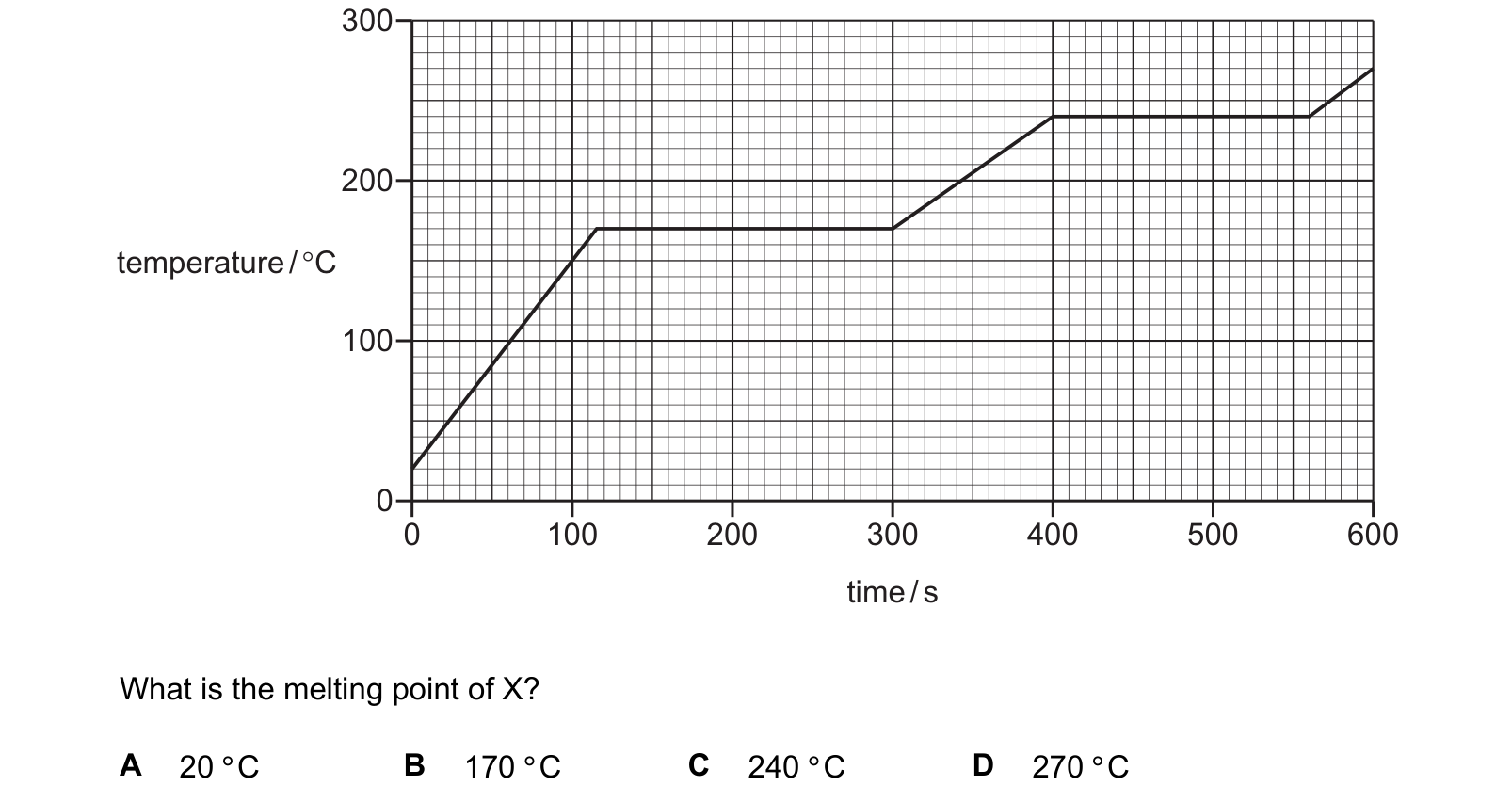
A cooling curve is the mirror image, with two flat sections where energy is released as the attractions re-form. The temperature of the flat sections gives you the melting point and the boiling point directly, and reading them off a graph is the commonest way this is examined.
The second flat section is always longer than the first, because separating particles completely takes more energy than merely letting them slide.
Temperature and the volume of a gas
Heating a gas held at constant pressure makes it expand.
The explanation: the particles gain kinetic energy and move faster, so they hit the container walls harder and more often. The gas pushes outwards until its volume has increased enough for the pressure inside to match the pressure outside again.
This is why a sealed plastic bottle brought indoors from the cold slowly swells, and why a gas syringe reading rises when the barrel is warmed.
Pressure and the volume of a gas
Increasing the pressure on a gas at constant temperature decreases its volume, and the decrease is in proportion.
The explanation: the particles are pushed closer together into the empty space between them. In the smaller volume they travel less distance between collisions, so they hit the walls more often and the pressure inside rises to match.
Worked example. 60 cm³ of air at a pressure of 100 kPa is compressed at constant temperature until the pressure reaches 300 kPa. What volume does it now occupy?
Pressure and volume multiply to a constant here, so the pressure has been tripled and the volume falls to a third:
100 × 60 / 300 = 20 cm³.
The 0620 syllabus asks you to describe this effect rather than to calculate it, so a sentence saying that trebling the pressure reduces the volume to a third will earn the mark. The arithmetic is worth doing because it makes the direction of the change impossible to get backwards.
Nothing about the particles themselves changes in either case. They do not shrink, expand, melt or get heavier. Only their speed and their spacing change.
Common mistakes
- Saying particles in a solid do not move. They vibrate about fixed positions.
- Saying the temperature rises while a substance is melting or boiling.
- Saying that the particles themselves expand when a gas is heated.
- Treating evaporation and boiling as the same thing.
- Reading the top of a heating curve as the melting point instead of reading the flat sections.
- Saying a gas is compressible because its particles are soft, rather than because there is space between them.
- Forgetting that freezing point and melting point are the same temperature.
Check you have it
Question 1
Solid X is heated for 600 seconds.
The graph shows the heating curve that is obtained. temperature / °C time / s
What is the melting point of X?
Answer: B.
Question 2
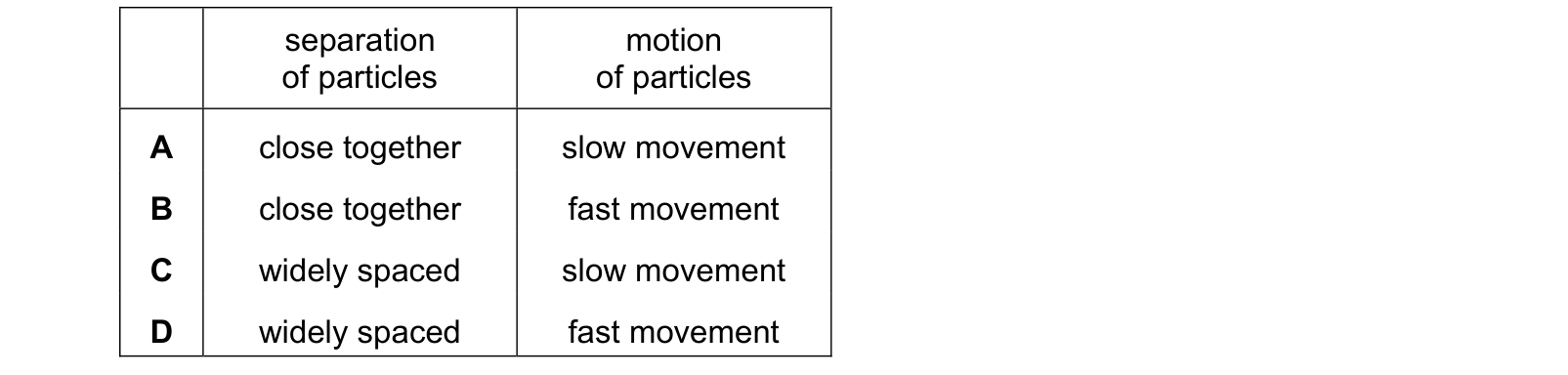
Which row describes the separation and motion of particles in a gas? Each answer gives, in order: separation of particles; motion of particles.
Answer: D.
Question 3
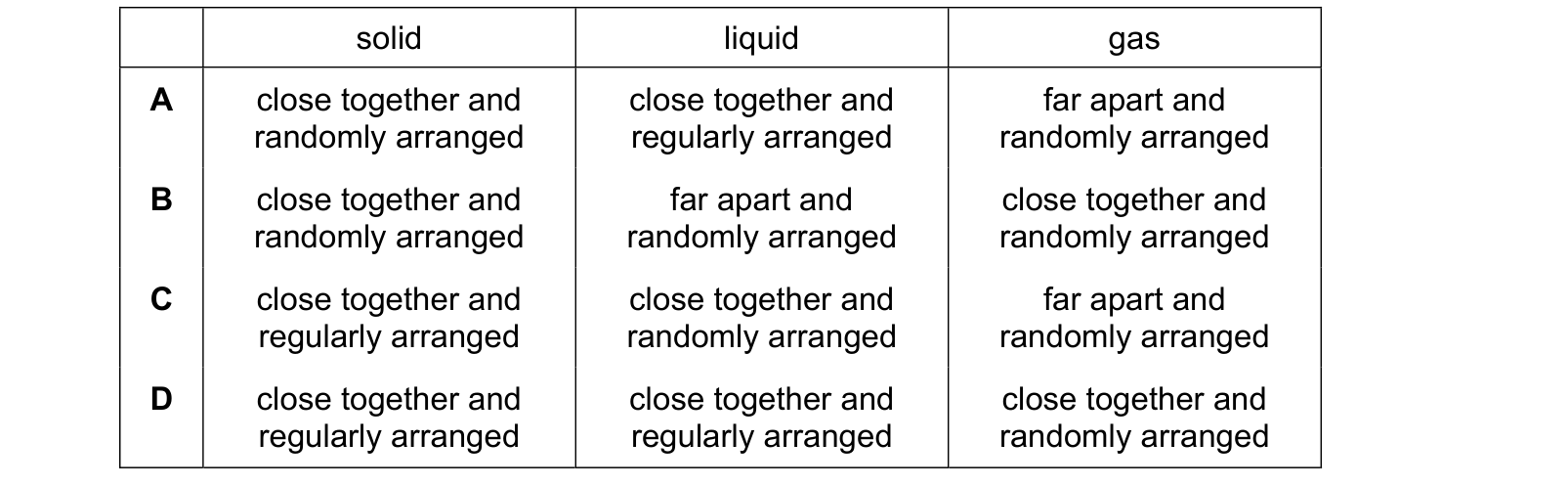
Which row describes the spacing and arrangement of particles in a solid, a liquid and a gas? Each answer gives, in order: solid; liquid; gas.
Answer: C.
What the syllabus asks for on this topicSyllabus points
Syllabus points
- State the distinguishing properties of solids, liquids and gases.
- Describe the structures of solids, liquids and gases in terms of particle separation, arrangement and types of motion.
- Describe changes of state in terms of melting, boiling, evaporating, freezing and condensing.
- Describe the effects of temperature and of pressure on the volume of a gas.
- Extended only: explain changes of state in terms of kinetic particle theory, including the interpretation of heating and cooling curves.
- Extended only: explain the effects of temperature and of pressure on the volume of a gas in terms of kinetic particle theory.
Related CIE 0620 Chemistry topics
Not the topic you were looking for? Describe what you are stuck on in your own words and we will take you to the notes that answer it.