Air quality and climate
Contents: 9 sections
Clean, dry air
| Gas | Approximate proportion by volume |
|---|---|
| Nitrogen, N₂ | 78% |
| Oxygen, O₂ | 21% |
| Noble gases (mostly argon) and carbon dioxide, CO₂ | the remaining 1% |
78 + 21 = 99, so everything else, argon at roughly 0.9% and carbon dioxide at roughly 0.04%, shares what is left. "Clean, dry" is doing real work in that phrase: it excludes water vapour, whose proportion varies with the weather, and it excludes the pollutants below.
Where each pollutant comes from
| Pollutant | Source |
|---|---|
| Carbon dioxide, CO₂ | Complete combustion of carbon-containing fuels |
| Carbon monoxide, CO, and particulates | Incomplete combustion of carbon-containing fuels |
| Methane, CH₄ | Decomposition of vegetation, and waste gases from digestion in animals |
| Oxides of nitrogen, NO and NO₂ | Car engines |
| Sulfur dioxide, SO₂ | Combustion of fossil fuels that contain sulfur compounds |
The carbon dioxide and carbon monoxide entries differ by one word. With plenty of oxygen every carbon atom ends up as CO₂; with a limited supply some ends as CO and some as particulates, which are tiny specks of solid carbon (soot).
Nitrogen and oxygen do not react at ordinary temperatures. Inside a car engine the spark raises the temperature enough to force them together:
N₂ + O₂ → 2NO
That is why a fuel containing no nitrogen at all still produces oxides of nitrogen. The nitrogen comes from the air drawn into the cylinder, not from the petrol.
What each pollutant does
| Pollutant | Adverse effect |
|---|---|
| Carbon dioxide and methane | Greenhouse gases, causing global warming and climate change |
| Carbon monoxide | Toxic gas |
| Particulates | Increased risk of respiratory problems and of cancer |
| Oxides of nitrogen | Acid rain, photochemical smog, respiratory problems |
| Sulfur dioxide | Acid rain |
Carbon monoxide is toxic because it binds to haemoglobin in red blood cells more strongly than oxygen does, so the blood carries less oxygen to the tissues. It is colourless and has no smell, which is what makes a faulty gas heater dangerous.
Acid rain forms when sulfur dioxide and oxides of nitrogen dissolve in cloud droplets and are oxidised, giving sulfuric acid and nitric acid. The rain that falls then corrodes limestone and marble buildings and metal structures, lowers the pH of lakes so fish die, and damages trees by stripping nutrients from the soil.
Photosynthesis
Green plants reverse part of the problem by removing carbon dioxide from the air:
carbon dioxide + water → glucose + oxygen
6CO₂ + 6H₂O → C₆H₁₂O₆ + 6O₂
The conditions are light, which supplies the energy, and chlorophyll, the green pigment that absorbs it. Photosynthesis is the reason planting trees appears in the list of strategies below.
Reducing the damage
Climate change
- Plant trees, which take carbon dioxide out of the air by photosynthesis.
- Reduce livestock farming, since cattle produce methane during digestion.
- Decrease the use of fossil fuels.
- Increase the use of hydrogen as a fuel, which burns to give only water, and of renewable energy from solar, wind and wave.
Acid rain
- Fit catalytic converters to vehicles, which remove carbon monoxide and oxides of nitrogen from the exhaust.
- Use low-sulfur fuels, so less sulfur dioxide is produced in the first place.
- Use flue gas desulfurisation: the waste gases from a power station are passed through calcium oxide or calcium carbonate, which is a base and neutralises the acidic sulfur dioxide.
CaO + SO₂ → CaSO₃
Match the strategy to the problem. Flue gas desulfurisation does nothing about carbon dioxide, and planting trees does nothing about sulfur dioxide. Questions award the mark for the pairing, not for the list.
The greenhouse effect (Extended)
The mechanism has four steps and each one carries a mark:
- The Sun emits radiation of short wavelength, which passes through the atmosphere.
- The Earth's surface absorbs it, warms, and re-emits energy at a longer wavelength, as infrared or thermal radiation.
- Molecules of greenhouse gases, chiefly carbon dioxide and methane, absorb that outgoing thermal radiation and re-emit some of it back towards the surface.
- A higher concentration of those gases traps more thermal energy, so the average surface temperature rises. That is global warming, and the shifts in weather patterns, sea level and ice cover that follow are climate change.
The greenhouse effect itself is natural and keeps the planet habitable. What is examined is the enhanced effect caused by the extra gas released by burning fossil fuels and by livestock.
Catalytic converters (Extended)
A catalytic converter is a honeycomb of ceramic coated with platinum and rhodium, fitted in the exhaust pipe. The honeycomb shape gives a very large surface area, so the gases meet the catalyst even though they are moving quickly.
2CO + 2NO → 2CO₂ + N₂
That single reaction removes two pollutants at once and produces two gases already present in clean air. Carbon monoxide is oxidised to carbon dioxide, and nitrogen monoxide is reduced to nitrogen, so it is a redox reaction.
A converter does not reduce carbon dioxide emissions. It increases them slightly, since it turns CO into CO₂. Saying that it cuts greenhouse gas output is a common and costly error.
Common mistakes
- Quoting the composition of air as 79% nitrogen and 20% oxygen. The figures wanted are 78% and 21%.
- Giving carbon dioxide as a product of incomplete combustion. Incomplete combustion gives carbon monoxide and particulates.
- Saying oxides of nitrogen come from nitrogen in the fuel. They come from the nitrogen in the air, forced to react by the heat of the engine.
- Naming carbon dioxide as a cause of acid rain. Acid rain is caused by sulfur dioxide and oxides of nitrogen.
- Saying carbon monoxide causes acid rain, or that sulfur dioxide is a greenhouse gas.
- Writing that greenhouse gases stop the Sun's radiation getting in. They absorb the outgoing thermal radiation from the surface.
- Claiming a catalytic converter removes carbon dioxide.
Check you have it
Question 1
Which row shows the conditions used for the conversion of sulfur dioxide to sulfur trioxide in the Contact process? Each answer gives, in order: pressure/atm; temperature/°C; catalyst.

Answer: B.
Question 2
Methane and carbon dioxide are both greenhouse gases. Which row identifies a source of methane and a source of carbon dioxide? Each answer gives, in order: source of methane; source of carbon dioxide.

Answer: B.
Question 3
Which row showing an air pollutant and its major source is not correct? Each answer gives, in order: pollutant; major source of pollutant.
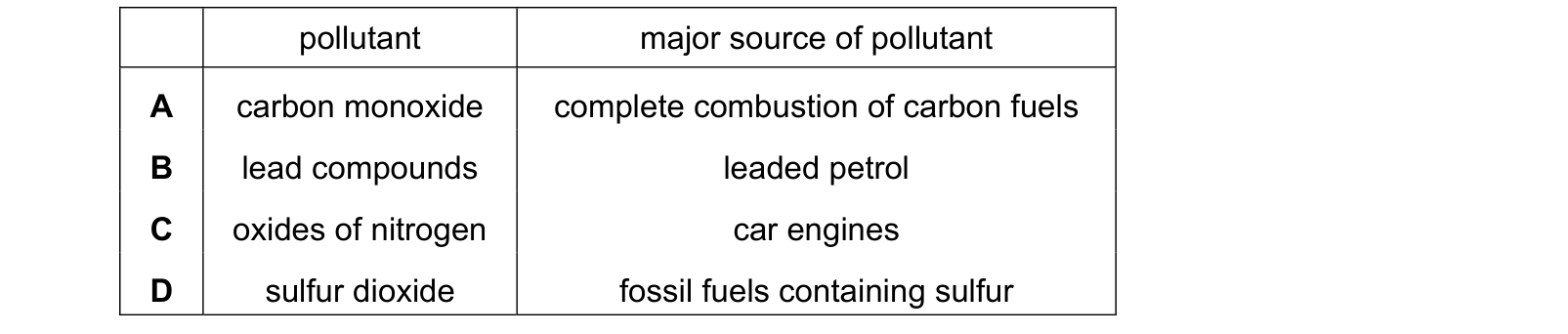
Answer: A.
What the syllabus asks for on this topicSyllabus points
Syllabus points
- State the composition of clean, dry air.
- State the source of each of the common air pollutants: carbon dioxide, carbon monoxide, particulates, methane, oxides of nitrogen and sulfur dioxide.
- State the adverse effect of each of those pollutants.
- State the strategies used to reduce climate change and acid rain.
- Describe photosynthesis and state its word equation and symbol equation.
- Extended: explain how greenhouse gases cause global warming, and describe the reaction in a catalytic converter.
Related CIE 0620 Chemistry topics
Not the topic you were looking for? Describe what you are stuck on in your own words and we will take you to the notes that answer it.